




Moai Statues
In the middle of the Pacific Ocean, thousands of kilometers from the nearest land, there is a small island. This island, known locally as Rapa Nui, attracts worldwide attention with its massive stone statues lined up along the coast. Have you ever wondered why these giant faces stand there? Let’s uncover the secrets of these stone giants together!
What Do These Statues Look Like?
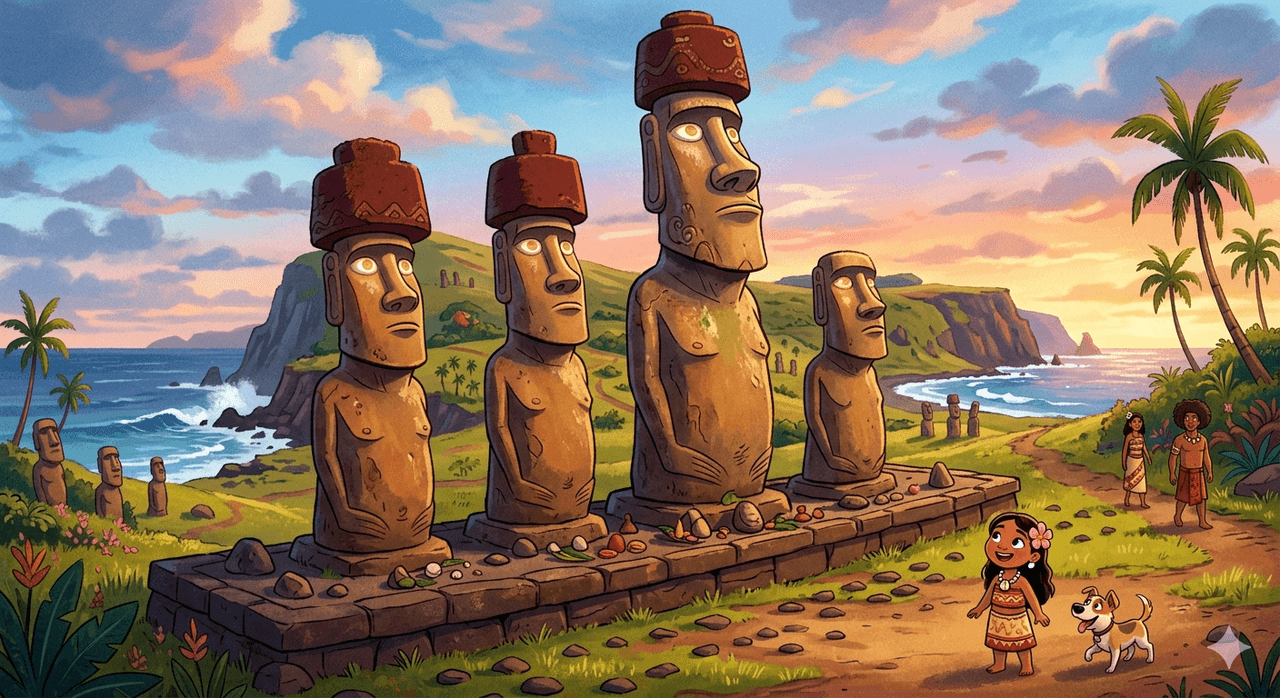
About 900 statues, known as Moai, are found on the island. These statues typically resemble human torsos without legs, with long ears and large eyes. Some have heavy cylindrical hats on their heads called pukao, made from red stone. The statues range in height from 2 to 20 meters. Some are so heavy that they are longer than a modern five-story building and weigh up to 88 tons. Their eyes are made from a shiny stone called obsidian, and it is believed that this stone preserves the spirit of the statue.
How Were the Giant Statues Made and Moved?
These monumental artworks were created by the Rapa Nui people between approximately the 10th and 16th centuries. The islanders carved the statues with great skill from volcanic rock. Yet the greatest mystery is how these people, without wheels or draft animals, transported tons of stone over many kilometers. Some researchers believe the statues were dragged on sleds made of wooden logs using thick ropes. One theory even suggests that the statues were moved to their positions by rocking them side to side with ropes, as if walking. This required hundreds of people to work together in perfect harmony.
Why Are There So Many Statues?
Researchers believe these statues represented the ancestors and tribal chiefs of the island’s people. Over time, different tribal leaders competed by commissioning larger and more magnificent statues. These monumental works symbolized the power and wealth of each tribe. However, building and moving these massive statues required cutting down vast numbers of trees. Unfortunately, when the forests disappeared, the island’s natural balance was disrupted, leading to the collapse of a great civilization. Today, these statues stand as a heritage reminding us both of the grandeur of the past and the vital importance of protecting nature.
Time Travel
Dutch explorer Jacob Roggeveen became the first European to see these giant statues when he arrived on the island on Easter Day in 1722. At that time, there were very few trees left on the island, and Roggeveen could not believe how these people, without machines, had managed to erect such giants.