




Muradiye (District)
Muradiye is an important center requiring study for its waterfalls and its thousands-of-years-long history. The district’s historical and geographical features provide data regarding the region’s past.
Historical Development
Settled life in Muradiye dates back approximately 5000 years. On the high cliffs of this period, a fortress was constructed during the Urartian era; today, remnants of Urartian wall foundations as well as towers from the Seljuk and Ottoman periods remain.
In 1635, Ottoman Sultan Murad IV stayed in this region during a military campaign. The settlement, formerly known as “Bargiri,” was renamed “Muradiye” in commemoration of this visit.
Geographical Features: Muradiye Waterfall
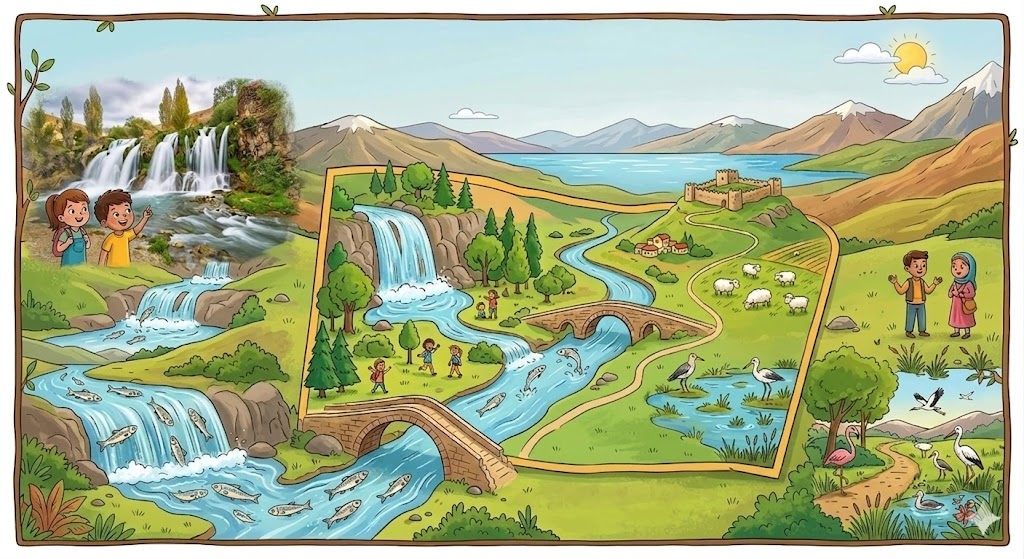
One of the district’s most significant geographical features is the Muradiye Waterfall, which derives its name from the sultan. The waterfall cascades from a height of approximately 50 meters over the Bend-i Mahi Çayı.
The waterfall and its surroundings present different appearances according to the seasons:
- Spring and Summer: A strong flow is observed due to the river’s volume, accompanied by rich environmental plant diversity.
- Winter: Low temperatures cause the flowing water to freeze, forming icicles.

Muradiye Waterfall (Generated by Artificial Intelligence)
Architectural Structures: Bridges and Churches
In addition to its natural features, Muradiye is notable for its historical structures. The Devil’s Bridge, constructed in the 19th century at the narrowest point of the Bend-i Mahi Çayı, is one of the region’s key transit points due to its architectural design and location.

Devil’s Bridge (Generated by Artificial Intelligence)
The Church of Saint Stephen, located at the foot of Aksorık Mountain, is another stone structure reflecting the region’s cultural heritage. This structure, which has survived to the present day, holds significance for religious tourism and the architectural history of the area.

Church of Saint Stephen (Generated by Artificial Intelligence)