



New Mosque
The New Mosque is a uniquely significant site built during the Ottoman era. It is not only a beautiful structure but also surrounded by numerous interesting buildings such as a bazaar, mausoleum, and fountain. Let us embark on a historical journey!

New Mosque (Generated by Artificial Intelligence)
The History of the New Mosque
The foundation of the New Mosque was laid in 1597. At that time, the sultan was III. Mehmed, and his mother, Safiye Sultan, decided to commission this mosque. It was constructed near the waterfront in Eminönü.
The construction was initially led by Mimar Davud Ağa, a student of the renowned architect Mimar Sinan. However, since the ground level was at sea level, water began to seep in! To solve this, large wooden piles were driven deep into the ground and bound together with lead to create a solid foundation. As a result, the mosque has remained undamaged despite earthquakes and the shifting banks of the Golden Horn. How sturdy it is, is it not?
Unfortunately, in 1598, a plague epidemic broke out and Davud Ağa lost his life. He was succeeded by Dalgıç Ahmed Ağa. However, when III. Mehmed and Safiye Sultan passed away in 1603, construction was halted. In 1660, a great fire devastated Istanbul and damaged the mosque. It was then that Turhan Sultan, mother of IV. Mehmed, took charge. Turhan Sultan resolved to complete the unfinished mosque. Under the leadership of Mimar Mustafa Ağa, construction resumed in 1661 and the mosque was completed and opened in 1665. A grand ceremony marked its opening, gifts were distributed, and the mosque was adorned with beautiful carpets and chandeliers.

New Mosque (Generated by Artificial Intelligence)
The Architecture of the New Mosque
The New Mosque features a design reminiscent of those built by Mimar Sinan. A large central dome rests on four massive pillars. On the sides are four half-domes, and smaller domes occupy the corners. Because the mosque is situated at a low elevation, it was built atop a high platform, accessed by stairs. The courtyard contains 20 columns that support 24 smaller domes. In the center of the courtyard stands an octagonal, ornately decorated sebil. This fountain is used for ritual ablutions before prayer.
The mosque has two minarets, rising from the northern corners of the complex. The exterior façade is richly detailed with small galleries, columns, and ornamental arches. Inside, there is a special section called the hünkâr mahfili, reserved for the sultans’ prayers. Access to this elevated platform is through doors inlaid with mother-of-pearl and a beautiful corridor. From this corridor, you can even enjoy views of the Golden Horn!

New Mosque (Generated by Artificial Intelligence)
The New Mosque Complex
The New Mosque is not merely a mosque but an entire külliye—a complex of buildings surrounding the mosque. These include:
- Spice Bazaar: Formerly known as the Valide Bazaar, this L-shaped market consists of numerous shops selling spices, Turkish delight, and souvenirs. It contains 88 shops, and at the intersection of its alleys lies a prayer area known as dua meydanı.
- Mausoleum: Located south of the mosque, this mausoleum houses the tombs of Hatice Turhan Sultan and many sultans. Its walls are decorated with tiles, and 44 individuals are buried within.
- Sebil and Fountain: The sebil is an ornate structure built to distribute water to passersby. Next to it stands a fountain. Both are made of marble and completed in 1663.
- Hünkâr Pavilion: This private residence for the sultans, attached to the mosque, features tilework, mother-of-pearl doors, and rooms with views of the Golden Horn.
- Library: Built in 1724 by III. Ahmed, it contains elegant decorative elements.
- Muvakkithâne: This structure, used to calculate prayer times, was built in 1813 and bears the tuğra of II. Mahmud.
Originally, the complex also included other structures such as a primary school, but some have not survived to the present day. The courtyard walls have also deteriorated over time due to the expansion of surrounding shops and roads.
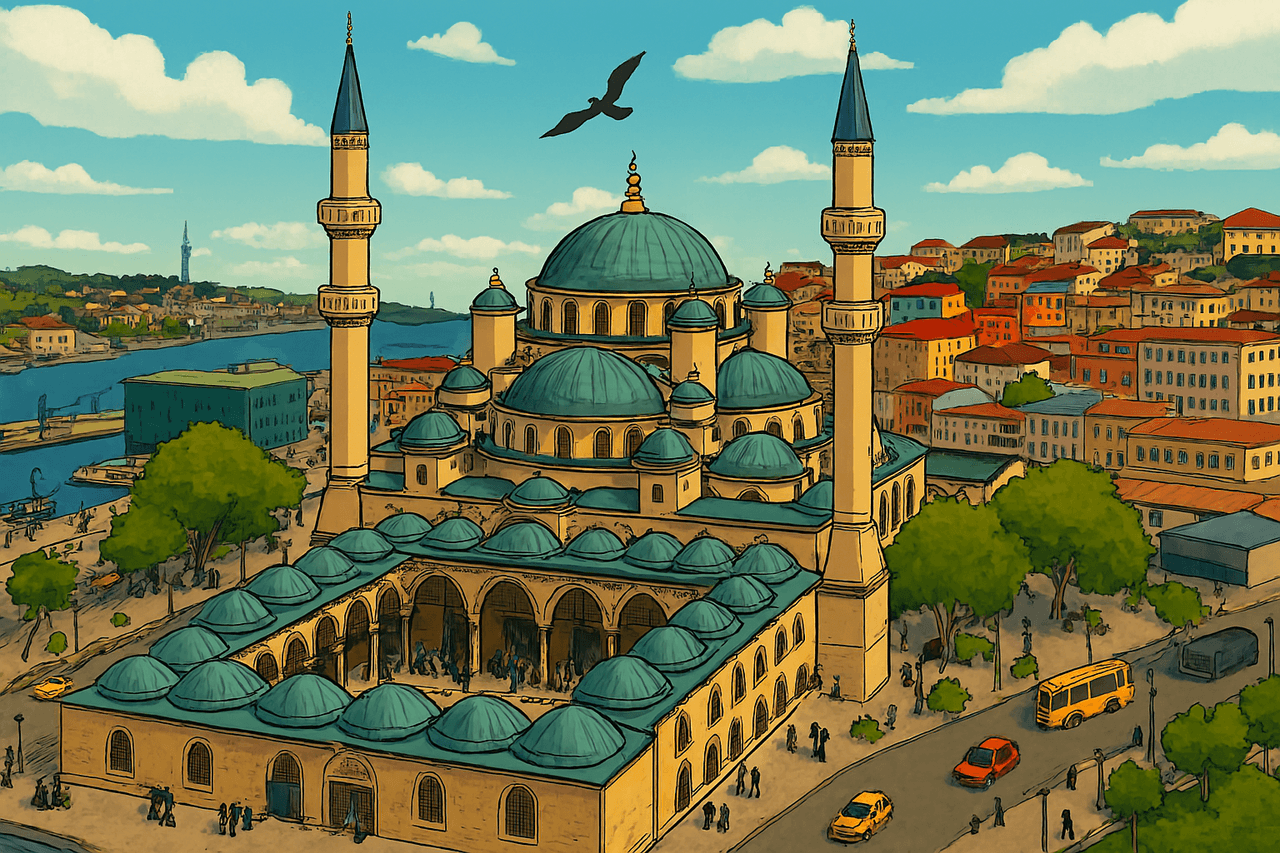
New Mosque (Generated by Artificial Intelligence)
Features of the New Mosque
The New Mosque reflects the classical style of Ottoman architecture. Its tiles, calligraphic decorations, marble pulpit, and mihrab are exceptionally elegant. Even birdhouses are found in the courtyard! During regular prayer times, around 1,500 people gather in the mosque, and on Fridays, the number rises to 7,000–8,000.
The New Mosque, with its solid foundations and exquisite decorations, is one of Istanbul’s most distinctive sites. If you ever visit Eminönü, be sure to see this mosque and the adjacent Spice Bazaar. There, you can experience history firsthand and explore the colorful shops of the market.
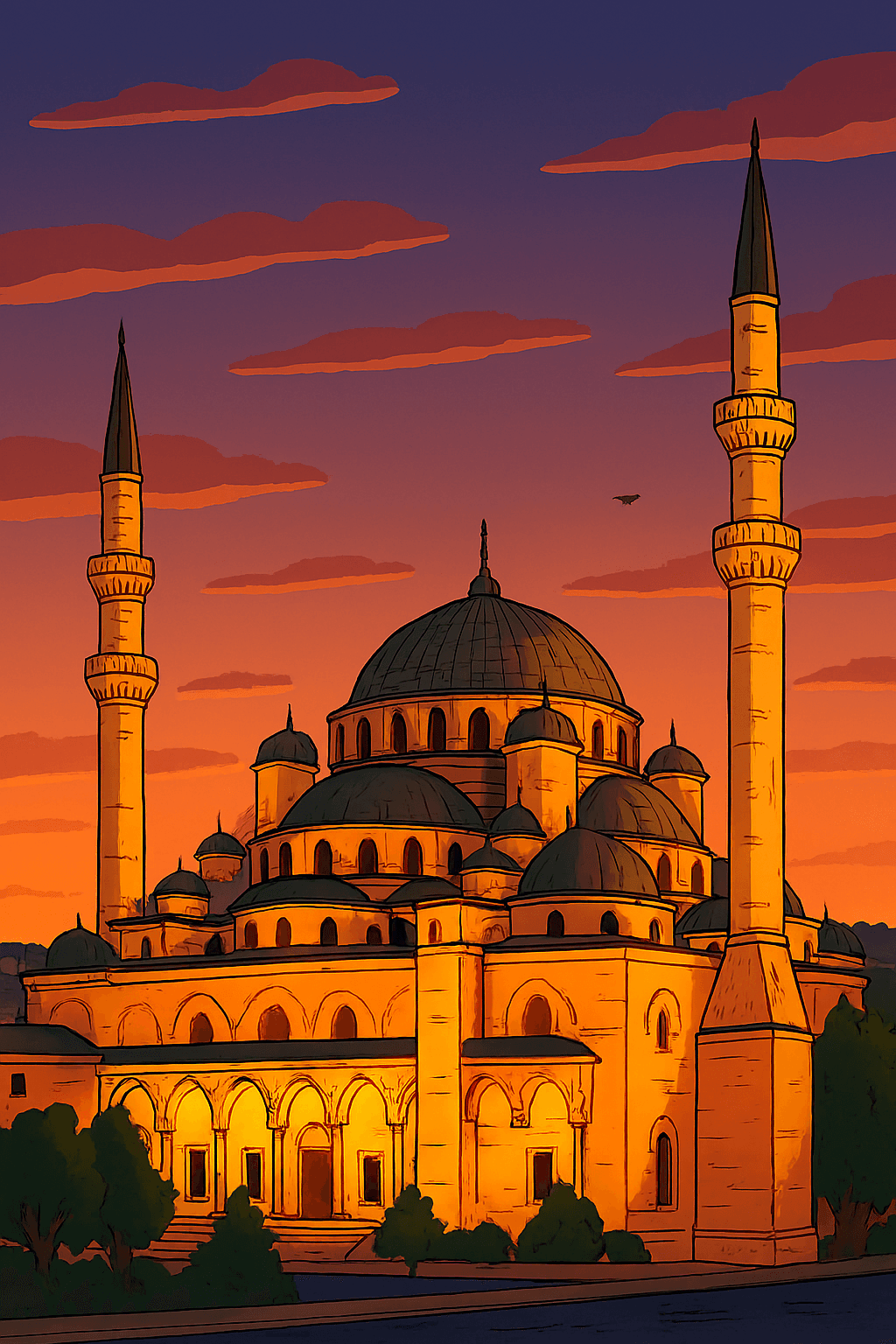
New Mosque (Generated by Artificial Intelligence)


