


This article was automatically translated from the original Turkish version.
+2 More
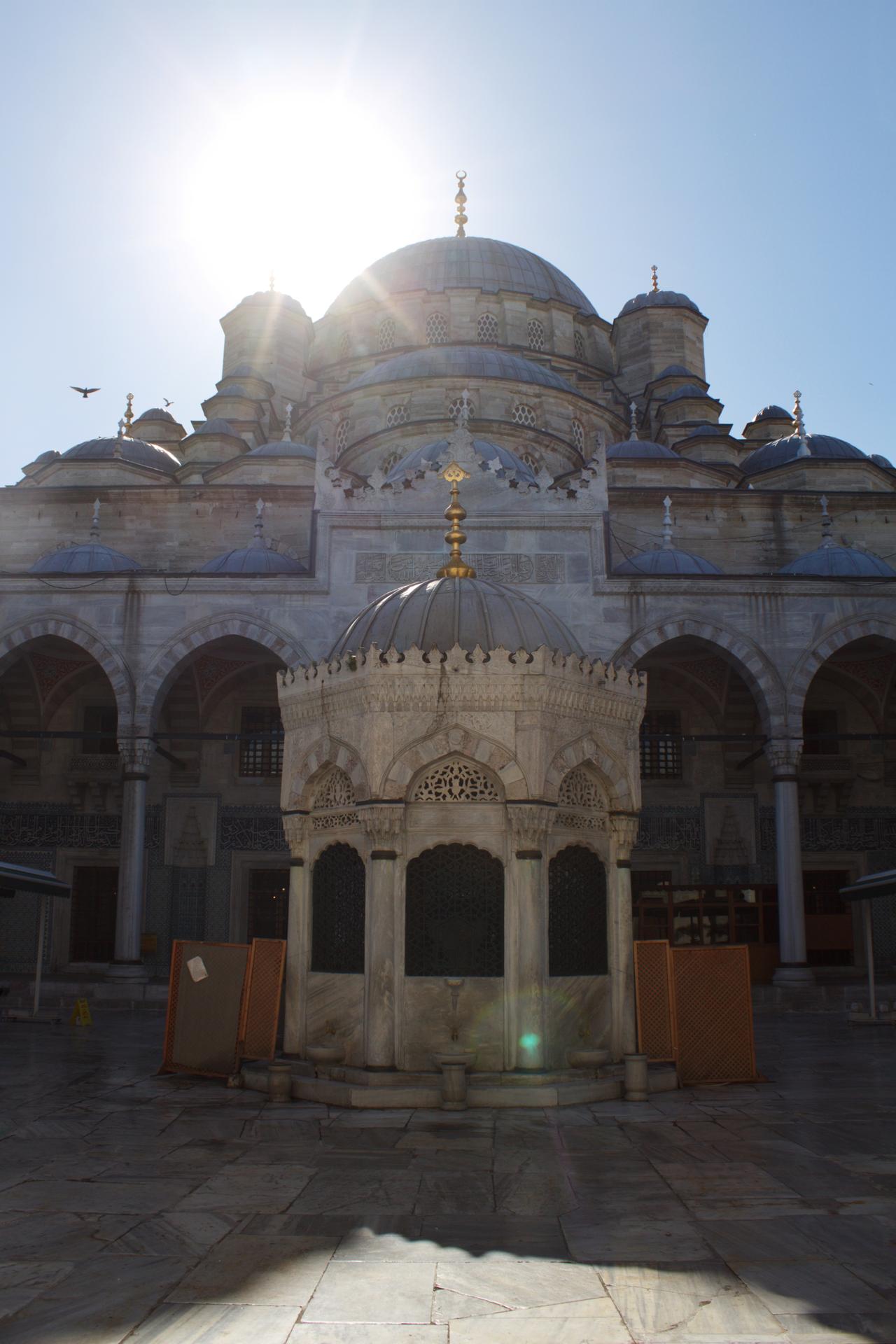
Photo: Melahat Pamuk
New Mosque
Location | Eminönü Istanbul | ||||||||
|---|---|---|---|---|---|---|---|---|---|
Year of Construction | 1597–1663 | ||||||||
Architect(s) | Mustafa Ağa Dalgıç Ahmed Ağa Davud Ağa | ||||||||
Architectural Feature(s) | rich tile decorations two minarets with three balconies each arcaded courtyard Large dome and four half-domes | ||||||||
Yeni Camii is a mosque located in the Eminönü district of Istanbul, at the entrance of the Golden Horn, within the last great külliye of Ottoman classical architecture. The külliye consists of the mosque, the hünkâr kasrı, the arasta (Egyptian Bazaar), a türbe, a dârülkurrâ, a sebil, a çeşme, and a sıbyan mektebi. Later, a library, a muvakkithâne, additional türbes, and çeşmes were added to the complex. Its location on the waterfront and directly in front of the harbor gave the structure both strategic and symbolic significance.

Yeni Cami (Anadolu Agency)
The foundation of Yeni Camii was laid in 1597 by order of Safiye Sultan, mother of III. Mehmed. The site chosen in the Eminönü-Bahçekapı area was a bustling commercial zone known at the time for its proximity to the customs house and for housing Jewish and Christian neighborhoods.
The first architect, Davud Ağa, a student of Mimar Sinan, drove piles into the reclaimed land at sea level to establish solid foundations. Upon his death, the project was taken over by Dalgıç Ahmed Ağa. Construction was halted in 1603 following the death of III. Mehmed and Safiye Sultan’s withdrawal to the Old Palace; the structure remained in ruins for many years.
After the great fire of 1660, Hatice Turhan Sultan, mother of IV. Mehmed, undertook the reconstruction of the incomplete mosque. Work began under the supervision of Chief Architect Mustafa Ağa, and the mosque was completed and opened in 1663. The opening ceremony was attended by the sultan, state officials, and the ulema; the mosque was furnished with valuable gifts, carpets, and chandeliers.
The plan of Yeni Camii is an evolved form of the scheme used by Mimar Sinan in the Şehzade Camii. The nearly square harim is covered by a central dome with a diameter of 16.20–17.50 meters and four half-domes. The corners are completed with smaller domes forming a quadrangular layout. While the dome structure follows classical norms, it exhibits a more pointed profile. The external architecture is notable for its pyramidal rise and two-story galleries on the side facades.
A courtyard surrounded by arcades supported by twenty muqarnas-capped columns lies to the north of the mosque. At the center of the courtyard is an octagonal şadırvan with delicate ornamentation. The mosque is entered through three gates, whose marble work is particularly striking. Two minarets, each with three balconies, rise at the corners of the final congregational arcades. On the southwest courtyard wall, three sundials and birdhouses are visible.

Cami Kubbesi (Photo: Melahat Pamuk)
The interior of the mosque is richly adorned with tiles produced in Iznik and Kütahya during the 17th century, as well as with penwork, woodwork, and marble decorations. The lower walls are clad in tiles dominated by blue, turquoise, white, and green tones. Motifs such as carnations, tulips, pomegranate flowers, and cypress trees appear on the tiles. Arches, pendentives, and the dome surface are decorated with penwork.
The mihrab is a muqarnas niche, while the minbar stands out with its elegant marble craftsmanship featuring ajouré geometric compositions. The hünkâr mahfili is decorated with tile panels, mother-of-pearl inlaid doors, and colored stone inlay panels. A tile panel depicting the Kaaba in the müezzin mahfili is particularly notable.

Interior Decorations of the Mosque (Photo: Melahat Pamuk)
In the 19th century, the construction of the Galata Bridge led to the demolition of the outer courtyard walls and surrounding structures, disrupting the külliye’s integrity. The sıbyan mektebi was removed in 1904. The mosque underwent repairs in 1912–13 and at various later periods. In the 2000s, the hünkâr kasrı and interior decorations underwent comprehensive restoration.
Anadolu Ajansı. “3,5 Asırlık Yeni Cami Tarihinin En Kapsamlı Restorasyonundan Geçiyor.” Accessed September 23, 2025.
Fatih Kaymakamlığı. "Yeni Camii." Fatih Kaymakamlığı Resmî Web Sitesi. Accessed September 23, 2025. http://www.fatih.gov.tr/yeni-camii
Çobanoğlu, Ahmet Vefa. "Yenicâmi Külliyesi." TDV İslâm Ansiklopedisi. Accessed September 23, 2025. https://islamansiklopedisi.org.tr/yenicami-kulliyesi
Şendağ, Meltem and Kazan, Hilal. *Yeni Cami (Valide Cami)*, Islamic Art History Spring Term Midterm Assignment, 2014. Accessed September 23, 2025. https://www.academia.edu/download/36972904/yeni_camii.pdf
Photo: Melahat Pamuk
New Mosque
Location | Eminönü Istanbul | ||||||||
|---|---|---|---|---|---|---|---|---|---|
Year of Construction | 1597–1663 | ||||||||
Architect(s) | Mustafa Ağa Dalgıç Ahmed Ağa Davud Ağa | ||||||||
Architectural Feature(s) | rich tile decorations two minarets with three balconies each arcaded courtyard Large dome and four half-domes | ||||||||
No Discussion Added Yet
Start discussion for "New Mosque (Eminönü)" article
History
Architectural Features
Interior Space and Decorations
Külliye Elements
Later Periods and Restorations