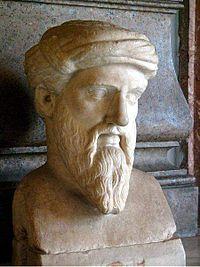




Pythagoras
Pythagoras was a thinker, mathematician, and somewhat mystical philosopher born around 570 BCE on the island of Samos. People called him the "father of numbers" because, in his view, everything in the universe was fundamentally based on numbers—but for him, this was not merely mathematics; it was the language of the cosmos.
Unable to find peace on Samos, Pythagoras later moved to Croton in southern Italy, where he founded his own school. This school functioned as a mathematics club, a music workshop, and a somewhat mystical brotherhood. But note: students were forbidden from revealing what they learned to outsiders.
Pythagoras’s Interesting School
Pythagoras’s school included both girls and boys, which was highly unusual for that era. Students were divided into two groups:
- Listeners (those who listened in silence),
- Mathematicians (those who delved deeper).
Students had to follow strict rules: eat little, work hard, live disciplined lives, and show respect to their master… (You might think of it as a bit like “mathematical ninja” training!)

(Generated by artificial intelligence.)
Numbers: The Key to the Universe
According to Pythagoras, numbers possessed special powers:
- 3 = Family,
- 4 = Justice,
- 5 = Marriage,
- 6 = Vitality,
- 7 = Lucky time,
- 10 = The most perfect number!
Odd numbers were considered “masculine,” while even numbers were seen as “feminine.” In his view, the universe stood in harmony through the balance of these numbers.

(Generated by artificial intelligence.)
Music and Mathematics
Pythagoras was also deeply interested in music. Through experiments with strings, he discovered that pitch changed with the length of the string.
For example, if you halve the length of a string, the resulting sound is exactly one octave higher than the original. Thus, Pythagoras showed that music could be understood not only by the ear but also through mathematics.

(Generated by artificial intelligence.)
Pythagorean Theorem
Of course, his most famous discovery is the Pythagorean Theorem concerning right triangles:
The square of the hypotenuse equals the sum of the squares of the other two sides!
(That is, the well-known formula: a² + b² = c².)
Today, we still use this theorem when building houses, designing bridges, and creating computer graphics.
His Ideas About the Cosmos
According to Pythagoras, the Earth was spherical and the stars and planets moved in circular orbits. Some of his students even believed the Earth itself was in motion. These ideas later inspired Copernicus’s heliocentric model of the universe.