


+2 More

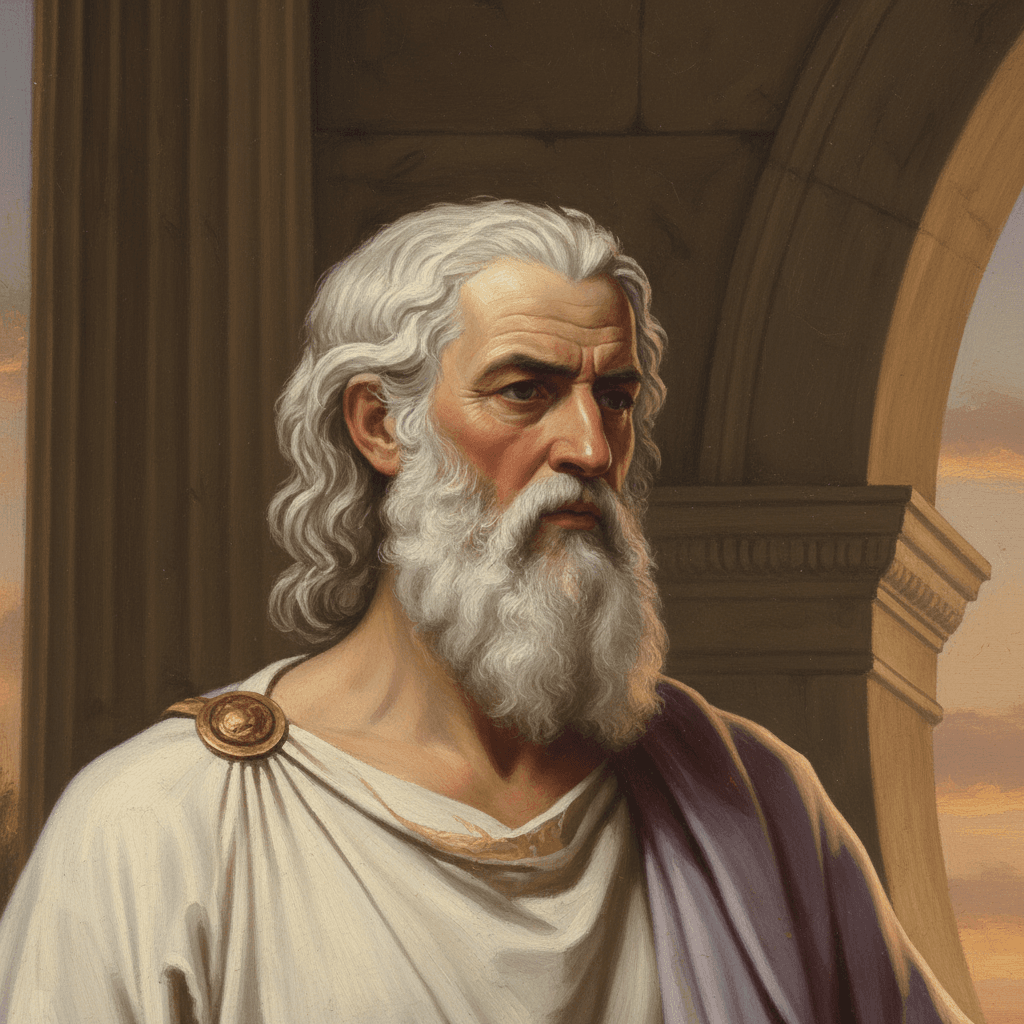
Pythagoras (Generated by Artificial Intelligence.)
Year and Place of Birth | 580 BCE, Samos Island | ||||||||
|---|---|---|---|---|---|---|---|---|---|
Year and Place of Death | around 500 BCE, Metapontion | ||||||||
School | Pythagorean Order / Croton School | ||||||||
Field | mathematics, philosophy, music theory, cosmology | ||||||||
Contributions | Pythagorean theorem, number theory, musical ratios, doctrine of transmigration of souls | ||||||||
İmportant Concepts | everything is number, harmonic ratios, mathematical cosmos | ||||||||
Pythagoras (c. 580–500 BCE) was one of the most influential philosophers of ancient Greece. He made pioneering contributions in mathematics, astronomy, and mysticism, and his philosophical school and way of life profoundly shaped both scientific thought and religious-mystical traditions. Pythagoras’s teachings were based on the idea that numbers constitute the fundamental structure of the universe, a view that played a significant role in the development of Western philosophy.
Pythagoras was born on the island of Samos around 580 BCE. During his youth, he traveled to Egypt and Babylon, acquiring substantial knowledge in mathematics, astronomy, and mysticism. These journeys were decisive in his intellectual development. He later settled in Croton, a city in southern Italy, where he founded a community that combined scientific and religious elements. Pythagoras was not merely a philosopher but also a leader and teacher. His school taught students not only mathematical and philosophical knowledge but also a specific way of life.
The order founded by Pythagoras required its members to lead an ascetic life. Pythagoras argued that physical desires must be controlled and the soul purified. Consequently, members abstained from eating meat, consuming alcohol, and using animal products. They walked barefoot, wore simple clothing, and lived a minimalist existence. Unlike other philosophical schools of the time, Pythagoras’s community was open to women, who formed an important part of the order.
One of Pythagoras’s most important religious beliefs was the doctrine of transmigration of souls (metempsychosis). He believed that the soul is immortal and, after leaving one body, reincarnates into another. This view was influenced by Orphic mysticism and introduced a foreign element into Greek philosophy. Pythagoras saw death as a form of liberation and argued that the soul must be freed from the chains of physical desires. He dedicated his life to spiritual purification and guided his students along the same path.
Pythagoras is remembered in history for his work in mathematics and geometry. His most famous discovery is the Pythagorean Theorem, which states that in a right triangle, the square of the hypotenuse is equal to the sum of the squares of the other two sides. Although it is believed that the Babylonians and Egyptians were aware of this relationship earlier, Pythagoras and his followers systematized this knowledge and developed mathematical proof methods. He also discovered that the sum of the interior angles of a triangle equals two right angles. Pythagoras believed that numbers form the foundation of the universe and maintained that everything could be expressed in terms of numbers.
Pythagoras also proposed pioneering ideas in astronomy and cosmology. He argued that celestial bodies are spherical and move in circular orbits. One of his most intriguing theories was that the motion of celestial bodies follows harmonic ratios similar to those in music, producing a cosmic music. This concept is known as the “music of the spheres” (musica universalis). According to Pythagoras, this music is inaudible to mortal ears but represents the mathematical order of the universe. This idea later influenced the work of scientists such as Johannes Kepler.
Pythagoras and his followers exerted political influence in the Greek cities of southern Italy. Pythagoras supported an aristocratic form of government, which brought him into conflict with democratic movements. During democratic uprisings, the Pythagorean movement faced violent attacks, and many of its members were killed. It is believed that Pythagoras himself died during these conflicts. However, some followers managed to escape to Tarentum and Phlius, where they continued to spread his teachings.
Pythagoras made significant contributions to the development of science through his mystical inclinations. His discoveries in mathematics, geometry, astronomy, and music deeply influenced Greek thought and subsequent scientific endeavors. His belief that numbers constitute the foundation of the universe shaped Plato and played a crucial role in the development of Western philosophy. His mystical and religious teachings merged with scientific thought to form a unique philosophical system. Pythagoras’s legacy forms one of the foundational pillars of modern mathematics and scientific thought.
Ronan, Colin A. Bilim Tarihi: Dünya Kültürlerinde Bilimin Tarihi ve Gelişmesi. 3. Baskı. TÜBİTAK Akademik Dizi, 2003.
Tekeli, Sevim, Esin Kâhya, Melek Dosay Gökdoğan, Remzi Demir, Hüseyin G. Topdemir, Yavuz Unat, Ayten Koç Aydın, and İnan Kalaycıoğulları. Bilim Tarihine Giriş. Genişletilmiş ve Güncellenmiş 11. Basım. Ankara: Nobel Akademik Yayıncılık, 2021.
Zeller, Eduard. Grek Felsefesi Tarihi. Çeviren: Ahmet Aydoğan. 2. Baskı. Say Yayınları, İstanbul, 2008.

Pythagoras (Generated by Artificial Intelligence.)
Year and Place of Birth | 580 BCE, Samos Island | ||||||||
|---|---|---|---|---|---|---|---|---|---|
Year and Place of Death | around 500 BCE, Metapontion | ||||||||
School | Pythagorean Order / Croton School | ||||||||
Field | mathematics, philosophy, music theory, cosmology | ||||||||
Contributions | Pythagorean theorem, number theory, musical ratios, doctrine of transmigration of souls | ||||||||
İmportant Concepts | everything is number, harmonic ratios, mathematical cosmos | ||||||||
The Life of Pythagoras
The Pythagorean Order and Way of Life
The Doctrine of Transmigration of Souls and Religious Beliefs
Contributions to Mathematics and Geometry
Astronomy and Cosmology
Political and Social Impact
Significance and Legacy