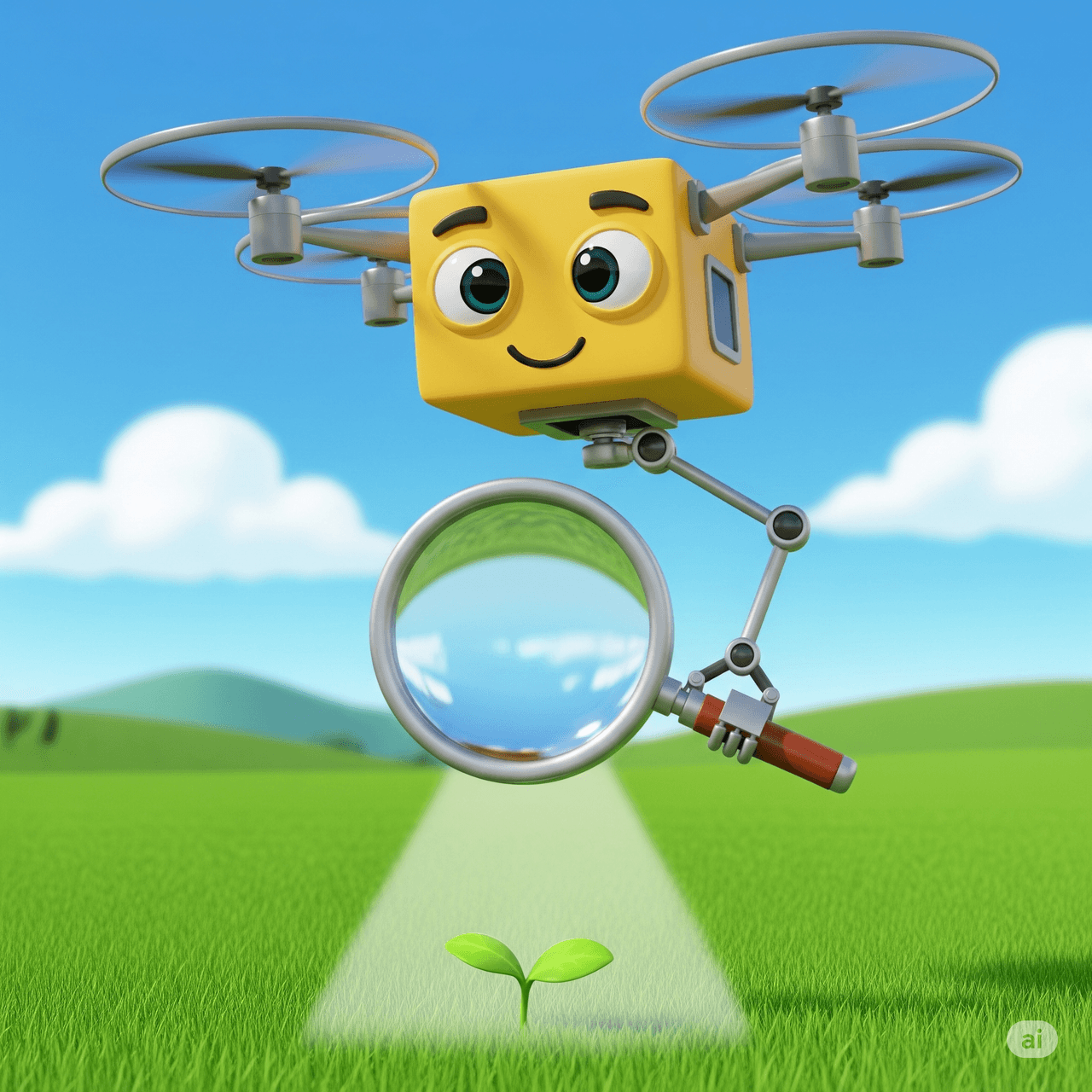




The Role of Drones in Agriculture
Drones are unmanned aerial vehicles that can be remotely controlled or programmed via specific software. When used in agriculture, they can survey large areas from the sky and collect imagery and data. This helps farmers make more accurate decisions.

(Generated by Artificial Intelligence.)
Why Are They Used in Agriculture?
Agricultural production requires continuous monitoring and precise planning. Controlling entire fields using traditional methods is time consuming. Drones facilitate this process by collecting data from large areas in a short time. As a result, agricultural labor requirements decrease and time and resources are saved.
Principle of Operation
Drones used in agriculture are equipped with cameras infrared sensors and GPS systems. Thanks to these technologies plant health moisture levels fertilizer needs and disease risks can be measured. The collected data is analyzed on computers to guide farmers.
Plant Health Monitoring
Drones detect early signs of disease by examining leaf color and growth patterns. This allows farmers to resolve issues before they spread. This reduces crop loss and increases agricultural productivity.

(Generated by Artificial Intelligence.)
Fertilization and Irrigation Planning
One of the most important aspects of agriculture is the proper use of fertilizer and water. Drones identify which areas require more water or fertilizer. This prevents resource waste and enables environmentally friendly production.
Harvest Prediction and Productivity
Drone technology tracks crop growth stages to estimate harvest timing and volume. This enables farmers to plan more accurately. This method enhances efficiency in the agricultural-food chain and reduces losses.
Relationship with Digital Agriculture
Drone usage is part of Agriculture 4.0 and digital agriculture technologies. Working alongside smart farming systems they provide more advanced data. This allows farmers to make science-based decisions and optimize production processes.
Future Importance
Research indicates that drone usage will rapidly expand in agriculture. In the future drones supported by artificial intelligence and autonomous systems will be able to operate in fields almost like humans. This will strengthen the sustainability of agriculture and food security.