




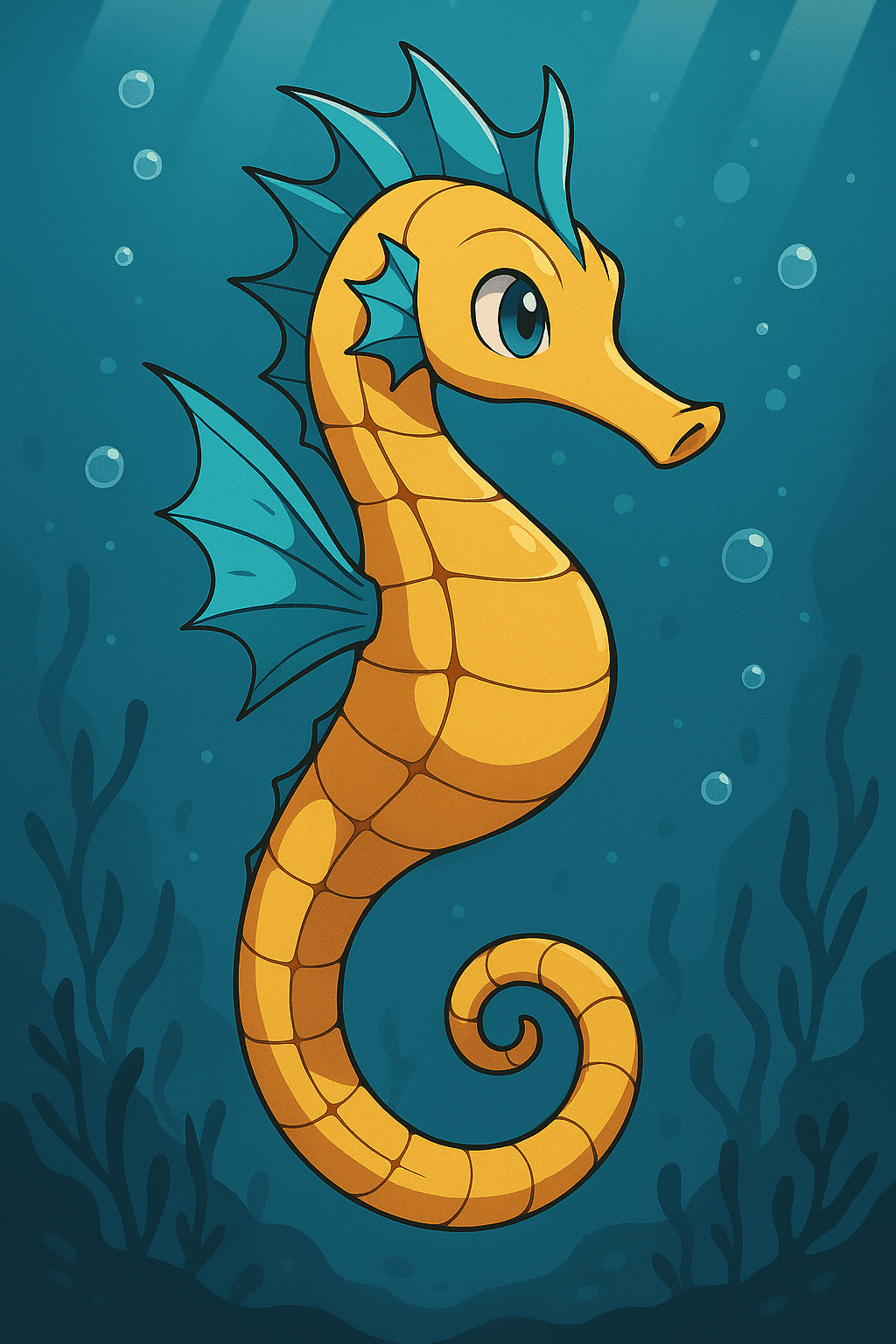
What is a seahorse?
Seahorses truly deserve their name! Their heads resemble those of horses. Yet, they are in fact fish! Unlike other fish, they swim upright. They achieve this unusual swimming posture thanks to a small fin on their backs. Though small, they possess many fascinating traits. Their Latin name is Hippocampus. They are closely related to seadragons and pipefish.

Small and large seahorses (generated by artificial intelligence.)
Physical Characteristics
The size of seahorses varies greatly. The smallest can be as tiny as a grape seed—just 1 to 2 centimeters! The largest can reach up to about 35 centimeters. Their bodies are long and slender. Some species, such as Hippocampus bargibanti, are so remarkable that they develop thin, thread-like projections on their bodies. These extensions make them look almost identical to seaweed and coral, rendering them nearly invisible to the naked eye. Thanks to this incredible camouflage, they avoid predators and escape being eaten.
What Do They Eat?
Seahorses are carnivorous and feed on tiny creatures. Plankton, water fleas, and small fish are their favorites. They remain motionless and wait for prey to come close. Using their long, pipe-like mouths, they instantly suck in their prey with a quick “Hup!” They have no stomachs, so they must eat almost continuously throughout the day!

Where Do They Live?
Seahorses typically inhabit shallow, warm seas—areas near coastlines that are not very deep. They hide among seagrass beds, seaweed, or coral reefs. Their colors blend with their surroundings, allowing them to remain unseen.
How Do They Reproduce?
Seahorses reproduce in a uniquely special way in the underwater world. The most remarkable feature: the males carry the babies! The female seahorse deposits her eggs into a specialized pouch on the male’s belly. The male then protects these eggs inside his pouch. After several weeks, tiny seahorses emerge from the pouch and swim into the ocean. From the moment they are born, the young seahorses immediately begin swimming on their own! This unusual division of reproductive roles makes seahorses stand out among marine creatures.
How Many Species Exist and Why Are They Protected?
Today, there are 47 different species of seahorses worldwide. Scientists believe seahorses have lived in the oceans for approximately 40 million years. Unfortunately, some species are now threatened. Ocean pollution, overfishing, and loss of habitat have placed them in danger. As a result, many species are now under protection in various regions.

Children observing a seahorse (generated by artificial intelligence.)
Interesting Features
Male seahorses give birth. Yes, you read that correctly!
They can change color, which helps them hide effectively.
Because their fins are very small, they swim extremely slowly.
🎨 Activity: Design Your Own Seahorse!
Design the seahorse of your imagination. This will be a seahorse unique to you!
What color will it be?
Will it glow in the dark?
Where will it live?
What will it eat?
What will its name be?
Draw it and write down its features. Show your special seahorse to those you love! 🌿