

This article was automatically translated from the original Turkish version.
Seahorse (Hippocampus) is a genus of fish distinguished by its tubular mouth, upright swimming posture, and curled tail, believed to have evolved approximately 40 million years ago. It is thought to comprise around 150 different species, including H. abdominalis and H. erectus. Seahorses inhabit coastal areas of tropical and temperate seas with low current, particularly in habitats covered by seagrass beds, coral reefs, and mangroves. In most species, males carry the pregnancy and nurture the young in a pouch known as a marsupium. Seahorses, recognized for their monogamous mating behavior, color-changing ability, and high camouflage skills, are protected under IUCN and CITES due to habitat destruction and commercial fishing pressure.
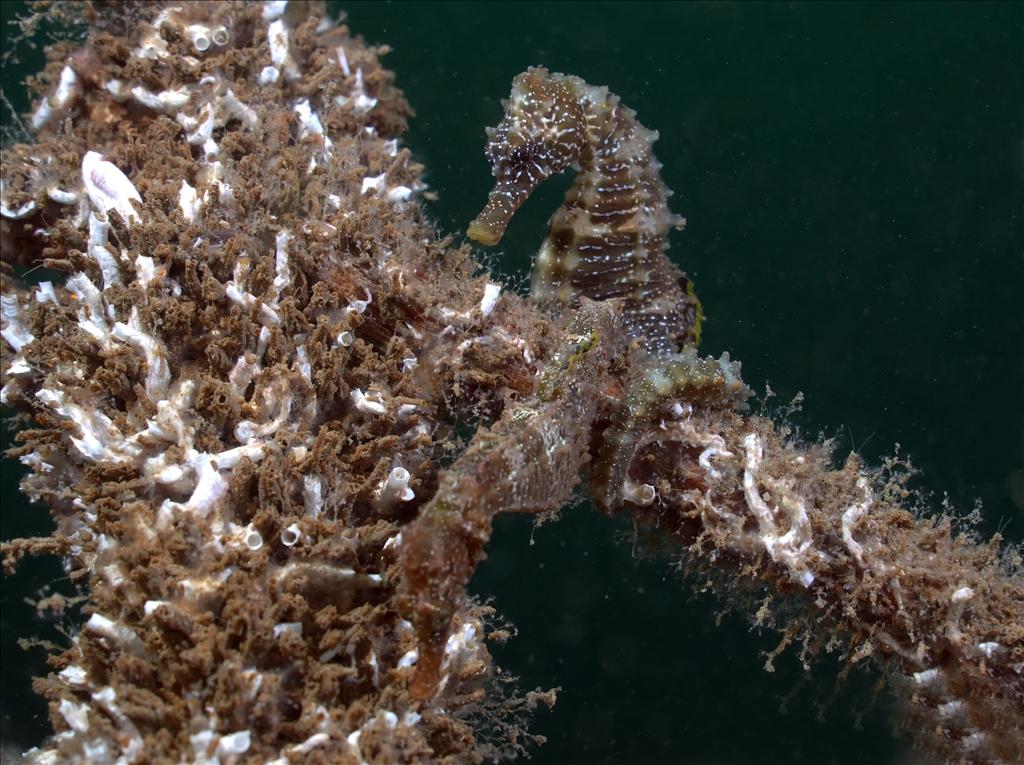
Seahorses are characterized by their curved bodies, prehensile tails, and heads angled toward the body. Their bodies and tails are covered with bony plates arranged in rings and stacked on top of each other, forming an external skeleton that protects them from predators. In some species, skin filaments hang from these plates and can elongate or contract to aid in camouflage. Unlike most fish, seahorses lack scales; instead, their bodies are armored with these rigid plates, making them inflexible. Their eyes can move independently, allowing them to look in two different directions simultaneously—a trait that aids both in tracking prey and avoiding predators.
Unlike other fish, seahorses swim in an upright position. Their dorsal fin beats 35 to 70 times per second to propel them forward, while steering and balance are controlled by the pectoral fins located on either side of the head. They possess pigment cells called chromatophores in their skin, enabling them to change color—a capability linked to camouflage, courtship, and stress responses. Adult size varies by species, ranging from 2 to 35 cm in length.

A Seahorse in Izmit Bay
Seahorses live in temperate and tropical waters worldwide, particularly in coastal areas with low current such as seagrass beds in regions like the Philippines, the Caribbean, and Indonesia. They prefer environments rich in aquatic vegetation such as coral, seaweed, and mangroves. In Asian countries, seahorses are heavily fished for various commercial purposes.
In Türkiye, seahorses are not targeted for commercial or economic purposes except in minor quantities for the aquarium trade. They inhabit the Aegean Sea, the Mediterranean Sea, and the Sea of Marmara. However, their habitats are under threat due to coastal development, marine pollution, and bottom trawling. Although 18 seahorse species have been recorded in Türkiye, only two are commonly observed and well documented: H. hippocampus, known as the Short-snouted Seahorse, and H. guttulatus, known as the Long-snouted Seahorse.
Seahorses are carnivorous predators. Equipped with a tubular mouth, they remain motionless and camouflaged, waiting patiently to ambush prey. They spend most of their time searching for food and, lacking teeth, swallow their prey whole using a rapid suction motion similar to a pipette. They feed on small mobile invertebrates such as plankton, larvae, small fish, Mysis shrimp (Mysis shrimp), and brine shrimp (Artemia). Their stomachs are small and their digestive systems simple, forcing them to feed frequently—up to 50 times a day—to meet their energy needs.

A Seahorse with Skin Filaments
Seahorses are among the rare fish species that form lifelong monogamous pairs. The first stage of their reproductive cycle involves elaborate courtship dances that can last for hours, typically including mutual color changes and circling movements. These rituals are critical for synchronizing the timing of egg transfer. During mating, the female uses a long tube called an ovipositor to deposit her eggs into the male’s pouch (marsupium). This pouch functions like a placenta, providing sufficient nutrients and oxygen for embryonic development. After a gestation period ranging from 10 days to 6 weeks, the male gives birth to fully formed, free-swimming young measuring approximately 212 mm in length, resembling miniature adults. Males of all species can give birth multiple times within a single breeding season.

Seahorse
Newborn seahorses possess all the characteristics of adults but are extremely small, about the size of a grain of rice. From the moment of birth, seahorse fry receive no parental care and are entirely independent. In the early stages of life, some seahorse larvae are planktonic, meaning they drift with ocean currents and cannot swim against them. Others immediately settle to the seabed and begin living among small marine plants and algae.
Seahorses are globally recognized as species requiring protection due to their limited distribution, habitat dependency, and anthropogenic threats. Coastal development, marine pollution, bottom trawling, and illegal fishing activities endanger their natural populations. In particular, Asian countries exert significant commercial pressure on seahorses due to demand from traditional medicine, ornamental goods production, and the aquarium trade. In response to these threats, all Hippocampus species were listed under CITES Appendix II in 2004, making international trade subject to permits. According to IUCN Red List assessments, Hippocampus hippocampus is classified as Near Threatened (NT), while H. guttulatus is categorized as Data Deficient (DD). In Turkish waters, the species H. hippocampus, H. guttulatus, and the Red Sea-origin H. fuscus are protected under fisheries regulations, and commercial fishing of these species is prohibited.
Akpınar, İlkay Özcan. “Ülkemiz Ve Dünya Denizlerinde Koruma Altındaki Denizatı Populasyonlarının Mevcut Durumu”. *Aquaculture Studies* 2012, no. 2 (April 2012): 24–31. Accessed July 30, 2025. https://dergipark.org.tr/tr/pub/yunusae/issue/21909/235439
Anadolu Ajansı. "Avustralya'da Nesli Tükenmekte Olan Denizatları İçin Üreme Programı Hayata Geçirildi." Accessed July 30, 2025.
Anadolu Ajansı. "İzmit Körfezi'ndeki denizatlarının yaşamı belgesel oluyor." Accessed July 30, 2025. https://www.aa.com.tr/tr/kultur/izmit-korfezindeki-denizatlarinin-yasami-belgesel-oluyor/3194047
Anadolu Ajansı. "İzmit Körfezi'nin derinliklerinde denizatları görüntülendi." Accessed July 30, 2025. https://www.aa.com.tr/tr/yasam/izmit-korfezinin-derinliklerinde-denizatlari-goruntulendi/2770104
IUCN. "The IUCN Red List of Threatened Species." IUCN seahorse.org. Accessed July 30, 2025. https://www.iucn-seahorse.org/
Oruç, Adnan Çağlar. "Morphological Comparison of Long-snouted Seahorse (Hippocampus guttulatus Cuvier, 1829) Populations in the Black Sea and the Aegean Sea." *Journal of Anatolian Environmental and Animal Sciences* 9, no. 3 (2024): 390-396. Accessed July 30, 2025. https://dergipark.org.tr/en/pub/jaes/issue/87228/1478209

No Discussion Added Yet
Start discussion for "Seahorse (Hippocampus)" article
Morphological Characteristics
Distribution and Habitat
Feeding and Hunting Behavior
Reproductive Characteristics
Conservation Status