




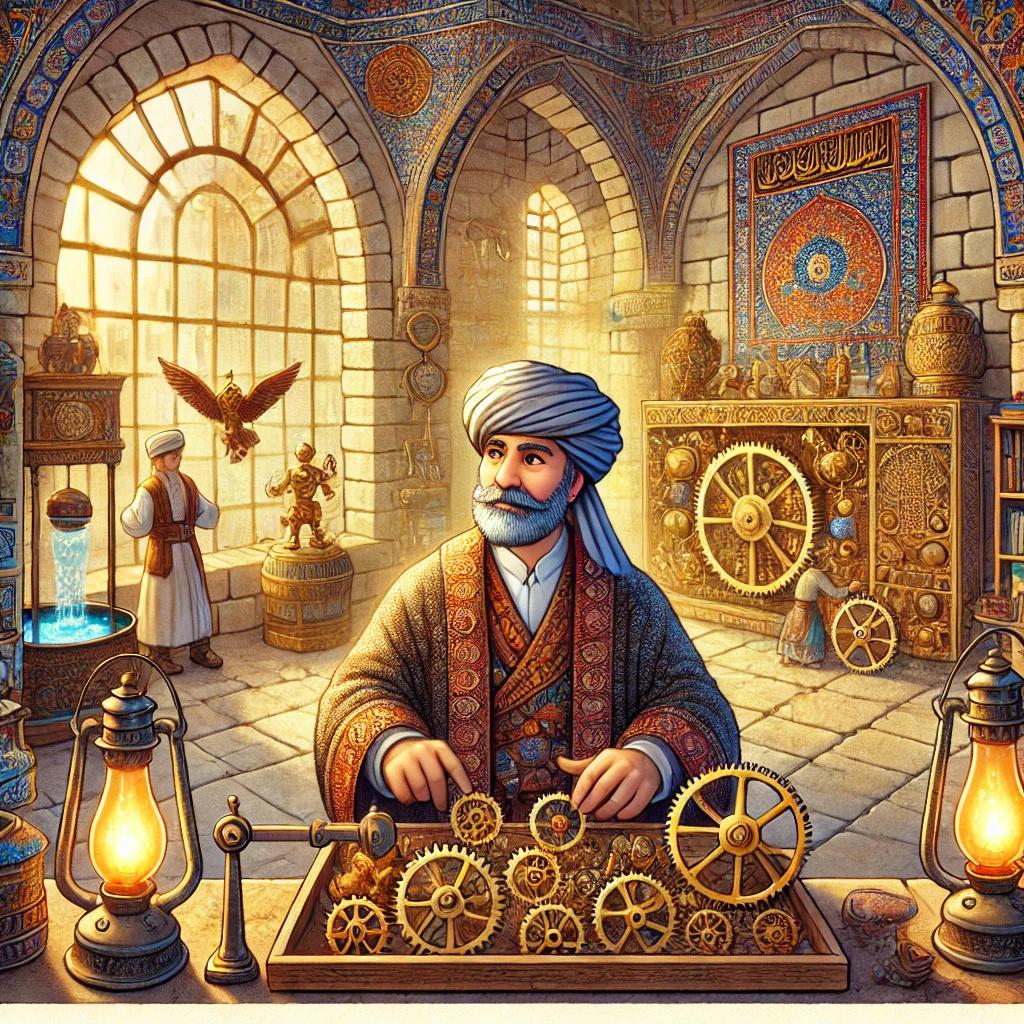
Who is Cezerî?
Al-Jazari, whose full name is “Abu al-Izz Isma‘il ibn al-Razzaz al-Jazari,” lived in the 12th century and is considered one of the greatest engineers and inventors of the Islamic world. He was born around 1136 near present-day Diyarbakır and served for many years under the Artuqid dynasty. He is remembered for achieving numerous firsts in the history of mechanical devices and automation.
The epithet “al-Jazari” refers to his birthplace, Cizre (known at the time as al-Jazira). Today, he is regarded as one of the pioneers of robotic science.
His Most Famous Work: Kitab al-Hiyal
Al-Jazari’s most important work is the “Kitab al-Jami‘ bayna al-‘Ilm wa al-‘Amal al-Nafi‘ fi Sina‘at al-Hiyal” (The Book of Knowledge of Ingenious Mechanical Devices), completed in 1206 and commonly known as Kitab al-Hiyal. In this book, al-Jazari describes the machines he designed and illustrates how they function. Some of the inventions documented in the book include:
- Water clocks and timekeeping devices
- Automatic wudu (ablution) machines
- Water-powered musical robots
- Mechanical elephants, birds, and human figures
- Chain-driven water pumps
- Combined locking and security systems

(Generated by artificial intelligence)
Al-Jazari’s inventions were not only functional but also notable for their aesthetic and entertaining qualities. His machines operated while simultaneously astonishing observers.
Scientific Method and Engineering Approach
Al-Jazari was not merely a craftsman; he was a systematic scientific thinker. For each device, he first defined the problem, devised a solution, produced detailed drawings, and then demonstrated its practical application. In this way, he employed the modern engineering design process centuries ahead of his time.

(Generated by artificial intelligence)
He embraced the philosophy that “when science and art unite with intellect and imagination, wonders emerge.” To this day, some engineering schools continue to teach al-Jazari’s methods.
A Scientist Ahead of His Time
Al-Jazari’s inventions were not only influential in his own era but also served as harbingers of many future engineering principles. During the European Renaissance, timekeeping technology, water-powered machines, and automation systems developed in Europe incorporated mechanisms strikingly similar to those depicted in his drawings. This demonstrates that al-Jazari’s contributions hold a significant place not only in the history of Islamic science but also in global scientific history.