



Scientific Developments in the Abbasid Period
The Abbasid Caliphate (750–1258) was a period of major advancements in science and culture in Islamic history. The Bayt al-Hikma (House of Wisdom), established in Baghdad, was a significant center of learning where scholars from different cultures came together. During this era, substantial progress was made in mathematics, astronomy, medicine, chemistry, physics, philosophy, and geography.

(Generated by artificial intelligence)
Mathematics and Astronomy
- Al-Khwarizmi is regarded as the founder of algebra and shaped mathematics through his work 'Hisab al-Jabr wa’l-Muqabala.'
- Al-Battani advanced trigonometric calculations and employed sine and tangent functions.
- Observatories were established to track celestial movements and calculate calendars.

(Generated by artificial intelligence)
Medicine and Pharmacy
- Al-Razi (Rhazes) was the first to distinguish between smallpox and measles and made significant contributions to experimental medicine.
- Ibn Sina (Avicenna) exerted influence on medicine for centuries through his work 'Al-Qanun fi’t-Tibb.'
- Hospitals (bimaristans) were established and medical education was systematized.

(Generated by artificial intelligence)
Philosophy and Translation Activities
- Al-Farabi systematized Aristotle’s ideas and focused on logic and political philosophy.
Chemistry and Physics
- Jabir ibn Hayyan bridged alchemy and chemistry, emphasizing experimental methods.
- Processes such as distillation, dissolution, and vaporization were explained.
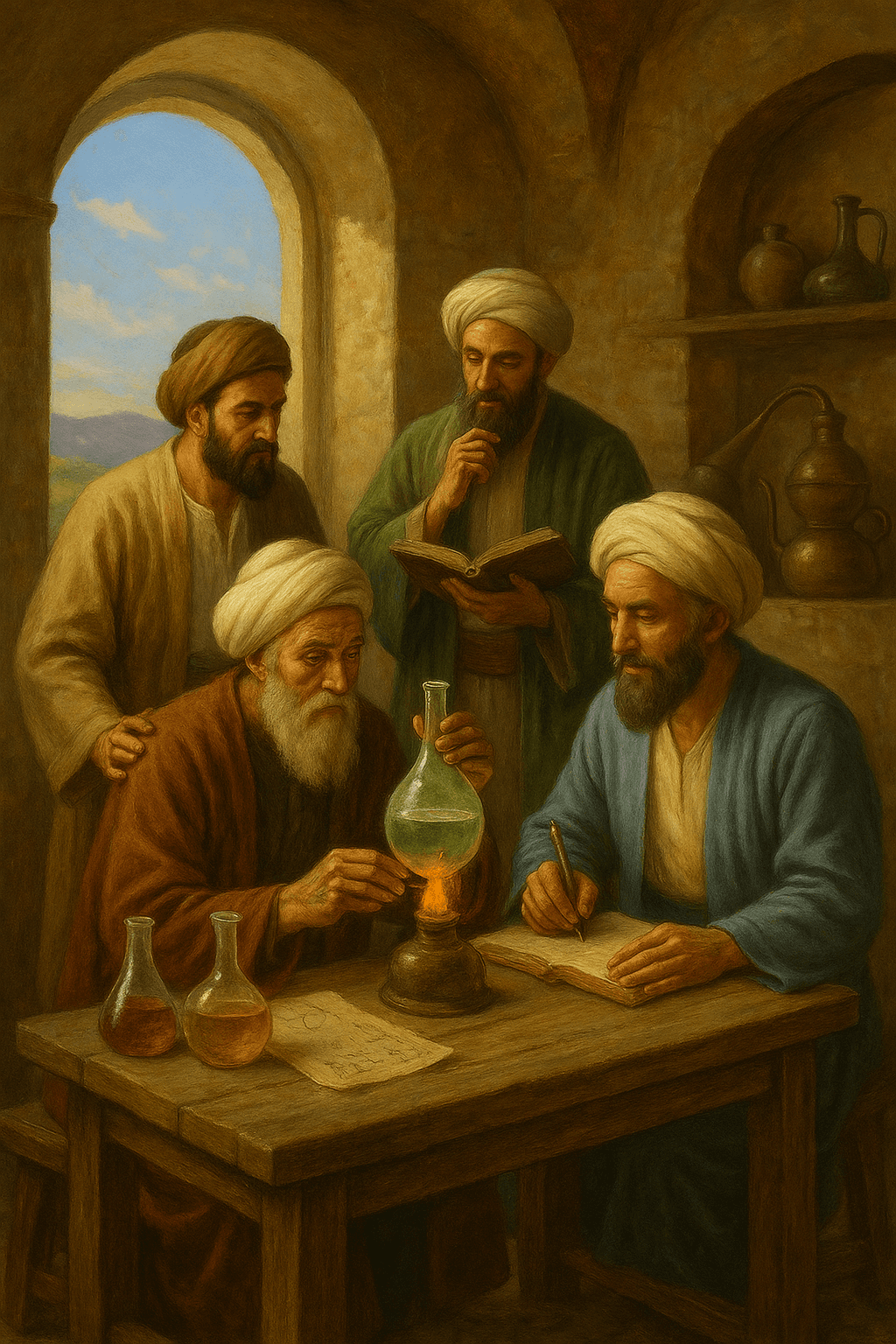
(Generated by artificial intelligence)
Geography and Travel
- Geographers created world maps and provided detailed descriptions of various regions.
- Travelers such as Ibn Khordadbeh, Ibn Fadlan, and Al-Masudi gathered knowledge and shared it in their writings.

(Generated by artificial intelligence)
References
Kaya, Mahmut. 'Tarihte İslam Felsefesi.' Istanbul: İz Yayıncılık, 2020.
Gutas, Dimitri. *Greek Thought, Arabic Culture.* London: Routledge, 1998.
Nasr, Seyyid Hüseyin. *İslam ve Bilim ve Medeniyet Tarihi.* Istanbul: İnsan Yayınları, 2003.
UNESCO. 'The House of Wisdom.' https://en.unesco.org