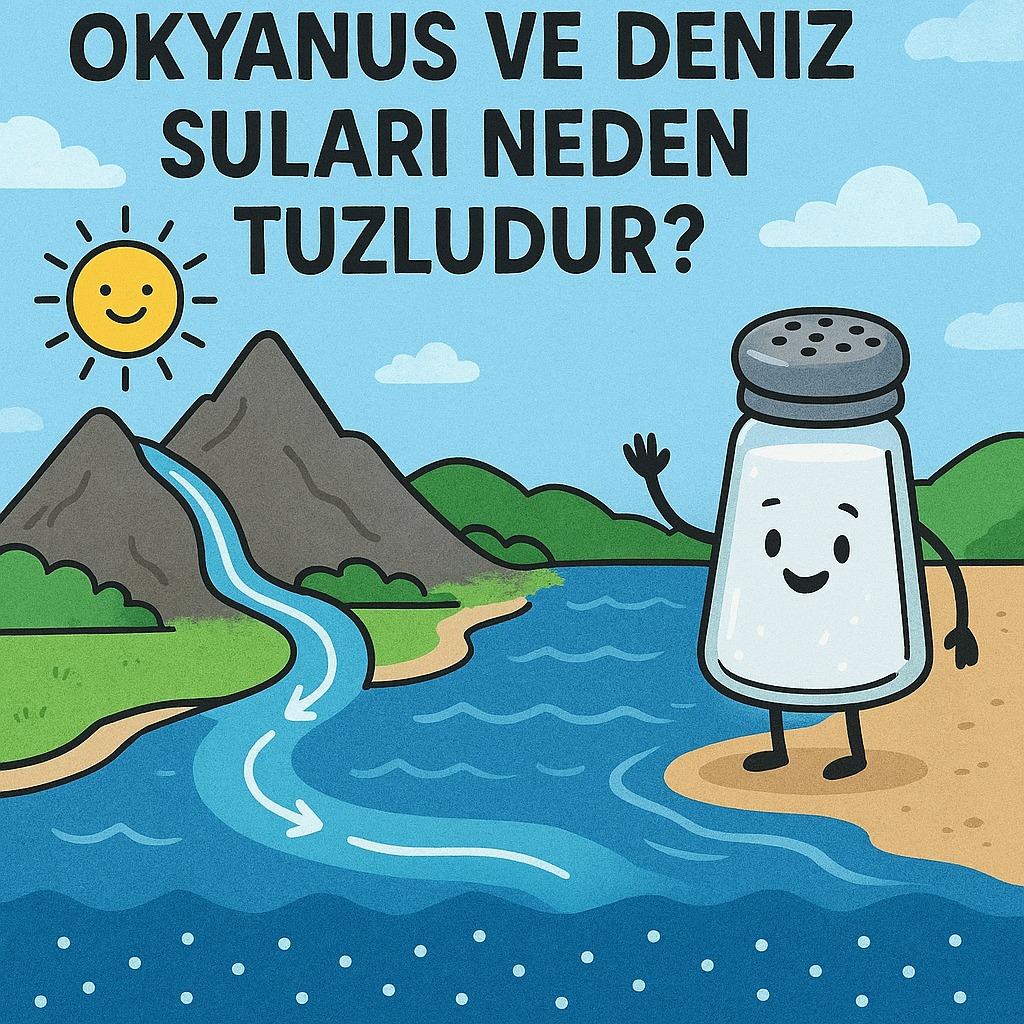




Why Are Ocean and Sea Waters Salty?
Oceans and seas are salty because they contain large amounts of salt (mineral-based substances). Most of this salt has dissolved into the water through the erosion of rocks and minerals emerging from the seafloor. This process, which has continued for millions of years, has shaped the oceans into their current state.
The Power of Rain
When raindrops fall on rocks, they slowly erode them (break them into small fragments). Minerals within the rocks (natural stone materials) dissolve and mix with the rainwater. Over time, these waters feed larger rivers through small streams and creeks. Thus, minerals detached from rocks embark on very long journeys.

(Generated by Artificial Intelligence.)
The Journey of Rivers
Rivers carry minerals they absorb from the soil and rocks around them. These minerals travel dissolved in the water and eventually reach the seas. After journeys spanning hundreds or even thousands of kilometers, the seas are nourished by these minerals. This is one of the most important reasons for the salinity of the oceans.
The Water Cycle
The water cycle (the movement of water from Earth’s surface to the atmosphere and back again) plays a major role in maintaining the salinity of the oceans. Seawater evaporates due to the Sun’s heat and forms clouds. Rain falling from these clouds returns to the land, rivers, and lakes. However, during this cycle, salt does not rise into the sky—it remains entirely in the oceans. Therefore, the oceans have not lost their salt over millions of years.
Left Behind: The Salt
The Sun heats the water and causes it to evaporate. As the evaporated water rises into the atmosphere, salt molecules (tiny particles) are left behind. Over time, as evaporation continues constantly, the amount of salt accumulates and increases in the oceans. While freshwater is constantly renewed, saltwater remains unchanged. This is why rivers are fresh and oceans are salty.
Salinity Levels
The salinity of oceans—the amount of salt dissolved in water—is on average 3.5 percent. This means that in one liter of seawater, there are approximately 35 grams of salt. Although this amount seems small, when considering all the oceans together, it forms a massive mass. In fact, if all the salt on Earth were extracted, it would cover the planet’s surface with a thick layer of salt.
Why Is Salinity Different?
Salinity is not the same everywhere on Earth. In very hot regions, water evaporates extensively, leaving behind more salt. In colder regions, particularly where glaciers melt, freshwater entering the sea reduces salinity. Therefore, some seas are saltier than others. For example, the Red Sea is saltier than the ocean average, while the Black Sea is less salty.
Underwater Volcanoes
Volcanoes on the ocean floor (mountains that release lava and gases from beneath the Earth’s surface) cause minerals to dissolve into seawater. The hot gases and molten rock fragments released by these volcanoes add different minerals to seawater. Thus, ocean salinity depends not only on minerals brought by rivers but also on these powerful subterranean processes.

(Generated by Artificial Intelligence.)
Salinity and Marine Life
Salinity is vital for marine organisms. The ability of fish, crustaceans, and algae to survive depends on the salt concentration of seawater. If salinity increases too much or decreases too much, many organisms cannot survive. Therefore, the bodies of marine creatures have evolved to function in harmony with the salt content of seawater.
Salinity and Humans
The properties of seawater are also important for humans. Seawater has greater buoyancy than freshwater, so ships and boats float more easily in the sea. Additionally, throughout history, humans have extracted salt from the oceans to preserve food and use it in daily life. The salt in seawater is a valuable resource for both nature and humanity.