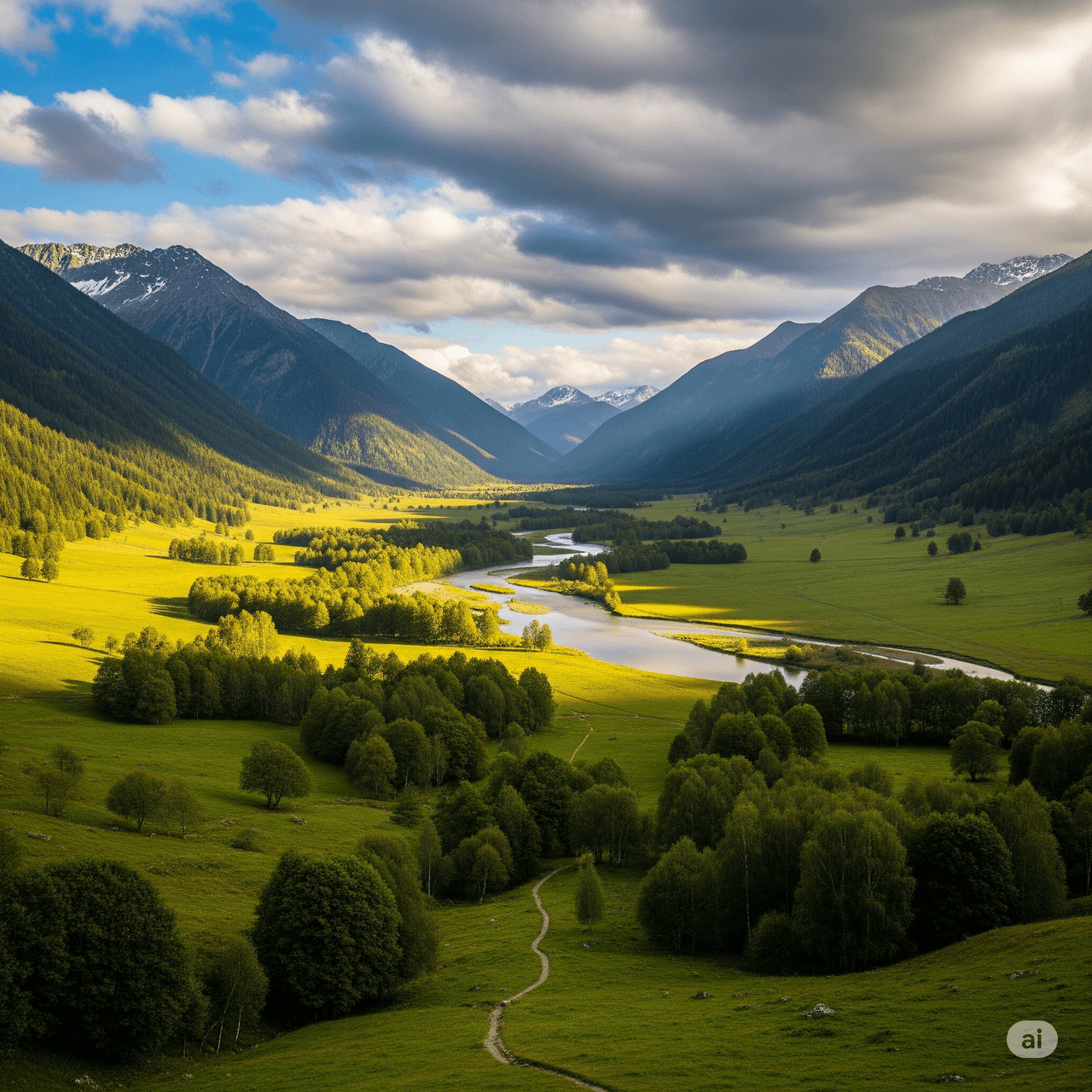




What is a River?
Rivers are surface water masses that move along the slope of the Earth’s surface under the influence of gravity and follow a defined channel. Rivers that originate from a source and flow into a sea, lake, or another river are active components of the hydrosphere. These systems, formed by surface runoff, play fundamental roles in shaping the land surface and sustaining the water cycle.

(Generated by Artificial Intelligence.)
General Characteristics
Rivers flow either continuously or seasonally. Continuous rivers exhibit a consistent discharge throughout the year, while seasonal rivers carry water only during rainy periods. A river’s regime, that is, its pattern of flow over the course of a year, varies depending on its sources and climatic conditions. Some rivers maintain a steady flow year-round, while others show marked differences between dry and wet seasons. River discharge refers to the volume of water passing a specific cross-section per second and is influenced by various geographical, climatic, and anthropogenic factors.
River Discharge
River discharge is defined by relating the volume of water passing a given point to time. This characteristic directly determines a river’s transport capacity, erosive power, and environmental impacts. Key factors influencing river discharge include precipitation volume, temperature, evaporation rate, land structure, and vegetation cover. Additionally, human interventions such as dam construction, irrigation activities, and the redirection of water to other areas can cause significant changes in discharge.

(Generated by Artificial Intelligence.)
River Regime
The river regime describes the pattern of flow a river exhibits throughout the year. Rivers with a regular regime maintain a balanced discharge throughout the year, while those with an irregular regime vary in response to seasonal differences in precipitation and temperature. Rivers fed by multiple sources—such as rainfall, snowmelt, and glacial melt—are classified as having a composite regime. The river regime is of critical importance for both flood risk assessment and water resource management.
Erosion and Deposition Effects
Rivers cause significant geomorphological processes in their surrounding environments. In areas of high slope, they erode their channels to form valleys, canyons, and waterfalls. In regions where the slope decreases, they deposit the materials they carry, creating deltas, alluvial fans, and terraces. These processes play a decisive role in the evolution of the natural environment and the formation of agricultural lands.
Effects in Coastal Areas
Rivers contribute to the formation of coastal landforms, particularly where they meet the sea. The alluvial sediments they deposit at their mouths can lead to the development of deltas. These areas are ecologically rich and hold significant potential for agriculture and settlement. Moreover, since the coastline can change over time, the natural structures and property arrangements in these regions hold special importance.