This article was automatically translated from the original Turkish version.
+1 More
Gezende Canyon (Mersin)
Location | Mersin Province upper basin of the Göksu River Gülnar District | ||||||||
|---|---|---|---|---|---|---|---|---|---|
Elevation(s) | Between 800 and 1000 meters | ||||||||
Formation | Tectono-karstic processes | ||||||||
Geological Structure | Limestone, dolomite | ||||||||
Microtopography | Bedrock potholes, terraces, natural bridges, labyrinth structures | ||||||||
Bedding Plane Dimensions | Diameter ~1 m, depth 2-3 m | ||||||||
Water Source | Göksu River, Gezende Dam effect | ||||||||
Vegetation Cover | Turkish pine (Pinus brutia), cedar (Cedrus libani), juniper (Juniperus sp.), maquis | ||||||||
Tourism Activities | Hiking, canyon passage (canyoning), rafting, canoeing, photography, birdwatching, camping | ||||||||
Gezende Canyon is located within the boundaries of Gülnar district in Mersin Province, in Türkiye’s Mediterranean Region. The canyon is situated in the upper basin of the Göksu River, around the Gezende Dam. This area, approximately 30 kilometers from the district center, is surrounded by the neighborhoods of Saray and Zeyne to the north. Geographically positioned within the western extensions of the Taurus Mountains, the canyon features a rugged topography and lies at an average elevation of 800–1000 meters above sea level.
The main body of the canyon was formed through the gradual deepening of the valley carved by the Göksu River, combined with karstic processes. Access to the canyon is provided via a road starting from the Gülnar district center. Parts of the road are stabilized and permit visitor passage, particularly during the summer months.

Gezende Canyon(Gülnar Subdistrict Office)
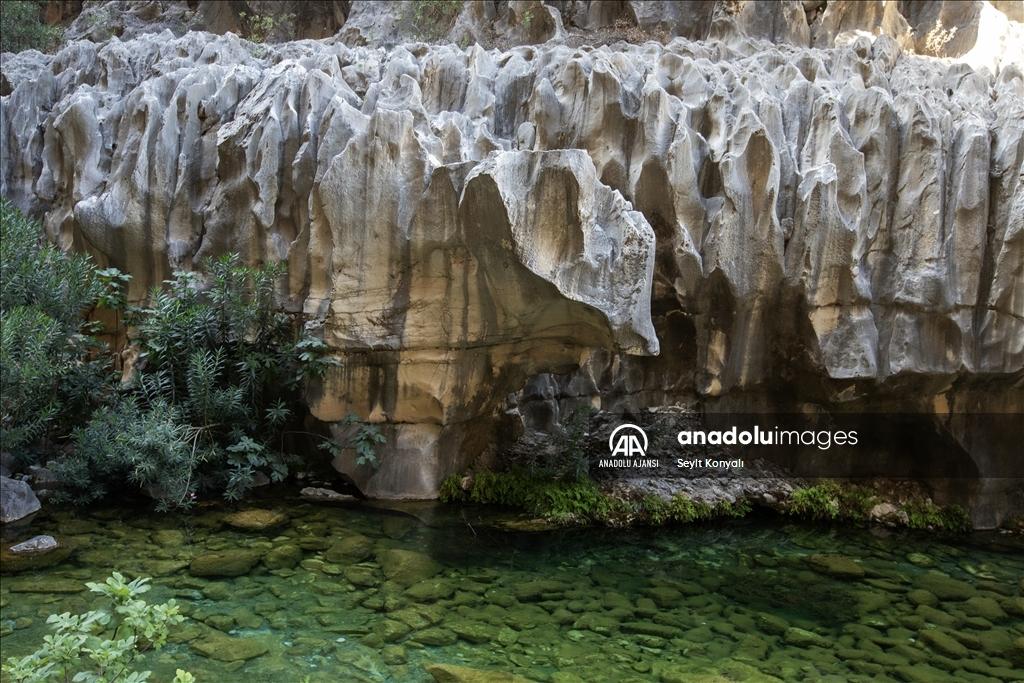
Gezende Canyon is a morphological structure shaped by the combined effects of tectonic activity and karstic processes. Its geological composition consists primarily of limestone and dolomite, lithological units highly susceptible to karstification. This structure has been sculpted by the erosive action of the Göksu River, resulting over time in deep valleys, steep slopes, and microforms.
Within the canyon bed, particularly over a 4-kilometer stretch, thousands of potholes have been identified. These depressions have an average diameter of one meter and depths ranging between two and three meters. These formations are classified as typical fluvial erosion features created by swirling currents and entrained sediments carried by the river. Additionally, grooves, flutes, natural bridges, and labyrinth-like forms observed along the canyon enhance its geomorphological diversity.
On the canyon’s slopes, karstic processes have produced various fracture systems and narrow passages within the limestone. These structures play a significant role in directing both surface and subsurface water flow. Key factors influencing the canyon’s formation include seasonal variations in the Göksu River’s discharge, bed gradient, and lithological heterogeneity.
Gezende Canyon lies within the upper course of the Göksu River, whose flow has been the primary determinant in shaping the canyon. The river plays an active role in both surface erosion and the formation of microforms. The volume of water carried by the river has varied seasonally since the construction of the Gezende Dam, leading to a reduction in flow regime within the canyon. This has slowed the active formation of certain microforms.
The area surrounding the canyon is covered by vegetation characteristic of the Mediterranean climate. The slopes and upper areas are predominantly covered by Turkish pine (Pinus brutia) stands. At higher elevations, Lebanon cedar (Cedrus libani) and juniper (Juniperus sp.) species are found. Within the canyon itself, maquis vegetation and various herbaceous plants are also observed.
From a faunal perspective, the canyon and its surroundings provide habitat for a variety of wildlife species. Predatory bird species such as the golden eagle (Aquila chrysaetos) and the eagle owl (Bubo bubo) have been recorded in the region. Mammals including wild boar and fox are also present. Riverbanks and shaded areas offer suitable microhabitats for amphibians and reptiles.
The ecosystem exhibits a complex structure formed by the interaction of aquatic and terrestrial elements. Steep terrain, variable humidity levels, and differing light exposure directly influence the distribution of plant and animal species.

Gezende Canyon(Gülnar Subdistrict Office)
Gezende Canyon offers a landscape suitable for various nature-based tourism activities due to its distinctive geomorphological structure and natural scenery. The canyon’s microforms, riverbeds, steep cliffs, and vegetation support a range of recreational pursuits.
Main tourism activities possible along the canyon include nature hiking (trekking), canyoning, and river sports (rafting, canoeing). Particularly during summer months, water-based activities can be conducted in certain sections depending on seasonal flow. Potholes and narrow passages provide suitable routes for guided nature hikes and are also utilized for photography and landscape observation.
Viewpoints and natural open spaces located at higher elevations of the canyon are also suitable for passive nature tourism activities such as birdwatching. The region’s notable faunal diversity, especially predatory birds, makes bird observation feasible. Additionally, the forested and open areas surrounding the canyon hold potential for rural tourism practices such as camping.
However, it is noted that tourism infrastructure in the area is limited and most activities are conducted as individual or guided explorations. The absence of an official protection or tourism status for the canyon remains a constraint on the development of planned tourism initiatives.
Although Gezende Canyon is a site of significant natural and geomorphological value, it currently lacks any formal conservation status. The absence of legal designations such as national park, nature park, or natural monument poses risks to the integrity of its ecosystem.
The nearby Gezende Dam directly affects the region’s hydrological regime. Due to the dam, river discharge within the canyon remains low for most of the year, diminishing the river’s shaping capacity. Additionally, reduced water volume has shortened the duration of water filling in certain potholes and microforms.
Uncontrolled growth in tourism activities could lead to degradation of the canyon’s physical and ecological structure. In the literature, the following conservation measures are proposed for the area:
These recommendations aim to preserve the region’s natural values while enabling sustainable tourism development. Although these measures have not yet been formally implemented, they have been raised by local authorities and researchers as priorities.

Gezende Canyon(Gülnar Subdistrict Office)
The economic activities of the local population living around Gezende Canyon are partially based on agriculture and animal husbandry. The region’s topography and climatic conditions allow for limited agricultural activity, particularly in areas characterized by Turkish pine and maquis vegetation.
Tourism has not yet made an organized or widespread contribution to the regional economy, but individual and small-scale visitor initiatives have been observed due to the canyon’s natural and geomorphological appeal. These visits, especially increasing during summer months, can indirectly benefit local commercial activities.
Culturally, traditional customs and local ways of life continue in the canyon’s surroundings. Residents possess traditional knowledge and experience regarding the sustainable use of natural resources. Literature also suggests that the development of nature tourism could have potential impacts on rural development and social structures.
Local administrations and civil society organizations have initiated various efforts concerning the conservation of the canyon and the evaluation of its tourism potential. These initiatives are significant for enhancing economic benefits and preserving cultural values.
Anadolu Ajansı. (2025). Serinlemek isteyen turistlerin adresi Gezende Kanyonu. Accessed July 13, 2025. https://www.aa.com.tr/tr/pg/foto-galeri/serinlemek-isteyen-turistlerin-adresi-gezende-kanyonu/0.
Atasoy, A., & Ercik, C. (2021). Gülnar (Mersin) Gezende Kanyonu’nun turizm potansiyeli. *Karadeniz Uluslararası Bilimsel Dergi*, 51, 151-177. Accessed July 13, 2025. https://doi.org/10.17498/kdeniz.958058.
Gülnar Kaymakamlığı. (n.d.). Gülnar Ortaburun. Accessed July 13, 2025. http://gulnar.gov.tr/gulnar-ortaburun.

Gezende Canyon (Mersin)
Location | Mersin Province upper basin of the Göksu River Gülnar District | ||||||||
|---|---|---|---|---|---|---|---|---|---|
Elevation(s) | Between 800 and 1000 meters | ||||||||
Formation | Tectono-karstic processes | ||||||||
Geological Structure | Limestone, dolomite | ||||||||
Microtopography | Bedrock potholes, terraces, natural bridges, labyrinth structures | ||||||||
Bedding Plane Dimensions | Diameter ~1 m, depth 2-3 m | ||||||||
Water Source | Göksu River, Gezende Dam effect | ||||||||
Vegetation Cover | Turkish pine (Pinus brutia), cedar (Cedrus libani), juniper (Juniperus sp.), maquis | ||||||||
Tourism Activities | Hiking, canyon passage (canyoning), rafting, canoeing, photography, birdwatching, camping | ||||||||
No Discussion Added Yet
Start discussion for "Gezende Canyon (Mersin)" article
Geological and Geomorphological Features
Hydrography and Ecosystem
Potential for Nature and Adventure Tourism
Conservation Status and Sustainability
Local Economy and Socio-Cultural Interactions