


This article was automatically translated from the original Turkish version.
+1 More
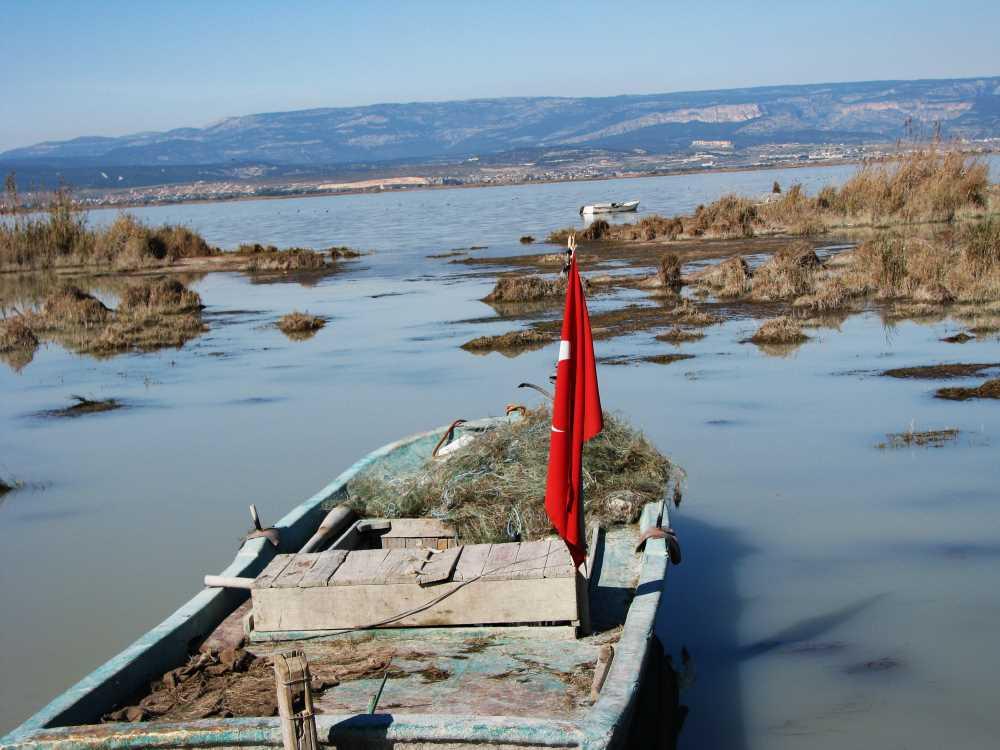
Göksu Delta
Location | Silifke Türkiye Mersin | ||||||||
|---|---|---|---|---|---|---|---|---|---|
Area(s) | Approximately 15 000 hectares | ||||||||
Protection Status | Wetland of International Importance (Ramsar) First Degree Natural Site | ||||||||
Affiliated Institution | Ministry of Agriculture and Forestry, General Directorate of Nature Conservation and National Parks | ||||||||
Notable Species | Ministry of Agriculture and Forestry, General Directorate of Nature Conservation and National Parks | ||||||||
The Göksu Delta, also known as the Silifke Plain, is an internationally significant wetland located within the boundaries of the Silifke district in Mersin Province, on the Mediterranean coast of southern Türkiye. Covering an area of approximately 15,000 hectares, the delta was formed where the Göksu River flows into the sea. It encompasses lagoons, reed beds, saline marshes, dunes, agricultural lands and forested areas.
The Göksu Delta is situated south of the Silifke district, at the point where the Göksu River empties into the Mediterranean Sea. Its flat topography, aligned with sea level, creates an extensive network of habitats where saline and freshwater ecosystems intermingle. Important wetland areas in the region include the Akgöl and Paradeniz lagoons. The climate of the delta is typical Mediterranean, with hot dry summers and mild wet winters.

Göksu Delta. (AA)
The Göksu Delta lies along a major migratory route and is home to over 300 bird species. Breeding species in the area include the Dalmatian pelican, little bittern, flamingo, white stork, black-winged stilt and kingfisher. The delta is also one of the rare sites on the Mediterranean coast where the endangered loggerhead sea turtle (Caretta caretta) and green sea turtle (Chelonia mydas) lay their eggs.
Due to its position at the intersection of aquatic and terrestrial ecosystems, the delta is also rich in plant diversity. Areas dominated by reed beds, saline meadows and maquis vegetation enhance habitat richness.
The Göksu Delta was declared a First Degree Natural Site in 1990 and in 1994 gained the status of “Wetland of International Importance” under the Ramsar Convention. Conservation and monitoring activities are carried out by the General Directorate of Nature Conservation and National Parks under the Ministry of Agriculture and Forestry. The area is also designated as an “Important Bird Area” and an “Important Natural Area”.

A Bird Species Observed in the Göksu Delta. (General Directorate for the Protection of Natural Assets)
The Göksu Delta is an attractive destination for birdwatchers, nature photographers and ecotourism enthusiasts. However, tourism activities in the region are limited and visitor management plans are implemented to prevent degradation of the natural environment. Ecotourism-focused tours are supported by birdwatching observation points and nature walking trails.
Nevertheless, agricultural activities, uncontrolled urbanization and the unsustainable use of water resources pose threats to habitat integrity, and conservation efforts are ongoing to mitigate these risks.
Ministry of Environment and Urbanization of the Republic of Türkiye – Special Environmental Protection Areas. (PRD CONSTRUCTION)
Anadolu Ajansı. "Mersin’in Kıyısındaki Göksu Deltası." Accessed June 6, 2025.
Ministry of Environment, Urbanization and Climate Change of the Republic of Turkey. "Göksu Deltası (Official Information Page). Accessed June 6, 2025.
Ministry of Environment, Urbanization and Climate Change of the Republic of Turkey. "Göksu Deltası Silifke (Special Environmental Protection Area Management Plan)." Directorate General of Nature Conservation. Accessed June 6, 2025.
Turkish Ministry of Culture and Tourism. "Göksu Deltası - Silifke." *Kültür Portalı*. Accessed June 6, 2025. https://www.kulturportali.gov.tr/turkiye/mersin/TurizmAktiviteleri/goksu-deltasi-silifke
YouTube, PRD YAPIM Channel. "T.C. Çevre ve Şehircilik Bakanlığı-Özel Çevre Koruma Bölgeleri-Göksu Deltası." Accessed June 6, 2025.

Göksu Delta
Location | Silifke Türkiye Mersin | ||||||||
|---|---|---|---|---|---|---|---|---|---|
Area(s) | Approximately 15 000 hectares | ||||||||
Protection Status | Wetland of International Importance (Ramsar) First Degree Natural Site | ||||||||
Affiliated Institution | Ministry of Agriculture and Forestry, General Directorate of Nature Conservation and National Parks | ||||||||
Notable Species | Ministry of Agriculture and Forestry, General Directorate of Nature Conservation and National Parks | ||||||||
Geographical Location and Physical Structure
Biodiversity and Ecological Importance
Conservation Status and Management
Tourism and Sustainability