


This article was automatically translated from the original Turkish version.
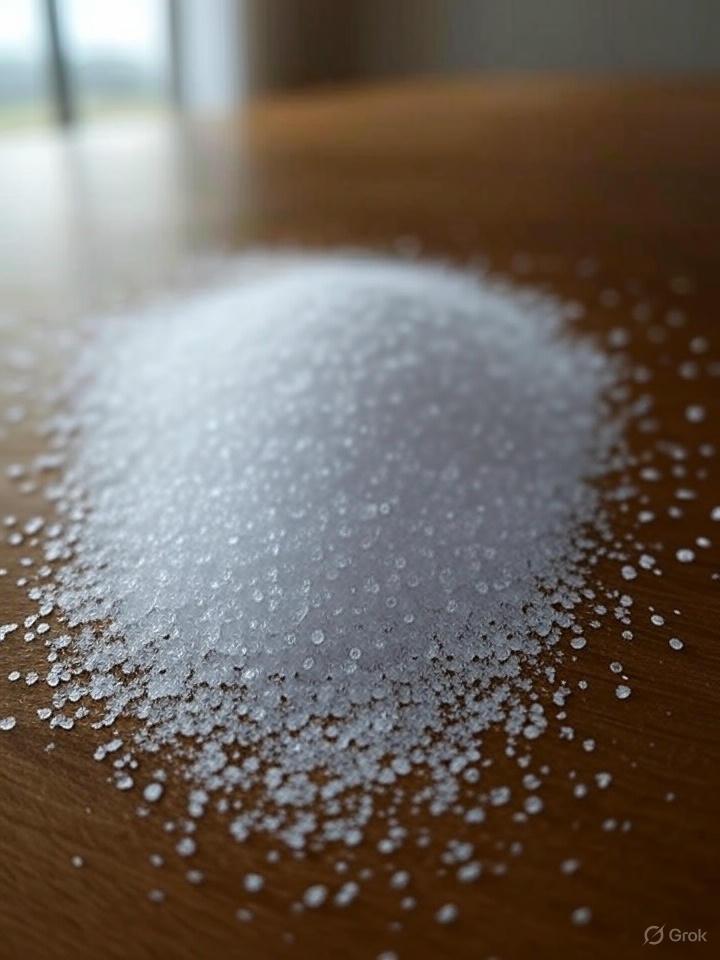
Sodium Chloride
Chemical Formula | NaCl | ||||||||
|---|---|---|---|---|---|---|---|---|---|
Appearance | crystalline solid White | ||||||||
Molecular Weight | 58.44 g/mol | ||||||||
pH Value | 7 (Neutral) | ||||||||
Structure(s) | Ionic (FCC lattice) | ||||||||
Ionic Structure | Composed of Na⁺ and Cl⁻ ions | ||||||||
Type of Salt | Neutral salt | ||||||||
Formation | NaOH + HCl → NaCl + H₂O | ||||||||
Area(s) of Use | road de-icing water treatment chlor-alkali production medical solutions Food | ||||||||
Sodium chloride (NaCl) is a crystalline, white, ionic compound composed of sodium (Na⁺) and chloride (Cl⁻) ions. In daily life it is known as “table salt” and holds significant biological and industrial importance. Chemically, it is a neutral salt formed by the reaction of a strong acid with a strong base.
NaCl occurs naturally in high concentrations both in underground salt deposits and in seawater. Major producers include the United States, China, India, and Canada.
Sodium chloride, or table salt, is one of the oldest and most strategic substances in human history. The preservative and flavor-enhancing properties of salt made it essential for pre-agricultural societies. Archaeological evidence indicates that salt was extracted in Chinese settlements as early as 6000 BCE. In China’s Sichuan region, the use of salt wells dates back to the 3rd millennium BCE, and early salt distillation techniques were developed there.
In ancient Rome, salt became an economically and socially significant commodity. Part of Roman soldiers’ pay was rendered in salt; this practice is the origin of the English word “salary.” The Romans prioritized the construction of roads and transport routes for salt, as evidenced by ancient roads named “Via Salaria” (Salt Road).
Throughout the Middle Ages, salt remained a fundamental component of trade and taxation. In India, salt was tightly controlled both during the Mughal period and under British colonial rule; Gandhi’s famous 1930 Salt March became a symbolic act of resistance against these restrictions.
In Anatolia, salt production and distribution have been under state control since the Hittite era. During the Ottoman Empire, salt mines were declared state property (miri mülk) and brought under central administration. This practice underscores the long historical continuity of salt’s strategic importance.
From the late 19th century onward, industrial development transformed sodium chloride from merely a foodstuff into a fundamental raw material for the chemical industry. Its role in the chlor-alkali industry has further enhanced its economic and technological value in the modern era.
Sodium chloride (NaCl) is a crystalline, white solid with an ionic structure. At room temperature, it remains stable and consists of equal numbers of sodium (Na⁺) and chloride (Cl⁻) ions. It has a face-centered cubic crystal structure, in which each sodium ion is surrounded by six chloride ions. The molecular weight of sodium chloride is 58.44 g/mol. Its melting point is 801 °C and its boiling point is 1,413 °C. At 25 °C, its density is approximately 2.165 g/cm³. It is highly soluble in water, with about 357 grams dissolving in one liter at 20 °C. This high solubility enhances the ionic conductivity of its solution, making it effective in both biological and industrial systems.
Chemically, sodium chloride is a neutral salt formed by the reaction of a strong acid, hydrochloric acid (HCl), with a strong base, sodium hydroxide (NaOH). This neutralization reaction produces NaCl and water. Consequently, a 1 molar aqueous solution of NaCl exhibits a pH of approximately 7 and displays neutral characteristics. It fully dissociates in water, providing electrical conductivity. Chemically stable under normal conditions, it does not react readily but melts before vaporizing at high temperatures. It may react with strong oxidizing agents, particularly concentrated sulfuric acid. All these properties have made sodium chloride not only table salt but also a fundamental chemical raw material with broad industrial applications.
Sodium Chloride Neutralization Reaction
Sodium and chloride ions regulate the osmotic balance of extracellular fluid. They play vital roles in muscle contraction, nerve transmission, and blood pressure control. Since the body cannot synthesize them, they must be obtained externally. Deficiency can lead to hyponatremia, while excess may cause hypertension and other disorders.
When used for de-icing roads and sidewalks, salt can lead to sodium accumulation in soil and disrupt the ionic balance of surface waters. Therefore, controlled environmental release is essential. It can also have toxic effects on vegetation and contribute to metal corrosion in infrastructure systems.
American Chemistry Council. “Sodium Chloride.” *ChemicalSafetyFacts.org*. Accessed June 25, 2025. https://www.chemicalsafetyfacts.org/chemicals/sodium-chloride/
ChemLin. "Sodium Chloride." ChemLin.org. Accessed June 25, 2025. https://chemlin.org/chemical-compound/Sodium%20Chloride.php
National Center for Biotechnology Information. “Sodium Chloride Supply Chain Profile.” *epa.gov.* Accessed June 25, 2025. https://www.epa.gov/system/files/documents/2023-03/Sodium%20Chloride%20Supply%20Chain%20Profile.pdf
National Institute of Standards and Technology (NIST). “Sodium Chloride.” NIST Chemistry WebBook. Accessed June 25, 2025. https://webbook.nist.gov/cgi/cbook.cgi?ID=C7647145&Mask=1D
PubChem. "Sodium Chloride." National Center for Biotechnology Information. Accessed June 25, 2025. https://pubchem.ncbi.nlm.nih.gov/compound/Sodium-Chloride

Sodium Chloride
Chemical Formula | NaCl | ||||||||
|---|---|---|---|---|---|---|---|---|---|
Appearance | crystalline solid White | ||||||||
Molecular Weight | 58.44 g/mol | ||||||||
pH Value | 7 (Neutral) | ||||||||
Structure(s) | Ionic (FCC lattice) | ||||||||
Ionic Structure | Composed of Na⁺ and Cl⁻ ions | ||||||||
Type of Salt | Neutral salt | ||||||||
Formation | NaOH + HCl → NaCl + H₂O | ||||||||
Area(s) of Use | road de-icing water treatment chlor-alkali production medical solutions Food | ||||||||
No Discussion Added Yet
Start discussion for "Sodium Chloride (NaCl)" article
History
Physical and Chemical Properties
Applications
Biological Role and Importance
Environmental Impact