


This article was automatically translated from the original Turkish version.
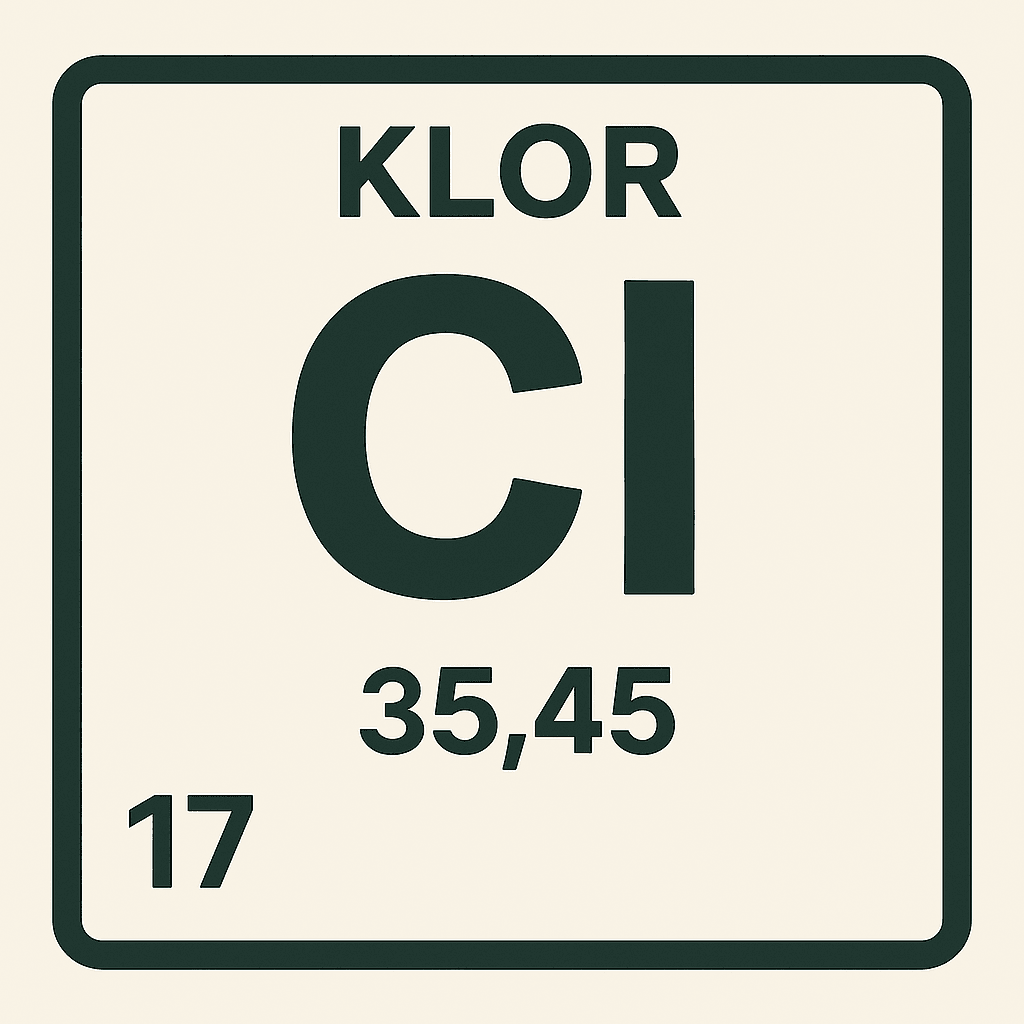
Chlorine (Cl) - Generated with Artificial Intelligence
Symbol | Cl | ||||||||
|---|---|---|---|---|---|---|---|---|---|
Atomic Number | 17 | ||||||||
Atomic Mass | 35.45 g/mol | ||||||||
Periodic Table Group | 17 (Halogens) | ||||||||
Element Class | Nonmetal | ||||||||
Physical State (25 °C) | Gas | ||||||||
Electron Configuration | [Ne] 3s² 3p⁵ | ||||||||
Electronegativity | 3.16 (Pauling scale) | ||||||||
Melting Point | -101.5 °C | ||||||||
Boiling Point | -34.04 °C | ||||||||
Isotopes | Cl-37 (24.23%) Cl-35 (75.77%) | ||||||||
Discovery(ies) | 1774 – Carl Wilhelm Scheele (First Isolated) 1810 – Humphry Davy (Confirmed as Element) | ||||||||
Applications | Cleaning Products Chemical Syntheses Bleaching Agents Disinfectants PVC Production Water Treatment | ||||||||
Chlorine is an element located in the halogen group of the periodic table with an atomic number of 17. This element, commonly found in nature and used for various industrial purposes, is notable for its chemical properties and high reactivity. Chlorine is an important element in life and environmental sciences and is a component of many compounds.
The element chlorine was first isolated in 1774 by Swedish chemist Carl Wilhelm Scheele as a greenish-yellow gas produced by the reaction of manganese dioxide with hydrochloric acid. However, its identification as an element was established later in 1810 by Sir Humphry Davy, who demonstrated that the substance was not a compound but a new element.

Representative Image of Chlorine Gas (Generated by Artificial Intelligence)
Chlorine is a nonmetal element located in group 17 (halogens) and period 3 of the periodic table. Its atomic number is 17 and its atomic mass is approximately 35.45. In its natural state it exists as a gas and forms diatomic molecules (Cl₂). Due to its membership in the halogen group, it exhibits high reactivity. Its electron configuration is [Ne] 3s² 3p⁵.
At room temperature, chlorine is a yellow-green gas with a pungent odor and is toxic. Its melting point is approximately -101 °C and its boiling point is around -34 °C. Chlorine is about 2.5 times denser than air. A single covalent bond exists between the two chlorine atoms in the molecule, and this bond has high bond energy. Chlorine acts as a strong oxidizing agent in chemical reactions. When it comes into contact with water, it forms hydrogen chloride (HCl) and hypochlorous acid (HOCl).
Chlorine has an electronegativity value of 3.16, indicating its strong ability to attract electrons. This makes it highly active in the formation of many compounds. Among the halogens, its reactivity is second only to fluorine.
Chlorine has two stable isotopes found in nature: ^35Cl and ^37Cl. The ^35Cl isotope occurs at approximately 75.78 percent, while ^37Cl occurs at approximately 24.22 percent. Both isotopes have identical chemical properties and exist naturally as a mixture.
Chlorine is rarely found in its free state in nature; it is typically present in saline water, minerals, and various compounds. Its most common compound is sodium chloride (NaCl), along with other halide salts. Ocean water contains high concentrations of chloride ions. Chlorine compounds have wide applications in industry, disinfectants, and organic chemistry.
Chlorine is an essential element for living organisms. In the human body, chloride ions are found primarily in extracellular fluids such as plasma and interstitial fluid. These ions play a role in maintaining electrolyte balance, nerve transmission, and acid-base equilibrium. Additionally, in the form of hypochlorous acid, chlorine participates in the microbe-killing mechanism of white blood cells.
Chlorine is produced commercially primarily through the electrolysis of brine. In this process, chlorine gas, hydrogen gas, and sodium hydroxide are obtained. The electrolysis method is widely used in industry both for chlorine production and for the recovery of byproducts. Production processes are significant in terms of energy efficiency and environmental impact.
Chlorine gas poses environmental risks due to its high reactivity and toxic effects. Exposure can cause respiratory irritation, eye and skin burns. Therefore, appropriate safety measures must be implemented in areas where chlorine is used or stored. If released into the environment, it can have adverse effects on ecosystems. Waste management and gas control systems are critical in this regard.
Chlorine is widely present in both inorganic and organic compounds. Inorganic compounds include simple salts and acids such as sodium chloride, hydrogen chloride, and chloride ions. Organic chlorine compounds are synthetic or natural compounds containing chlorine atoms bonded to a carbon skeleton. The chemical and physical properties of these compounds determine their applications.
Chlorine reacts with many elements and compounds. It reacts with water to form hydrogen chloride and hypochlorous acid, and with metals to produce salts. In organic chemistry, chlorine plays an active role in halogenation reactions. The single bond in the chlorine molecule and its high electronegativity are the primary reasons for its reactivity.
Various chemical and spectroscopic methods are used to analyze chlorine and its compounds. Determining chlorine concentration is particularly important in water treatment and environmental analysis. Titrimetric methods, colorimetric chemical reactions, and modern spectroscopic techniques are commonly preferred for analytical detection of chlorine.
In organic chemistry, chlorine serves as a key component in halogenation reactions. The addition of chlorine atoms to organic compounds alters their physical, chemical, and biological properties. Chlorinated organic compounds are used as primary raw materials in the production of plastics, solvents, pesticides, and pharmaceuticals.
Various byproducts and wastes are generated during chlorine production and use. Many of these byproducts are toxic and can pose risks to the environment and human health if not properly managed. Special technologies have been developed in industrial facilities to control and dispose of gaseous, liquid, and solid wastes. Waste management is a fundamental aspect of the sustainable and safe use of chlorine.
When released into the atmosphere, chlorine can participate in photochemical reactions that produce compounds harmful to the ozone layer. In water and soil environments, it undergoes various chemical transformations. These processes are important for understanding chlorine’s persistence and bioaccumulation in the environment. The environmental movement of chlorine must be monitored for pollution control and ecosystem health.
Chlorine gas and certain chlorinated compounds are toxic. High-dose exposure can cause respiratory irritation, pulmonary edema, and serious health problems. Some chlorinated organic compounds have environmental persistence and can bioaccumulate, leading to long-term toxic effects. Therefore, safe use of chlorine and minimization of exposure are essential.

Applications of Chlorine Element (Generated by Artificial Intelligence)
Major applications of chlorine include water treatment and disinfection, plastic production (especially PVC), organic synthesis, and the paper and textile industries. It is widely used as a microbe-killing agent in water and wastewater disinfection. Additionally, it serves as a primary raw material in the synthesis of various chlorinated organic compounds.
Avşar, Edip, Seval Gaye Karadağ, İsmail Toröz, and Asude Hanedar. “İstanbul Ömerli Ham Suyunda Dezenfeksiyon Amaçlı Klor Dioksit Kullanımının Dezenfeksiyon Yan Ürün (DYÜ) Oluşumuna Etkisinin Araştırılması.” *Pamukkale Üniversitesi Mühendislik Bilimleri Dergisi* 23, no. 3 (2017): 297–302. Accessed July 25, 2025. https://dergipark.org.tr/tr/download/article-file/317365.
Bolat, İlyas, and Ömer Kara. “Bitki Besin Elementleri: Kaynakları, İşlevleri, Eksik ve Fazlalıkları.” *Bartın Orman Fakültesi Dergisi* 19, no. 1 (June 2017): 218–228. Accessed July 25, 2025. .
National Center for Biotechnology Information. "Klor." *PubChem.* Accessed July 25, 2025. https://pubchem.ncbi.nlm.nih.gov/compound/chlorine#section=Computed-Properties.
TÜBİTAK Bilim Genç. "Klor." *Bilim ve Teknik.* Accessed July 25, 2025. https://bilimgenc.tubitak.gov.tr/periyodik-tablo/Klor.

Chlorine (Cl) - Generated with Artificial Intelligence
Symbol | Cl | ||||||||
|---|---|---|---|---|---|---|---|---|---|
Atomic Number | 17 | ||||||||
Atomic Mass | 35.45 g/mol | ||||||||
Periodic Table Group | 17 (Halogens) | ||||||||
Element Class | Nonmetal | ||||||||
Physical State (25 °C) | Gas | ||||||||
Electron Configuration | [Ne] 3s² 3p⁵ | ||||||||
Electronegativity | 3.16 (Pauling scale) | ||||||||
Melting Point | -101.5 °C | ||||||||
Boiling Point | -34.04 °C | ||||||||
Isotopes | Cl-37 (24.23%) Cl-35 (75.77%) | ||||||||
Discovery(ies) | 1774 – Carl Wilhelm Scheele (First Isolated) 1810 – Humphry Davy (Confirmed as Element) | ||||||||
Applications | Cleaning Products Chemical Syntheses Bleaching Agents Disinfectants PVC Production Water Treatment | ||||||||
Discovery
Classification and Basic Properties
Physical and Chemical Properties
Electronegativity and Reactivity
Isotopes
Natural Occurrence and Compounds
Biological Role and Importance to Living Organisms
Industrial Production of Chlorine
Environmental Impacts and Safety Measures
Classification of Chlorine Compounds
Physical and Chemical Reactions of Chlorine
Analytical Detection and Measurement of Chlorine
Role of Chlorine in Organic Chemistry
Byproducts and Waste Management in Industrial Use of Chlorine
Environmental Behavior of Chlorine
Toxicology of Chlorine and Its Effects on Human Health
Applications