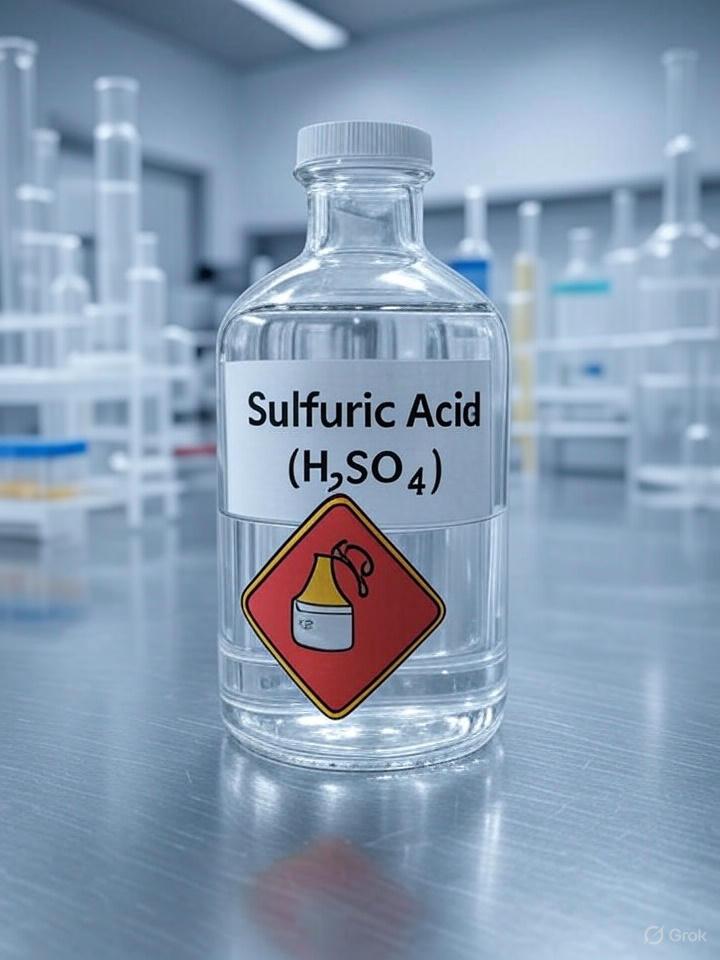
Sulfuric acid (H₂SO₄) is a corrosive, hydrogen ion (H⁺) donor compound belonging to the mineral acid class, composed of two hydrogen atoms, one sulfur atom, and four oxygen atoms. It is a dense, oily liquid that ranges in color from colorless to pale yellow. Due to its widespread use in industrial production, it is among the fundamental substances of industrial chemistry. Historically, it has also been known as “oil of vitriol.” Annual production volume is a significant indicator of a country’s chemical industry capacity.
Sulfuric acid does not occur freely in nature; however, trace amounts can be detected in some volcanic gases. Its industrial production is primarily carried out via the contact process.
History
The history of sulfuric acid has paralleled the earliest systematic chemical experiments in human history. The first known references to its forms appear in the works of the 8th-century Islamic scholar Jabir ibn Hayyan. Jabir obtained sulfuric acid derivatives from iron sulfate (FeSO₄), aluminum sulfate (Al₂(SO₄)₃), and natural vitriol minerals, naming these substances “oil of vitriol.” This terminology continued to be used in subsequent periods.
In the 13th century, Albertus Magnus and Roger Bacon obtained acidic solutions by distilling vitriol compounds and helped popularize this process in Europe. In the 16th century, Johann Rudolf Glauber produced sulfuric acid vapor by heating iron and copper sulfates, enabling experiments with purer solutions.
In England in 1746, chemist John Roebuck developed the first commercial-scale sulfuric acid production system, establishing the lead chamber process. This method relied on the reaction of gases produced by heating iron sulfate and nitrate together inside large lead vessels. Throughout the 18th and 19th centuries, this process became widely used in Europe and America, increasing the demand for sulfuric acid in sectors such as textiles, leather, and metallurgy alongside the Industrial Revolution.
However, the lead chamber process eventually became inadequate due to low efficiency and limited concentration output. In 1831, British chemist Peregrine Phillips developed the more efficient contact process. In this method, sulfur dioxide (SO₂) reacts with oxygen in the presence of vanadium pentoxide (V₂O₅) as a catalyst to produce sulfur trioxide (SO₃). This advancement made large-scale, economical, and continuous production of sulfuric acid possible.
Throughout the 20th century, the process was refined to improve efficiency, reduce environmental impact, and enhance control through automation systems. Today, sulfuric acid production is widespread in nearly every country, and its output is often regarded as an indicator of a nation’s chemical industry capacity.
Physical and Chemical Properties
Sulfuric acid (H₂SO₄) is a colorless, oily, heavy, and odorless liquid at room temperature. Due to its strong hygroscopic nature, it rapidly absorbs water vapor from humid air and can become concentrated. It also has high viscosity. The density of pure sulfuric acid is approximately 1.84 g/cm³, which is considerably higher than that of ordinary liquids. With a molecular weight of 98.08 g/mol, it consists of two hydrogen atoms, one sulfur atom, and four oxygen atoms, as indicated by its chemical formula.
The melting point of pure sulfuric acid is approximately 10.3 °C, and its boiling point is 337 °C. During boiling, it partially decomposes, releasing sulfur trioxide (SO₃) and water vapor. Its vapors are irritating, and inhalation poses health risks. Additionally, contact with skin causes severe corrosive effects.
Sulfuric acid is classified as a strong acid due to its proton-donating ability. In aqueous solutions, it undergoes two-stage ionization:
1st ionization:
<span class="katex"><span class="katex-html" aria-hidden="true"><span class="base"><span class="strut" style="height:0.8333em;vertical-align:-0.15em;"></span><span class="mord"><span class="mord mathnormal" style="margin-right:0.08125em;">H</span><span class="msupsub"><span class="vlist-t vlist-t2"><span class="vlist-r"><span class="vlist" style="height:0.3011em;"><span style="top:-2.55em;margin-left:-0.0813em;margin-right:0.05em;"><span class="pstrut" style="height:2.7em;"></span><span class="sizing reset-size6 size3 mtight"><span class="mord mtight"><span class="mord mtight">2</span></span></span></span></span><span class="vlist-s"></span></span><span class="vlist-r"><span class="vlist" style="height:0.15em;"><span></span></span></span></span></span></span><span class="mord mathnormal" style="margin-right:0.05764em;">S</span><span class="mord"><span class="mord mathnormal" style="margin-right:0.02778em;">O</span><span class="msupsub"><span class="vlist-t vlist-t2"><span class="vlist-r"><span class="vlist" style="height:0.3011em;"><span style="top:-2.55em;margin-left:-0.0278em;margin-right:0.05em;"><span class="pstrut" style="height:2.7em;"></span><span class="sizing reset-size6 size3 mtight"><span class="mord mtight"><span class="mord mtight">4</span></span></span></span></span><span class="vlist-s"></span></span><span class="vlist-r"><span class="vlist" style="height:0.15em;"><span></span></span></span></span></span></span><span class="mspace" style="margin-right:0.2778em;"></span><span class="mrel">→</span><span class="mspace" style="margin-right:0.2778em;"></span></span><span class="base"><span class="strut" style="height:0.8547em;vertical-align:-0.0833em;"></span><span class="mord"><span class="mord mathnormal" style="margin-right:0.08125em;">H</span><span class="msupsub"><span class="vlist-t"><span class="vlist-r"><span class="vlist" style="height:0.7713em;"><span style="top:-3.063em;margin-right:0.05em;"><span class="pstrut" style="height:2.7em;"></span><span class="sizing reset-size6 size3 mtight"><span class="mord mtight"><span class="mord mtight">+</span></span></span></span></span></span></span></span></span><span class="mspace" style="margin-right:0.2222em;"></span><span class="mbin">+</span><span class="mspace" style="margin-right:0.2222em;"></span></span><span class="base"><span class="strut" style="height:1.0778em;vertical-align:-0.2663em;"></span><span class="mord mathnormal" style="margin-right:0.08125em;">H</span><span class="mord mathnormal" style="margin-right:0.05764em;">S</span><span class="mord"><span class="mord mathnormal" style="margin-right:0.02778em;">O</span><span class="msupsub"><span class="vlist-t vlist-t2"><span class="vlist-r"><span class="vlist" style="height:0.8115em;"><span style="top:-2.4337em;margin-left:-0.0278em;margin-right:0.05em;"><span class="pstrut" style="height:2.7em;"></span><span class="sizing reset-size6 size3 mtight"><span class="mord mtight"><span class="mord mtight">4</span></span></span></span><span style="top:-3.1031em;margin-right:0.05em;"><span class="pstrut" style="height:2.7em;"></span><span class="sizing reset-size6 size3 mtight"><span class="mord mtight"><span class="mord mtight">−</span></span></span></span></span><span class="vlist-s"></span></span><span class="vlist-r"><span class="vlist" style="height:0.2663em;"><span></span></span></span></span></span></span></span></span></span>
2nd ionization:
<span class="katex"><span class="katex-html" aria-hidden="true"><span class="base"><span class="strut" style="height:1.0778em;vertical-align:-0.2663em;"></span><span class="mord mathnormal" style="margin-right:0.08125em;">H</span><span class="mord mathnormal" style="margin-right:0.05764em;">S</span><span class="mord"><span class="mord mathnormal" style="margin-right:0.02778em;">O</span><span class="msupsub"><span class="vlist-t vlist-t2"><span class="vlist-r"><span class="vlist" style="height:0.8115em;"><span style="top:-2.4337em;margin-left:-0.0278em;margin-right:0.05em;"><span class="pstrut" style="height:2.7em;"></span><span class="sizing reset-size6 size3 mtight"><span class="mord mtight"><span class="mord mtight">4</span></span></span></span><span style="top:-3.1031em;margin-right:0.05em;"><span class="pstrut" style="height:2.7em;"></span><span class="sizing reset-size6 size3 mtight"><span class="mord mtight"><span class="mord mtight">−</span></span></span></span></span><span class="vlist-s"></span></span><span class="vlist-r"><span class="vlist" style="height:0.2663em;"><span></span></span></span></span></span></span><span class="mspace" style="margin-right:0.2778em;"></span><span class="mrel">⇌</span><span class="mspace" style="margin-right:0.2778em;"></span></span><span class="base"><span class="strut" style="height:0.8547em;vertical-align:-0.0833em;"></span><span class="mord"><span class="mord mathnormal" style="margin-right:0.08125em;">H</span><span class="msupsub"><span class="vlist-t"><span class="vlist-r"><span class="vlist" style="height:0.7713em;"><span style="top:-3.063em;margin-right:0.05em;"><span class="pstrut" style="height:2.7em;"></span><span class="sizing reset-size6 size3 mtight"><span class="mord mtight"><span class="mord mtight">+</span></span></span></span></span></span></span></span></span><span class="mspace" style="margin-right:0.2222em;"></span><span class="mbin">+</span><span class="mspace" style="margin-right:0.2222em;"></span></span><span class="base"><span class="strut" style="height:1.1205em;vertical-align:-0.2663em;"></span><span class="mord mathnormal" style="margin-right:0.05764em;">S</span><span class="mord"><span class="mord mathnormal" style="margin-right:0.02778em;">O</span><span class="msupsub"><span class="vlist-t vlist-t2"><span class="vlist-r"><span class="vlist" style="height:0.8542em;"><span style="top:-2.4337em;margin-left:-0.0278em;margin-right:0.05em;"><span class="pstrut" style="height:2.7em;"></span><span class="sizing reset-size6 size3 mtight"><span class="mord mtight"><span class="mord mtight">4</span></span></span></span><span style="top:-3.1031em;margin-right:0.05em;"><span class="pstrut" style="height:2.7em;"></span><span class="sizing reset-size6 size3 mtight"><span class="mord mtight"><span class="mord mtight">2</span><span class="mord mtight">−</span></span></span></span></span><span class="vlist-s"></span></span><span class="vlist-r"><span class="vlist" style="height:0.2663em;"><span></span></span></span></span></span></span></span></span></span>
It completely donates its first proton, while the second proton dissociation occurs via an equilibrium reaction. This characteristic classifies it as a diprotic acid.
Thermodynamically quite stable, H₂SO₄ exhibits a tendency to decompose at high temperatures but has a high potential to react in many environments. As a strong dehydrating agent, it can remove water from organic substances. Consequently, when it comes into contact with carbohydrates (e.g., sucrose), carbonization occurs, separating the substance into water and carbon.
Additionally, sulfuric acid reacts with many metals to produce hydrogen gas. In such reactions, it exhibits redox properties. For example, its reaction with zinc (Zn) is as follows:
<span class="katex"><span class="katex-html" aria-hidden="true"><span class="base"><span class="strut" style="height:1em;vertical-align:-0.25em;"></span><span class="mord mathnormal" style="margin-right:0.07153em;">Z</span><span class="mord mathnormal">n</span><span class="mopen">(</span><span class="mord mathnormal">s</span><span class="mclose">)</span><span class="mspace" style="margin-right:0.2222em;"></span><span class="mbin">+</span><span class="mspace" style="margin-right:0.2222em;"></span></span><span class="base"><span class="strut" style="height:1em;vertical-align:-0.25em;"></span><span class="mord"><span class="mord mathnormal" style="margin-right:0.08125em;">H</span><span class="msupsub"><span class="vlist-t vlist-t2"><span class="vlist-r"><span class="vlist" style="height:0.3011em;"><span style="top:-2.55em;margin-left:-0.0813em;margin-right:0.05em;"><span class="pstrut" style="height:2.7em;"></span><span class="sizing reset-size6 size3 mtight"><span class="mord mtight"><span class="mord mtight">2</span></span></span></span></span><span class="vlist-s"></span></span><span class="vlist-r"><span class="vlist" style="height:0.15em;"><span></span></span></span></span></span></span><span class="mord mathnormal" style="margin-right:0.05764em;">S</span><span class="mord"><span class="mord mathnormal" style="margin-right:0.02778em;">O</span><span class="msupsub"><span class="vlist-t vlist-t2"><span class="vlist-r"><span class="vlist" style="height:0.3011em;"><span style="top:-2.55em;margin-left:-0.0278em;margin-right:0.05em;"><span class="pstrut" style="height:2.7em;"></span><span class="sizing reset-size6 size3 mtight"><span class="mord mtight"><span class="mord mtight">4</span></span></span></span></span><span class="vlist-s"></span></span><span class="vlist-r"><span class="vlist" style="height:0.15em;"><span></span></span></span></span></span></span><span class="mopen">(</span><span class="mord mathnormal">a</span><span class="mord mathnormal" style="margin-right:0.03588em;">q</span><span class="mclose">)</span><span class="mspace" style="margin-right:0.2778em;"></span><span class="mrel">→</span><span class="mspace" style="margin-right:0.2778em;"></span></span><span class="base"><span class="strut" style="height:1em;vertical-align:-0.25em;"></span><span class="mord mathnormal" style="margin-right:0.07153em;">Z</span><span class="mord mathnormal">n</span><span class="mord mathnormal" style="margin-right:0.05764em;">S</span><span class="mord"><span class="mord mathnormal" style="margin-right:0.02778em;">O</span><span class="msupsub"><span class="vlist-t vlist-t2"><span class="vlist-r"><span class="vlist" style="height:0.3011em;"><span style="top:-2.55em;margin-left:-0.0278em;margin-right:0.05em;"><span class="pstrut" style="height:2.7em;"></span><span class="sizing reset-size6 size3 mtight"><span class="mord mtight"><span class="mord mtight">4</span></span></span></span></span><span class="vlist-s"></span></span><span class="vlist-r"><span class="vlist" style="height:0.15em;"><span></span></span></span></span></span></span><span class="mopen">(</span><span class="mord mathnormal">a</span><span class="mord mathnormal" style="margin-right:0.03588em;">q</span><span class="mclose">)</span><span class="mspace" style="margin-right:0.2222em;"></span><span class="mbin">+</span><span class="mspace" style="margin-right:0.2222em;"></span></span><span class="base"><span class="strut" style="height:1em;vertical-align:-0.25em;"></span><span class="mord"><span class="mord mathnormal" style="margin-right:0.08125em;">H</span><span class="msupsub"><span class="vlist-t vlist-t2"><span class="vlist-r"><span class="vlist" style="height:0.3011em;"><span style="top:-2.55em;margin-left:-0.0813em;margin-right:0.05em;"><span class="pstrut" style="height:2.7em;"></span><span class="sizing reset-size6 size3 mtight"><span class="mord mtight"><span class="mord mtight">2</span></span></span></span></span><span class="vlist-s"></span></span><span class="vlist-r"><span class="vlist" style="height:0.15em;"><span></span></span></span></span></span></span><span class="mopen">(</span><span class="mord mathnormal" style="margin-right:0.03588em;">g</span><span class="mclose">)</span></span></span></span>
Concentrated sulfuric acid can also act as an oxidizing agent. Especially when hot and concentrated, it reacts with metals such as copper (Cu) and silver (Ag) to form sulfate salts, releasing SO₂ gas. Considering all these properties, sulfuric acid is one of the fundamental inorganic compounds widely preferred in industry due to both its physical stability and chemical reactivity.
Applications
- Fertilizer Industry: Sulfuric acid is a key reactant in the production of phosphate fertilizers. Treating phosphate rock with sulfuric acid yields widely used agricultural fertilizers such as superphosphate.
- Chemical Industry: It is used as an intermediate in the production of dyes, synthetic detergents, explosives, pharmaceuticals, and artificial fibers. It also serves in diverse applications such as metal surface cleaning, petroleum refining, and electrolyte production. Its role as an electrolyte in lead-acid batteries has secured its place in the energy sector.
- Laboratory and Industrial Cleaning: In laboratory settings, it functions as a desiccant and reaction initiator. In industry, it is used as a solvent for grease, dirt, and rust. It is particularly preferred for preparing metal surfaces prior to processing.
Production Process
Today, sulfuric acid production is primarily carried out via the three-stage contact process. In the first stage, sulfur (S) is burned in oxygen or sulfur-containing ores are roasted to produce sulfur dioxide (SO₂) gas:
<span class="katex"><span class="katex-html" aria-hidden="true"><span class="base"><span class="strut" style="height:0.7667em;vertical-align:-0.0833em;"></span><span class="mord mathnormal" style="margin-right:0.05764em;">S</span><span class="mspace" style="margin-right:0.2222em;"></span><span class="mbin">+</span><span class="mspace" style="margin-right:0.2222em;"></span></span><span class="base"><span class="strut" style="height:0.8333em;vertical-align:-0.15em;"></span><span class="mord"><span class="mord mathnormal" style="margin-right:0.02778em;">O</span><span class="msupsub"><span class="vlist-t vlist-t2"><span class="vlist-r"><span class="vlist" style="height:0.3011em;"><span style="top:-2.55em;margin-left:-0.0278em;margin-right:0.05em;"><span class="pstrut" style="height:2.7em;"></span><span class="sizing reset-size6 size3 mtight"><span class="mord mtight"><span class="mord mtight">2</span></span></span></span></span><span class="vlist-s"></span></span><span class="vlist-r"><span class="vlist" style="height:0.15em;"><span></span></span></span></span></span></span><span class="mspace" style="margin-right:0.2778em;"></span><span class="mrel">→</span><span class="mspace" style="margin-right:0.2778em;"></span></span><span class="base"><span class="strut" style="height:0.8333em;vertical-align:-0.15em;"></span><span class="mord mathnormal" style="margin-right:0.05764em;">S</span><span class="mord"><span class="mord mathnormal" style="margin-right:0.02778em;">O</span><span class="msupsub"><span class="vlist-t vlist-t2"><span class="vlist-r"><span class="vlist" style="height:0.3011em;"><span style="top:-2.55em;margin-left:-0.0278em;margin-right:0.05em;"><span class="pstrut" style="height:2.7em;"></span><span class="sizing reset-size6 size3 mtight"><span class="mord mtight"><span class="mord mtight">2</span></span></span></span></span><span class="vlist-s"></span></span><span class="vlist-r"><span class="vlist" style="height:0.15em;"><span></span></span></span></span></span></span></span></span></span>
In the second stage, SO₂ gas reacts with oxygen over catalyst beds containing vanadium pentoxide (V₂O₅) to convert into sulfur trioxide (SO₃):
<span class="katex"><span class="katex-html" aria-hidden="true"><span class="base"><span class="strut" style="height:0.8333em;vertical-align:-0.15em;"></span><span class="mord">2</span><span class="mord mathnormal" style="margin-right:0.05764em;">S</span><span class="mord"><span class="mord mathnormal" style="margin-right:0.02778em;">O</span><span class="msupsub"><span class="vlist-t vlist-t2"><span class="vlist-r"><span class="vlist" style="height:0.3011em;"><span style="top:-2.55em;margin-left:-0.0278em;margin-right:0.05em;"><span class="pstrut" style="height:2.7em;"></span><span class="sizing reset-size6 size3 mtight"><span class="mord mtight"><span class="mord mtight">2</span></span></span></span></span><span class="vlist-s"></span></span><span class="vlist-r"><span class="vlist" style="height:0.15em;"><span></span></span></span></span></span></span><span class="mspace" style="margin-right:0.2222em;"></span><span class="mbin">+</span><span class="mspace" style="margin-right:0.2222em;"></span></span><span class="base"><span class="strut" style="height:0.8333em;vertical-align:-0.15em;"></span><span class="mord"><span class="mord mathnormal" style="margin-right:0.02778em;">O</span><span class="msupsub"><span class="vlist-t vlist-t2"><span class="vlist-r"><span class="vlist" style="height:0.3011em;"><span style="top:-2.55em;margin-left:-0.0278em;margin-right:0.05em;"><span class="pstrut" style="height:2.7em;"></span><span class="sizing reset-size6 size3 mtight"><span class="mord mtight"><span class="mord mtight">2</span></span></span></span></span><span class="vlist-s"></span></span><span class="vlist-r"><span class="vlist" style="height:0.15em;"><span></span></span></span></span></span></span><span class="mspace" style="margin-right:0.2778em;"></span><span class="mrel">⇌</span><span class="mspace" style="margin-right:0.2778em;"></span></span><span class="base"><span class="strut" style="height:0.8333em;vertical-align:-0.15em;"></span><span class="mord">2</span><span class="mord mathnormal" style="margin-right:0.05764em;">S</span><span class="mord"><span class="mord mathnormal" style="margin-right:0.02778em;">O</span><span class="msupsub"><span class="vlist-t vlist-t2"><span class="vlist-r"><span class="vlist" style="height:0.3011em;"><span style="top:-2.55em;margin-left:-0.0278em;margin-right:0.05em;"><span class="pstrut" style="height:2.7em;"></span><span class="sizing reset-size6 size3 mtight"><span class="mord mtight"><span class="mord mtight">3</span></span></span></span></span><span class="vlist-s"></span></span><span class="vlist-r"><span class="vlist" style="height:0.15em;"><span></span></span></span></span></span></span></span></span></span>
In the final stage, the produced SO₃ does not react directly with water but instead reacts with a pre-prepared sulfuric acid solution to form oleum (H₂S₂O₇). The oleum is then diluted with water to obtain sulfuric acid at the desired concentration. This method is preferred due to factors such as efficiency, safety, and environmental sustainability.
Biological Effects
Sulfuric acid does not perform any direct biochemical function in living organisms; however, the sulfate ions it contains may play minor roles in certain metabolic processes. Contact with skin or eyes can cause severe chemical burns, and inhalation may lead to respiratory tract damage. Therefore, personal protective equipment is mandatory during use.
Environmental Effects
Sulfuric acid is one of the primary components of acid rain. It forms in the atmosphere when sulfur dioxide (SO₂) and sulfur trioxide (SO₃) gases from industrial activities react with water vapor. This leads to adverse effects such as soil acidification, disruption of aquatic ecosystem balance, and corrosion of infrastructure systems. Consequently, flue gas cleaning and chemical waste management systems are of critical importance.