


This article was automatically translated from the original Turkish version.
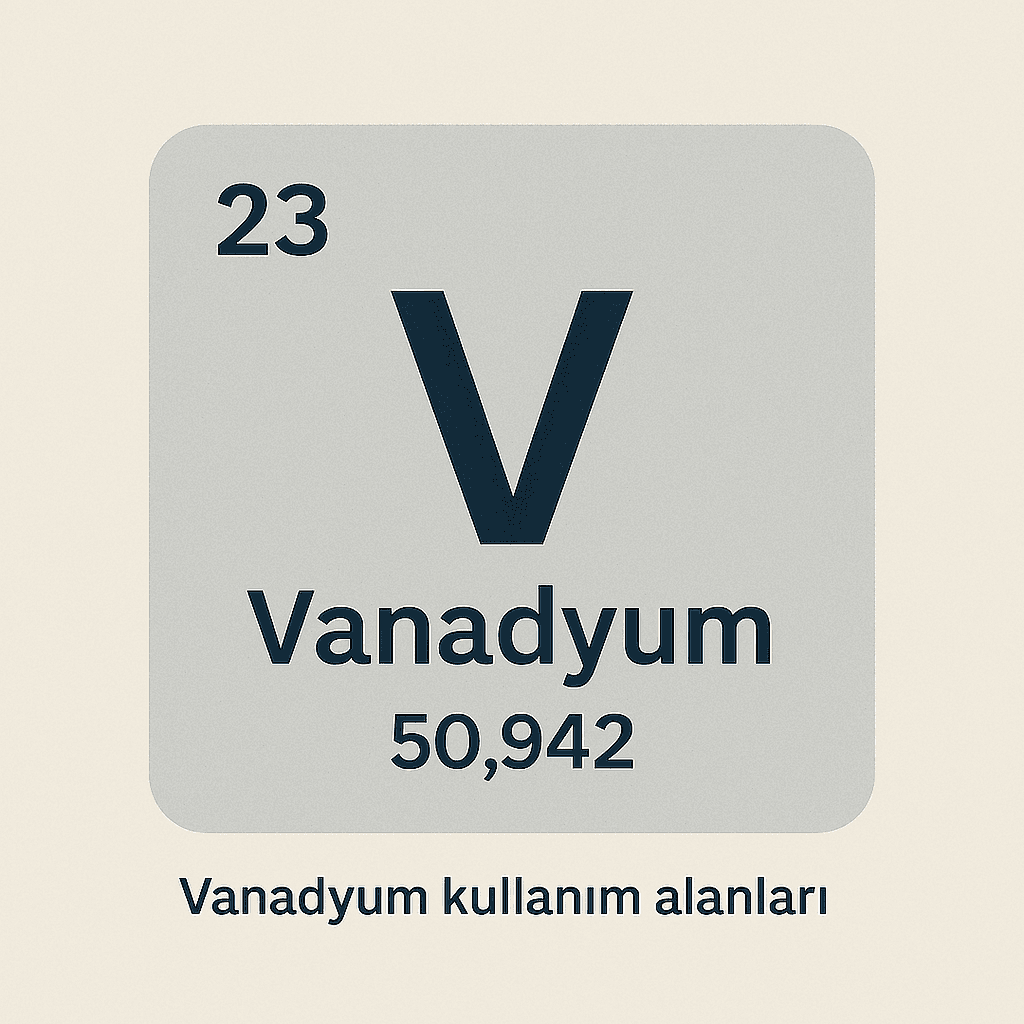
Vanadium (V) (Generated by Artificial Intelligence.)
Atomic Number | 23 | ||||||||
|---|---|---|---|---|---|---|---|---|---|
Atomic Mass | 50.9415 g/mol | ||||||||
Period/Group | 4 / 5 (Transition Metals) | ||||||||
Electron Configuration | [Ar] 3d³ 4s² | ||||||||
Crystal Structure | Body-Centered Cubic (BCC) | ||||||||
Melting Point | 1910 °C | ||||||||
Boiling Point | 3407 °C | ||||||||
Electronegativity (Pauling) | 1.63 | ||||||||
Natural Isotopes | ⁵¹V (Stable) ⁵⁰V (Radioactive) | ||||||||
Vanadium is a chemical element with atomic number 23 located in the transition metals group of the periodic table. This element is typically found in nature in compound form and plays various roles in both industrial and biological systems. The physical and chemical properties of vanadium make it significant across a wide range of applications from alloy technologies to biochemical processes.
Vanadium was first discovered in 1801 by Mexican mineralogist Andrés Manuel del Río. Although del Río claimed to have found a new element, his discovery was not accepted by the scientific community of the time. In 1830, Swedish chemist Nils Gabriel Sefström rediscovered vanadium and named the element. Sefström isolated vanadium from iron ores and named it after Vanadis, the Norse goddess of beauty in Scandinavian mythology.
Vanadium is a transition metal located in the fourth period and fifth group of the periodic table. With an atomic number of 23, it resides in the d-block and has the electron configuration [Ar] 3d³ 4s². This structure enables vanadium to exhibit multiple oxidation states and form a variety of complex compounds. Vanadium has an atomic mass of 50.9415 g/mol and exists as a solid under standard conditions. It possesses a metallic luster and is both malleable and ductile. Its classification as a transition metal is significant for its mechanical strength and chemical versatility. These properties are among the main reasons vanadium is preferred in alloy technologies.
At room temperature, vanadium has a body-centered cubic (BCC) crystal structure. This structure supports the metal’s mechanical strength and resistance to high temperatures. Magnetically, vanadium is paramagnetic; that is, it is weakly attracted to an external magnetic field but loses this property when the field is removed. This characteristic enables the evaluation of vanadium compounds in electronic and magnetic applications.
Vanadium is a silvery-gray, malleable, and ductile metal. Its melting point is 1910 °C and its boiling point is 3407 °C. Due to its high-temperature resistance, it is particularly favored in high-performance alloys. Chemically, vanadium exhibits multiple oxidation states and can form compounds with oxidation states of +2, +3, +4, and +5. These multiple oxidation states enable vanadium to be used in catalytic and redox reactions.
The Pauling electronegativity value of vanadium is approximately 1.63, indicating it is a metal with moderate electronegativity. Its reactivity is limited at low temperatures; however, at high temperatures it reacts with oxygen, halogens, and some acids to form various vanadium compounds. Vanadium pentoxide (V₂O₅) is particularly known as a strong oxidizing agent.
Vanadium has two naturally occurring isotopes:
The isotope ⁵¹V has properties suitable for use in nuclear magnetic resonance (NMR) studies.
Vanadium does not occur in nature in its free state; it is typically found in minerals such as vanadinite (Pb₅(VO₄)₃Cl), patronite (VS₄), and carnotite (K₂(UO₂)₂(VO₄)₂·3H₂O). It can also be present in trace amounts in fossil fuels such as petroleum and coal. Among vanadium compounds, vanadium pentoxide (V₂O₅) is the most common; it is used both as a catalyst and in pigment production.
Vanadium is considered a trace element for some living organisms. In particular, vanadium-containing enzymes have been identified in marine organisms. In the human body, the biological role of vanadium is not yet fully understood; however, some studies suggest it may exhibit insulin-like effects and influence glucose metabolism. At high doses, it can show toxic effects; therefore, its biological use must be carefully evaluated.

Applications of Vanadium Element (Generated by Artificial Intelligence.)
The most common application of vanadium is in metallurgy. In steel production, vanadium alloys are used to enhance strength and corrosion resistance. Vanadium pentoxide serves as a catalyst in the production of sulfuric acid. Vanadium compounds are also preferred in ceramic, glass, and pigment manufacturing. Additionally, vanadium is used in technological applications such as nickel-metal hydride batteries and vanadium redox flow batteries in certain energy storage systems.
National Center for Biotechnology Information. “Vanadium.” PubChem Compound Summary. Accessed August 16, 2025. https://pubchem.ncbi.nlm.nih.gov/compound/vanadium#section=Toxicological-Information
TÜBİTAK Bilim Genç. "Vanadyum." *Bilim Genç Periyodik Tablo*. Accessed August 16, 2025. https://bilimgenc.tubitak.gov.tr/periyodik-tablo/vanadyum
Çevik, Sabri. “Vanadyum.” *Afyon Kocatepe Üniversitesi Fen ve Mühendislik Bilimleri Dergisi* 14, no. 2 (2014): 9–18. Date Published August 1, 2014. Accessed August 16, 2025. https://dergipark.org.tr/tr/pub/akufemubid/issue/1611/20168

Vanadium (V) (Generated by Artificial Intelligence.)
Atomic Number | 23 | ||||||||
|---|---|---|---|---|---|---|---|---|---|
Atomic Mass | 50.9415 g/mol | ||||||||
Period/Group | 4 / 5 (Transition Metals) | ||||||||
Electron Configuration | [Ar] 3d³ 4s² | ||||||||
Crystal Structure | Body-Centered Cubic (BCC) | ||||||||
Melting Point | 1910 °C | ||||||||
Boiling Point | 3407 °C | ||||||||
Electronegativity (Pauling) | 1.63 | ||||||||
Natural Isotopes | ⁵¹V (Stable) ⁵⁰V (Radioactive) | ||||||||
Discovery
Classification and Fundamental Properties
Crystal Structure and Magnetic Properties
Physical and Chemical Properties
Electronegativity and Reactivity
Isotopes
Natural Occurrence and Compounds
Biological Role and Importance to Living Organisms
Applications