


This article was automatically translated from the original Turkish version.
The twelve-animal Turkish calendar is a traditional system of timekeeping based on the Turkic peoples’ concepts of nature, animals, and time, where each year is symbolized by one animal and consists of 12-year cycles (müçel). This system is not merely a calendar; it is also described as a worldview, mythology, prophetic tool, and a marker of personality.
Documentary film on the origin story of the 12-animal Turkish calendar (TRT2)
Expressions in the Orkhon Inscriptions indicate that this calendar was widely and influentially used during the Göktürk period:
“Kül Tigin died on the seventeenth day of the Sheep Year. We held the mourning ceremony on the twenty-seventh day of the ninth month. We completed his tomb, portrait, and stele on the twenty-seventh day of the seventh month of the Monkey Year.”
“After achieving such success, my father the khagan passed away on the twenty-sixth day of the tenth month of the Dog Year. I held the mourning ceremony on the twenty-seventh day of the fifth month of the Pig Year.”
The oldest known source discussing this calendar after the inscriptions is Kaşgarlı Mahmud’s “Divanü Lüğat-it-Türk”. Kaşgarlı Mahmud recounts a legend regarding its origin. According to the tale, a Turkic khagan asked which year a previous battle had taken place. The advisors could not recall the year. The khagan then ordered that each year be named after an animal. A hunting expedition was organized near the Ilisu River. The first twelve animals to cross the river after jumping into it had their names assigned to the years. Since the mouse was the first to leap into the water, the calendar begins with the Mouse Year.
A legend among the Kazakhs explains why the Mouse Year is the first and why the camel, a highly valued animal among Turkic tribes, is absent from this calendar:
“The livestock, which provides milk, meat, and hide, demands that the first year be named after itself. The horse says: ‘I give you what you get from it. Moreover, people ride on my back to travel long distances.’ The camel replies: ‘You are elegant, but my strength cannot be compared to yours. You could not even carry half the load I bear. Furthermore, you eat specially cut grass, oats, and barley, and drink spring water. I endure thirst, eat every kind of thorn and bush, my milk is delicious, and my meat and hide are beneficial.’
Then the sheep comes forward and says: ‘What would happen without me? How could any Kazakh make his tent, warm fur, or clothing without my wool? Is there any meat more delicious than my fatty mutton? I also give people milk and cheese.’ It demands that the first year be named the Sheep Year. The dog arrives and says: ‘You are all talking in vain. Without me, wolves would have devoured you long ago,’ claiming the first year should bear its name. This debate continues until midnight, while only the mouse listens silently. Finally, the mouse says: ‘Stop arguing. Whoever sees the morning sun first shall have the first year named after them.’ The other animals, especially the camel, accept this proposal, relying on the camel’s long neck.
In the end, the mouse climbs onto the camel’s back and sees the sun first, thus the first year of the twelve-animal system becomes the Mouse Year.
This calendar is not only symbolic but also an astronomical system, constructed based on the movements of the Sun and Moon, constellations, and seasonal cycles. The Turkic people regarded the sky as a great dome rotating around the polar star. In this cosmological model, the number twelve played a central role—divisions into twelve constellations, twelve zodiac signs, twelve directions, and twelve cycles defined the calendar’s structure.
The twelve-animal Turkic calendar includes the following animals: mouse, ox (cow), tiger, rabbit, dragon, snake, horse, sheep, monkey, rooster, dog, pig place.
Mouse Year: Winters are long and cold. Due to heavy rainfall, grain and fruit are abundant. However, since mice destroy grain, it is believed that confusion and conflicts will arise among the people.
Years: 1900, 1912, 1924, 1936, 1948, 1960, 1972, 1984, 1996, 2008, 2020, 2032, 2044
Ox (Cow) Year: Winters are harsh and cold. Due to the ox’s natural tendency to fight, this year is marked by wars. Discord and confusion are widespread among the people. Diseases and deaths increase among both humans and animals.
Years: 1901, 1913, 1925, 1937, 1949, 1961, 1973, 1985, 1997, 2009, 2021, 2033, 2045
Tiger Year: Winters are short and cold, while summers are long and hot. Conflicts arise between nations and discord among the people. Food becomes scarce and earthquakes are frequent.
Years: 1902, 1914, 1926, 1938, 1950, 1962, 1974, 1986, 1998, 2010, 2022, 2034, 2046
Rabbit Year: Seasons proceed in order. Rainfall is abundant, resulting in prosperity. Fruits and vegetables are plentiful. Justice and peace prevail among the people.
Years: 1903, 1915, 1927, 1939, 1951, 1963, 1975, 1987, 1999, 2011, 2023, 2035, 2047
Dragon Year: Rainfall is heavy, bringing abundance and blessings. Snowfall is heavy in winter. Discord and confusion arise among the people.
Years: 1904, 1916, 1928, 1940, 1952, 1964, 1976, 1988, 2000, 2012, 2024, 2036, 2048
Snake Year: Winters are long and cold. Due to low rainfall, drought occurs. Grain and fruit yields are low, increasing famine. Diseases and death multiply. Discord, deceit, and confusion rise among the people.
Years: 1905, 1917, 1929, 1941, 1953, 1965, 1977, 1989, 2001, 2013, 2025, 2037, 2049
Horse Year: Winters are severe. Discord arises among the people. Diseases and deaths are common among four-legged animals.
Years: 1906, 1918, 1930, 1942, 1954, 1966, 1978, 1990, 2002, 2014, 2026, 2038, 2050
Sheep Year: Winters are mild. Due to abundant rainfall, there is no water shortage. Prosperity in fruit and grain occurs. Conflicts among the people are resolved through justice and peace.
Years: 1907, 1919, 1931, 1943, 1955, 1967, 1979, 1991, 2003, 2015, 2027, 2039, 2051
Monkey Year: Winters are short but extremely cold. Discord, deceit, and theft are widespread. Fruits are destroyed by natural disasters. Especially diseases spread among at and camel populations.
Years: 1908, 1920, 1932, 1944, 1956, 1968, 1980, 1992, 2004, 2016, 2028, 2040, 2052
Rooster Year: Winters are long. Food is abundant. Since roosters scatter their surroundings while searching for food, confusion arises among the people. Wars, earthquakes, and diseases are frequent this year.
Years: 1909, 1921, 1933, 1945, 1957, 1969, 1981, 1993, 2005, 2017, 2029, 2041, 2053
Dog Year: Winters are cold. Anxiety and confusion prevail among the people. Diseases and deaths increase among both humans and animals.
Years: 1910, 1922, 1934, 1946, 1958, 1970, 1982, 1994, 2006, 2018, 2030, 2042, 2054
Pig Year: Snowfall is heavy in winter. Hostility and hatred increase among the people. Diseases spread and multiply among humans and animals. Theft is also widespread this year.
Years: 1911, 1923, 1935, 1947, 1959, 1971, 1983, 1995, 2007, 2019, 2031, 2043, 2055
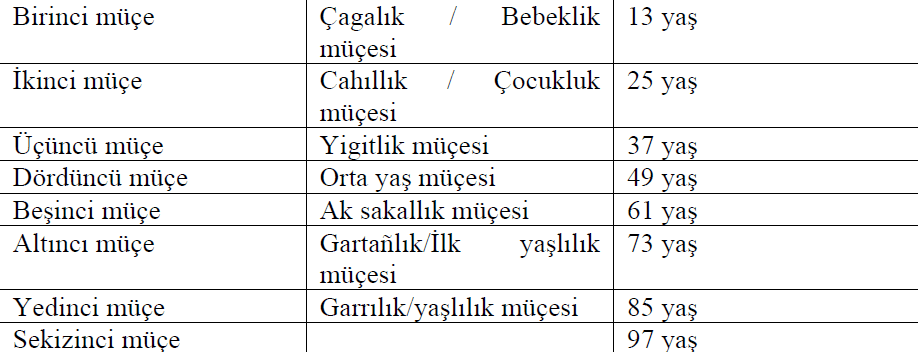
Each 12-year cycle is called “müçel”, “müşəl”, “müçöl”, or “müçə”. Each year is named after one animal, and this pattern repeats cyclically.
The day is divided into twelve parts, each called a “çağ”.
Months are named only by numerical order:
One social impact of the calendar is its use in age calculation. Human lifespan is measured as follows:
The twelve-animal Turkic calendar was used among various Turkic tribes in this day. Islamic-Turkic scholars referred to this twelve-year system as “Turkic history,” “Turkic history,” “Khitan history,” “Uyghur,” or “Sal-i Türkan,” meaning “Turkic year.” Among Turkic tribes, evidence of its use by the Göktürks appears in inscriptions. Examples include phrases from the Tonyukuk Inscription such as “He died on the seventeenth day of the Sheep Year.”
Uyghurs: In legal documents and wills, dates are indicated by the year’s animal name. This calendar was used not only to record dates but also to formalize legal procedures, arrange marriages, and document property transfers.
Golden Horde and Ilkhanate: In decrees, date ranges are given using this calendar. In books written during the Ilkhanate period (such as Jami' al-Tawarikh), year names are written in Turkish. This demonstrates that the Turkic calendar was valid not only among the general public but also in official state documents.
Nogais: The practice of dating using this calendar has continued among the Nogais for a long time. However, written examples of documents are rare. Information has been preserved primarily through oral tradition. Among the Nogais, the names of the twelve animals are: Şışkan (mouse), Sıyır (ox-black), Bars (tiger), Koyan (rabbit), Ulu~Balık (dragon/fish), Cılan (snake), Yılkı (horse), Village (sheep), Biçin (monkey), Chicken, İt (dog), Tonguz (pig).
Khakas: The Khakas call the calendar “pükül” (60-year cycle) and the 12-year subdivision “müçe.” Unlike other Turkic communities, they replace the Dragon Year with the Lizard Year and the Monkey Year with the Human Year. The twelve animals among the Khakas are: Küske çılı (Mouse Year), İnək çılı (Cow Year), Tülgü çılı (Fox Year), Hozan çılı (Rabbit Year), Kileski çılı (Lizard Year), Çılan çılı (Snake Year), Çılan çılı (Hırlıike) çılı (Sheep Year), Kizi çılı (Human Year), Tanah çılı (Rooster Year), Aday çılı (Dog Year), Soşa çılı (Pig Year).
In Khakas belief, the characteristics of the year of one’s birth influence the person’s nature.
The Khakas used this calendar for personality analysis, selecting marriage dates, and determining fortunate or unfortunate times.
Kazakhs refer to the 12-year cycle as “müşel.” They divide the animals of the calendar into two categories: “halal” and “haram.”
It is believed that years associated with haram things (such as the pig) bring disaster and famine. Kazakhs do not slaughter or kill the animal corresponding to their birth year. In a folk song among Altai Kazakhs, it is said: “I am twenty years old; my year is Meshin (monkey).”
Among Kazakhs, the “Sheep Year” is considered fertile, the “Tiger Year” is uncertain, and the “Mouse Year” is known for abundant grain.
Kyrgyz: They call the 12-year cycle “müçöl.” This appears in Kyrgyz folk poetry, lullabies, and the “Manas” epic. The names of the twelve animals in Kyrgyz are: Çıçkan (mouse), Uy (livestock), Bars (tiger), Koyon (rabbit), Uluu (dragon), Cılan (snake), Cılkı (horse), Koy (sheep), Meçin (monkey), Took (rooster), İt (dog), Donguz (pig).
In Kyrgyz lullabies, the müşel is noted as follows:
May your life be long
May your lullaby be beautiful
May your offspring multiply
May your kin be strong
Live seven “müçöl.”
Balcı, Mustafa. "Bilinmeyen Bir 12 Hayvanlı Takvim Risalesi: Takvîm-i Tatar Ma‘a-Acem." Türkbilig 20 (2010): 85–96.
Biray, Nergis. "12 Hayvanlı Türk Takvimi: Zamana ve İnsana Hükmetmek." Atatürk Üniversitesi Türkiyat Araştırmaları Enstitüsü Dergisi 39 (2009): 671–682.
Ergin, Muharrem. Orhun Abideleri. Hisar Yayınları, 2003.
Karimova, Gülmira, and Fikret Türkmen. "Kazakistan’da Hayvan Kültü ve 12 Hayvanlı Halk Takvimi." Folklor/Edebiyat Dergisi, no. 1 (2022): 41–47.
Külcü, Recep. "Türklerin Kültür Mirası Olarak ‘12 Hayvanlı Türk Takvimi.’" Akademia Disiplinlerarası Bilimsel Araştırmalar Dergisi 1, no. 1 (2015): 1–5.
Tavkul, Ufuk. "Kültürel Etkileşim Açısından On İki Hayvanlı Türk Takviminin Yayılışı." Modern Türklük Araştırmaları Dergisi 4, no. 1 (March 2007): 25–45.
Turan, Osman. (2019). On İki Hayvanlı Türk Takvimi. İstanbul: Ötüken. 101-106.

No Discussion Added Yet
Start discussion for "12 Animal Turkish Calendar" article
Origin
Animals of the Calendar and Their Meanings
Structure and Use of the Calendar
Geographical and Cultural Distribution of the Calendar