


This article was automatically translated from the original Turkish version.
1906 San Francisco Earthquake
History | April 18, 1906 | ||||||||
|---|---|---|---|---|---|---|---|---|---|
Time | 05:13 (local time) | ||||||||
Location | California San Francisco USA | ||||||||
Earthquake Magnitude | 7.8 | ||||||||
Number of Deaths | 3,000+ (official and estimated total) | ||||||||
Number of Injuries | 750 seriously injured (according to first-day data) | ||||||||
Material Damage | Approximately $500 million (in 1906 value) | ||||||||
The 1906 San Francisco Earthquake was a devastating earthquake that occurred on April 18, 1906, in and around the city of San Francisco, California. It is regarded as one of the most significant natural disasters in the modern history of the United States due to both its seismic effects and the destruction it caused. This event, which took place along the San Andreas Fault, led not only to extensive structural damage but also to widespread fires. Research conducted after the earthquake on the region’s geological structures, seismic sources, and ground movements became a pivotal turning point in the development of modern seismology.
The San Francisco earthquake occurred along the San Andreas Fault, which lies between the Pacific and North American tectonic plates and exhibits a horizontal slip movement of approximately 4 to 6 centimeters per year. During the 1906 earthquake, this slip exceeded six meters in some areas. Surface displacements measured around Point Reyes and Tomales Bay have been documented through geodetic studies.
The San Andreas Fault is a transform fault that extends along the California coast. During the earthquake, the surface rupture formed a discontinuity approximately 480 kilometers long. This directly ruptured segment released the majority of the seismic energy.
The magnitude of the 1906 San Francisco Earthquake varies slightly across sources, but the generally accepted moment magnitude is Mw 7.8. The earthquake’s focal depth is estimated at approximately 8 kilometers. It occurred at 05:12 in the morning and lasted about 42 seconds.
The intensity of the earthquake ranged from IX to XI on the Modified Mercalli Intensity Scale, with severe destruction concentrated in the city center and surrounding areas. USGS ShakeMap data indicate that the shaking was felt over a wide area, extending as far north as the Oregon border and as far south as near Los Angeles.

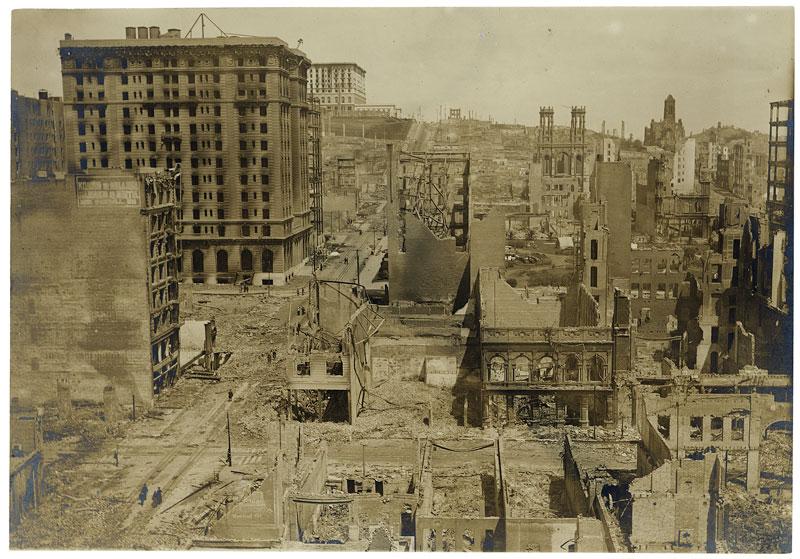
Aerial view of the ruins after the earthquake - George R. Lawrence
In the South-of-Market district, the mixing of underground water with the soil caused tin-roofed buildings to collapse, resulting in hundreds of deaths under the rubble. The fires that followed burned for four days. According to contemporary estimates, the material damage was approximately $500 million.
San Francisco’s fire chief, Dennis T. Sullivan, was severely injured when the building he was in collapsed and later died. John Dougherty assumed responsibility for firefighting efforts. All communication lines were severed and telecommunications collapsed. Army units were deployed from Fort Mason; between 7:00 and 11:00, various infantry and artillery units were assigned to maintain order in the city. Aftershocks continued throughout the day, and a strong aftershock at 08:14 caused further collapse of damaged buildings.
For the first time in a natural disaster, wireless telegraphy was used; disaster information was transmitted from a station in San Diego to the U.S.S. Chicago, a warship. Large fires broke out across the city; the fire known as the “Ham and Egg Fire” destroyed structures such as Western Addition, Mechanics’ Pavilion, and City Hall. By evening, with no space left in Portsmouth Square, dozens of corpses were buried. Orders were given to military and police units to shoot looters.
At dawn, the St. Francis Hotel in Union Square was consumed by flames. The Chronicle, Call, and Examiner newspapers began joint printing operations in Oakland. The U.S.S. Chicago, anchored in San Francisco Bay, arrived by evening. In the evening, houses along Van Ness Avenue were dynamited in an attempt to halt the spread of the fire.
The fire reached Franklin Street, triggering a mass evacuation of 20,000 people. This remains one of the largest civilian evacuations by sea in American history. Lt. Col. George Torney was appointed the sole authority responsible for public health in the city.
The fire was contained in the Mission District after the intervention of three thousand volunteers. Fire Chief Dennis T. Sullivan died on April 22 in a military hospital where he was receiving treatment. On the same day, newspaper statements emphasized the need to reassure the public that another major earthquake was unlikely.
California Governor Pardee announced that “the reconstruction of San Francisco has begun.” Empress Cixi of China offered a donation of 100,000 taels; President Theodore Roosevelt rejected this and similar foreign aid offers for diplomatic reasons.

San Francisco after the earthquake - George R. Lawrence
Thousands of buildings were destroyed directly by the earthquake, but the primary destruction was caused by the three-day fire that followed. These fires destroyed approximately three-quarters of the city and led to the loss of about 28,000 buildings. Official figures indicate that nearly 3,000 people lost their lives and more than 225,000 were left homeless.
Infrastructure suffered extensive damage; ruptured gas lines and broken water pipes hampered firefighting efforts. The city’s reconstruction took years and led to reforms in earthquake management and building safety across the United States.
The 1906 earthquake served as a landmark event in the development of modern seismology. Following the earthquake, horizontal movements in the Earth’s crust were meticulously analyzed using geodetic measurements. Triangulation and leveling surveys revealed the regional distribution of surface deformation, providing new data on fault movements and stress accumulation.
A study published by TÜBİTAK emphasizes that the mechanism responsible for the 1906 earthquake cannot be explained by reverse faulting but is primarily the product of a right-lateral transform fault. Stanford University modeling studies conducted after the earthquake demonstrated that the rupture could be better explained by a composite source model rather than a single segment.
Additionally, analysis of a 1906 photograph led to new assessments of the earthquake’s epicenter and enabled a more accurate modeling of the spatial distribution of surface deformation.
BBC Türkçe. "San Francisco Depremi: 100 Yıl Sonra." Accessed April 17, 2025.Link
Geological Engineers Association. "1906 San Francisco Earthquake." Accessed April 17, 2025.Link
Geology Science. "San Andreas Fault, California, USA." Accessed April 17, 2025.Link
Gizmodo. "How Scientists Used a 1906 Photo to Find the Center of the Quake." Accessed April 17, 2025.Link
Harita Genel Müdürlüğü. “San Andreas Fay Hattı Boyunca Meydana Gelen Yatay Hareketlerin Tespiti İçin Yapılan Jeodezi Çalışmaları.” Accessed April 17, 2025.Link
Library of Congress. "George R. Lawrence." Panoramic Photographs: Selected Photographers and Examples of Their Work. Accessed April 17, 2025.Link
Stanford University. "A Unified Source Model for the 1906 San Francisco Earthquake." Accessed April 17, 2025.Link
TÜBİTAK Bilim ve Teknik Dergisi. "Kuzey Kaliforniya’da Depremsellik ve Faylanma." Accessed April 17, 2025.Link
U.S. Geological Survey (USGS). "Devastation – 1906 San Francisco Earthquake." Accessed April 17, 2025.Link
U.S. National Archives. San Francisco Earthquake and Fire: April 18, 1906. Accessed April 17, 2025.Link
USGS. “ShakeMap Macroseismic Data – 1906 Earthquake.” Accessed April 17, 2025.Link

1906 San Francisco Earthquake
History | April 18, 1906 | ||||||||
|---|---|---|---|---|---|---|---|---|---|
Time | 05:13 (local time) | ||||||||
Location | California San Francisco USA | ||||||||
Earthquake Magnitude | 7.8 | ||||||||
Number of Deaths | 3,000+ (official and estimated total) | ||||||||
Number of Injuries | 750 seriously injured (according to first-day data) | ||||||||
Material Damage | Approximately $500 million (in 1906 value) | ||||||||
No Discussion Added Yet
Start discussion for "1906 San Francisco Earthquake" article
Geological Background
Characteristics of the Earthquake
Events Following the Earthquake
April 18, 1906
April 19, 1906
April 20, 1906
April 21–22, 1906
April 23, 1906
Damage and Losses
Scientific and Technical Studies