
This article was automatically translated from the original Turkish version.
2026 Nobel Prize in Physics, awarded by the Royal Swedish Academy of Sciences on 6 October 2026 to Belgian physicist Francis Halzen. The prize was awarded to Halzen "for his decisive contributions to the IceCube Neutrino Observatory and the discovery of high-energy neutrinos of astrophysical origin". The entire prize (1/1) was awarded to Halzen. Halzen is a professor at the University of Wisconsin–Madison and the principal investigator of the IceCube Neutrino Observatory in Antarctica.【1】 【2】
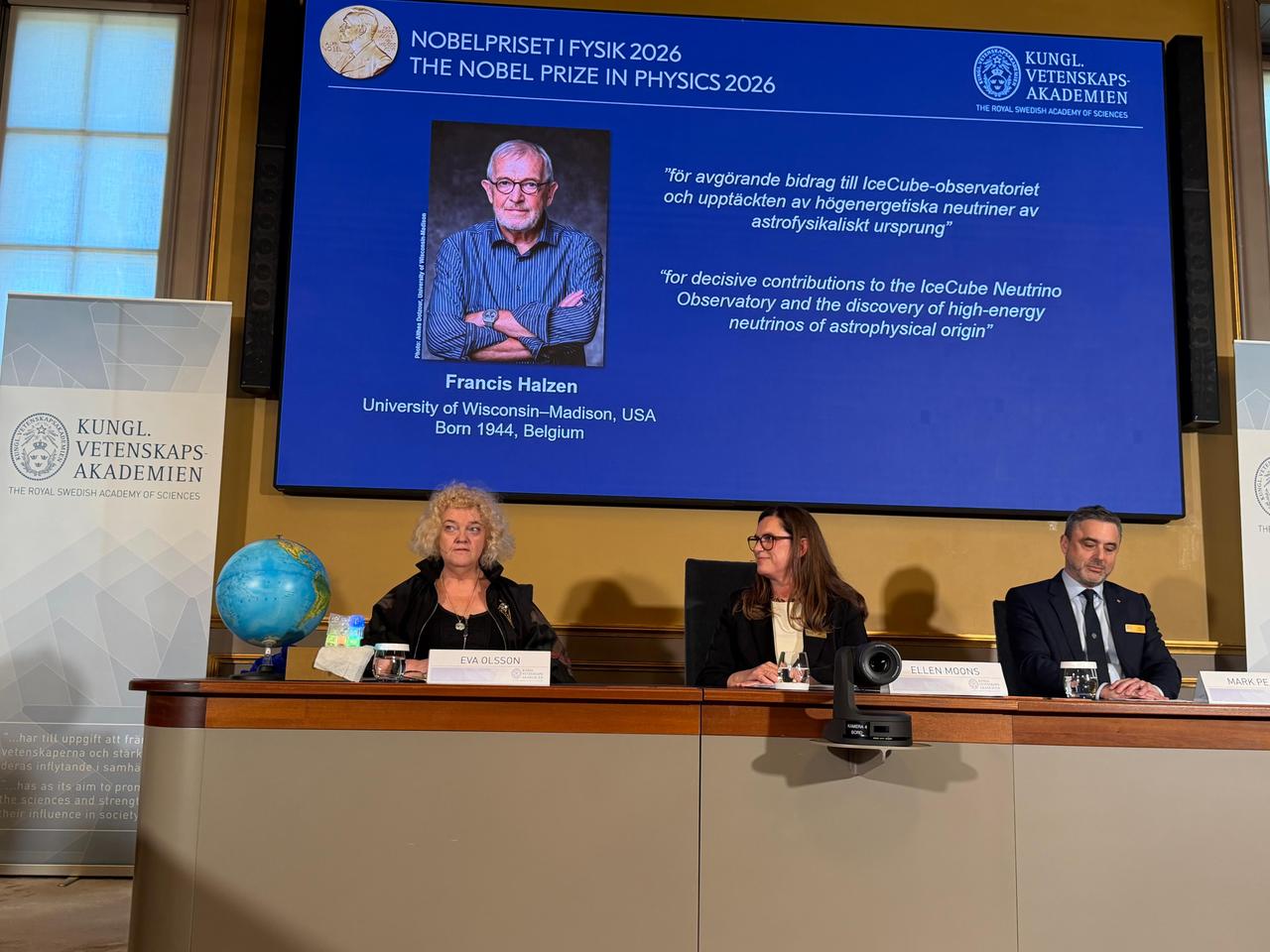
At a press conference held by the Royal Swedish Academy of Sciences, the recipient of the 2026 Nobel Prize in Physics is announced, 6 October 2026 - (Anadolu Agency)
The recipient of the 2026 Nobel Prize in Physics was announced on Tuesday, 6 October 2026, at a press conference held at the Royal Swedish Academy of Sciences in Stockholm. The prize was announced by the Academy’s General Secretary Ellen Moons. Moons is the first woman to lead the Academy and announce the prize.【3】
Following the press conference, a phone call from Halzen in Italy to the Nobel Committee for Physics was broadcast during the event.
The Royal Swedish Academy of Sciences’ press bulletin noted that Halzen recognized that the ice at the South Pole could be used to detect particles known as neutrinos. The bulletin stated that Halzen’s vision and scientific leadership were fundamental to the development of the one-cubic-kilometer IceCube Neutrino Observatory, equipped with light sensors.【4】 Through IceCube, researchers have been able to capture neutrinos from extremely high-energy processes in the distant universe.
Halzen was awarded the prize for his pioneering role in the development and operation of the IceCube Neutrino Observatory in Antarctica and his contributions to the discovery of high-energy neutrinos from astrophysical sources. The Academy emphasized that Halzen’s leadership opened the way for "a new kind of astronomy" in understanding the universe.【5】
Neutrinos are cosmic particles that have no electric charge and an extremely small mass. Because of these properties, they are difficult to detect. Neutrinos are present everywhere in the universe; they are emitted by stars such as the Sun, and trillions pass through the human body every second. Neutrinos are among the least understood of the 17 fundamental particles known to exist, and they pass through matter almost as if they were not there.【6】
Neutrinos arriving from distant regions of the cosmos are referred to as "ghost particles". With nearly no mass and no electric charge, neutrinos can pass through the densest environments—such as stars, planets, and galaxies—without being altered. Billions of neutrinos originate from the Sun; those from other regions of space are far rarer and harder to detect.【7】
Neutrinos pass undetected through the Earth and the human body. Very rarely, a single neutrino interacts with an atomic nucleus, making it possible for detectors with appropriate equipment to observe them. Scientists cannot observe neutrinos directly; instead, they measure the flashes of light or charged particles produced when neutrinos collide with other matter.
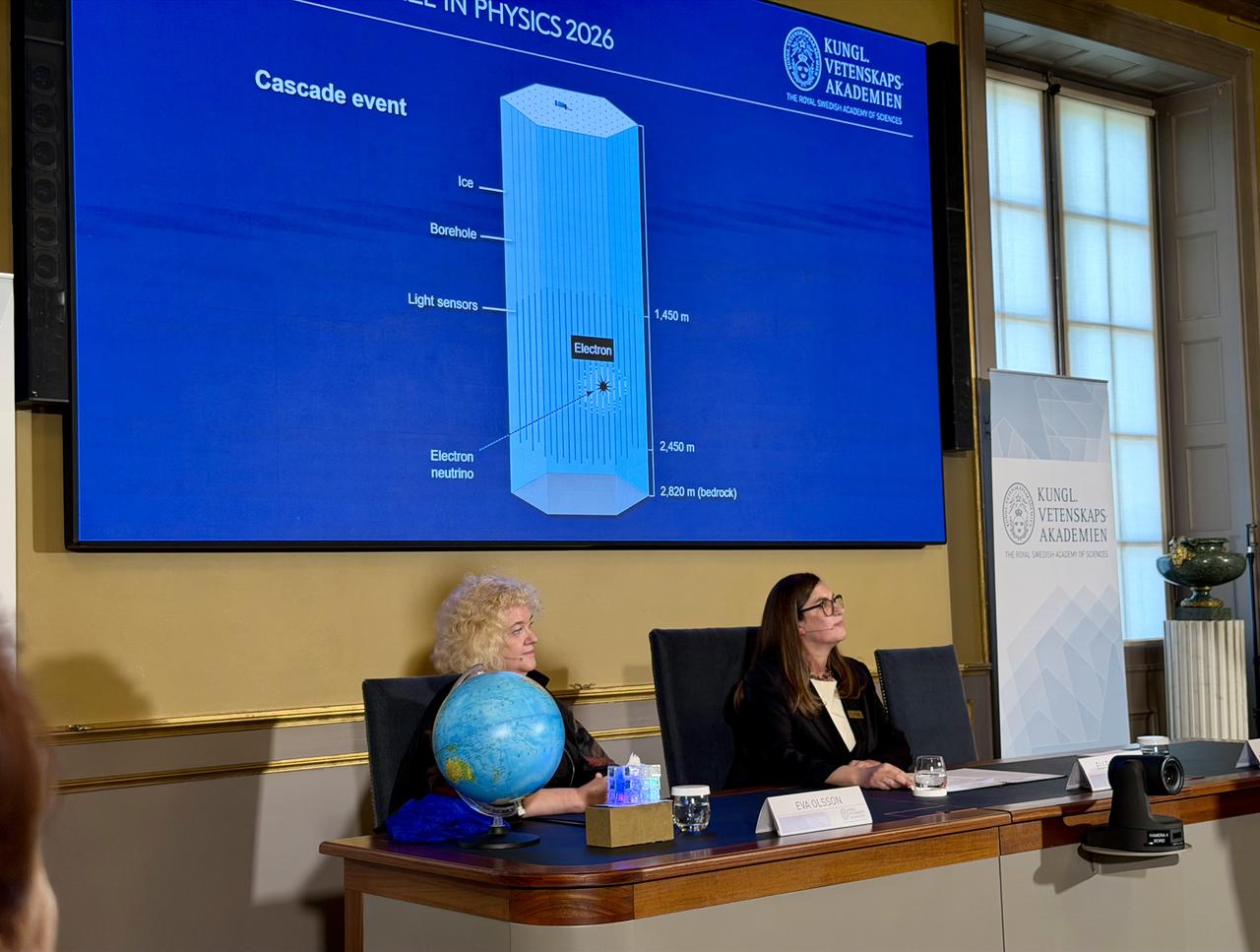
At a press conference held by the Royal Swedish Academy of Sciences, the recipient of the 2026 Nobel Prize in Physics is announced, 6 October 2026 - (Anadolu Agency)
It has long been known that natural particle accelerators in the cosmos can produce particles with energies up to a million times higher than those achievable in Earth-based laboratories. Many questions remain unanswered regarding what these sources are, where they are located, and what fundamental processes occur within them.【8】
Extremely high-energy neutrinos are produced in the same environments as other particle types. However, unlike other particles, neutrinos reach Earth without changing direction or losing energy. As a result, neutrinos can provide information unobtainable by any other means. The Academy’s statement emphasized that neutrinos travel to Earth without being deflected by dust clouds or magnetic fields.
The rare group of neutrinos studied by Halzen is recognized by researchers as particles that offer clues about how the universe evolved.【9】
In the 1980s, Halzen realized that Antarctic ice could be ideal for capturing neutrinos. However, placing sensitive equipment deep within the ice required an extensive effort involving researchers drilling kilometers-deep holes and lowering arrays of light sensors into them.
Halzen first presented his vision of detecting neutrinos at the South Pole in 1988. When a neutrino collides with an atomic nucleus, it produces a flash of light detectable by sensors embedded in clear glacial ice. The ice at the South Pole has advantages including minimal interference from other types of radiation and geological stability with no earthquakes. Halzen’s idea quickly gained support from other researchers, and within a few years preliminary tests were conducted with sensors embedded in the ice.【10】
Halzen began working on the AMANDA neutrino telescope at the South Pole in 1987, which is considered the precursor to IceCube. These efforts laid the foundation for the eventual construction of IceCube. AMANDA was completed in 2000, but it failed to detect the high-energy neutrinos Halzen sought. Work then began on IceCube.
Because cosmic high-energy neutrinos are extremely rare, a very large volume of ice is required to observe sufficient collisions. IceCube covers a one-cubic-kilometer area and was completed in 2011. Upon reaching full scale in 2011, the observatory consisted of 5,160 light sensors distributed across 86 cables.【11】
The observatory was constructed by using hot water jets to drill deep holes through a cubic kilometer of Antarctic ice and carefully lowering long sensor arrays into these holes. IceCube is the largest neutrino telescope in the world. It is also the first gigaton neutrino detector ever built and was designed primarily to observe neutrinos from the most violent astrophysical sources in the universe. The observatory became operational in 2010.【12】
The observatory is operated by the University of Wisconsin–Madison in the United States, where Halzen is based.
IceCube consists of specialized sensor arrays distributed in clear ice approximately one mile below the Antarctic surface. A high-energy neutrino from the center of a distant galaxy typically passes through this ice layer without interaction. However, occasionally a neutrino collides with an atom in the ice, producing a flash of light detected by the sensors. The sensors use this light to reconstruct the neutrino’s energy and direction of origin.【13】
By determining the path of the light, researchers can calculate the direction from which the neutrino came, thereby gaining information about the distant cosmic events that produced it.【14】 Unlike most telescopes on Earth, IceCube observes the universe not through starlight but through neutrinos.
Shortly after IceCube’s completion, researchers detected their first high-energy neutrinos, and several years later they published the discovery of neutrinos originating from far beyond the Solar System. This milestone marked the beginning of systematic research into cosmic neutrino sources.
In 2013, the research team announced the first evidence supporting the detection of cosmic neutrinos, and several years later collected sufficient data to confirm the discovery. The observatory contributed to the first detection of high-energy neutrinos from other galaxies.【15】
IceCube’s work is associated with the field known as "multi-messenger astronomy", in which neutrino measurements are used together with data from traditional telescopes and gravitational wave detectors to locate and study distant cosmic events.
The press bulletin stated that the continuous collection of neutrino interactions by IceCube will provide researchers with new insights into the extreme environments where high-energy neutrinos are produced and may reveal previously unknown cosmic phenomena.【16】 The Nobel Committee stated that IceCube would elevate neutrino astronomy to a new level and provide information about cosmic events hidden behind dust clouds and black holes.【17】
A project to expand IceCube to monitor eight cubic kilometers of ice is planned. The Trump administration’s 2027 budget proposal anticipates halving IceCube’s funding.
Francis Halzen was born in Tienen, Belgium, in 1944. He received his doctorate in 1969 from KU Leuven in Belgium. Halzen earned his master’s degree from the same university in 1966. At the time of the award announcement, he was 82 years old.
Halzen has been affiliated with the University of Wisconsin–Madison since 1972. He conducts research in particle physics, astrophysics, and cosmology and serves as the principal investigator of the IceCube Neutrino Observatory.
Halzen holds the titles of Vilas Research Professor and Gregory Breit Professor at the University of Wisconsin–Madison. As a theoretical physicist, Halzen has been a pioneer in the development of cosmic ray physics and astroparticle physics since the 1970s. Throughout his career, he has served as a visiting professor or scientist at various international universities and has received numerous awards for his research.【18】
Belgian Prime Minister Bart De Wever noted in a social media post that Halzen is the 11th Belgian to win a Nobel Prize.
After the prize announcement, Halzen, speaking by phone from Italy during the Nobel press conference, said: "It was a huge surprise and frankly I did not expect it." Halzen noted that while he had anticipated winning the prize, the announcement still felt "strange." He also added: "I am working on a proposal and hope this award helps its approval."
Halzen stated during the press conference: "Hearing about this award is a great joy. I hope it also reflects on the truly courageous people who joined me at the beginning of this project." Expressing that winning the prize was a "huge surprise" and a "joy," he continued: "When we started this project, everyone knew it might be a good idea, but very few of us—including myself—thought it would actually work. So it was a kind of adventure with no guarantee of success."
Mark Pearce, Chairman of the Nobel Committee for Physics, made the following statement: "Francis Halzen has led an international team of researchers and engineers who provided us with an extraordinary instrument. His determination and scientific vision have opened the way for a new kind of astronomy."
Nobel Committee member Eva Olsson noted during the press conference that Halzen realized "the ice at the South Pole could be used to visualize these neutrino messengers from the cosmos." Olsson said: "People joined him in the search for these neutrino messengers." She added that neutrinos "have opened a door to distant galaxies and tell us about the processes of exploding stars."[6] Olsson emphasized that these small, high-energy particles from space carry information that helps scientists better understand distant galaxies and exploding stars.
The Nobel Committee stated that Halzen’s work was decisive in the construction of the IceCube Neutrino Observatory, designed to transform ice into a neutrino detector.【19】
Belgian Prime Minister Bart De Wever described the prize as "an impressive tribute to a lifetime devoted to shedding light on the universe’s greatest mysteries through its smallest components."
Michael H. Moloney, President of the American Institute of Physics, said: "This is incredibly exciting. It is a timely and important recognition of Dr. Halzen’s extraordinary work in opening a completely new window on the universe."
Jonathan Bagger, theoretical physicist and President of the American Physical Society, said: "People did not know whether extragalactic sources would be bright enough to detect, so this was a risk. Halzen analyzed the issue, wrote proposals, and submitted them for peer review; this ultimately proved that the system worked."
Richard Fitzgerald, Editor-in-Chief of Physics Today, published by the American Institute of Physics, stated: "It has been a long time since the Nobel Prize was awarded to a single individual, and this highlights the uniqueness of his vision. Building it required a team of hundreds, but it all began with one person."
The monetary award for the 2026 Nobel Prize in Physics is 12 million Swedish kronor, equivalent to approximately 1.2 million US dollars. The prize amount is the same regardless of whether it is awarded to one person, a small group, or an institution. In addition to the monetary award, Nobel laureates receive a diploma and a medal.
The prize is scheduled to be presented to the recipient at a ceremony in Stockholm on 10 December, the anniversary of Alfred Nobel’s death.
First awarded in 1901, the Nobel Prize in Physics had been awarded 119 times to a total of 229 individuals prior to 2026. Previous laureates include Marie Curie, who won in 1903 for her work on radioactivity; Albert Einstein, who won in 1921 for his discovery concerning the photoelectric effect; I. I. Rabi, who won in 1944 for laying the scientific foundation for magnetic resonance imaging; and Frederick Reines, who won in 1995 for the discovery of low-energy neutrinos.【20】
The last time the Nobel Prize in Physics was awarded to a single individual before Halzen was in 1992, when it was awarded to French physicist Georges Charpak. The Nobel Prize in Physics was awarded in 2023 for the development of a tool to study electron motion, in 2024 for the development of fundamental techniques used in many modern artificial intelligence models, and in 2025 for the creation and study of quantum phenomena in macroscopic devices.【21】
The 2025 Nobel Prize in Physics was awarded to John Clarke, Michel Devoret, and John Martinis for the discovery of quantum mechanical tunneling in electrical circuits.【22】
Swedish inventor Alfred Nobel, in his will dated 1895, bequeathed the majority of his fortune to establish five prizes in physics, chemistry, physiology or medicine, literature, and peace. The will stipulated that the prizes be awarded to those who, during the preceding year, had conferred the greatest benefit to humankind. Physics is listed first in the will. The first prizes were awarded in 1901.
Following Nobel’s death, the Nobel Foundation was established on 29 June 1900. The Nobel Prizes are awarded by the Royal Swedish Academy of Sciences, the Swedish Academy, the Karolinska Institute, and the Norwegian Nobel Committee in the fields of physics, chemistry, literature, peace, and physiology or medicine.
The Nobel Memorial Prize in Economic Sciences was first awarded in 1969 following a decision by the Sveriges Riksbank in 1968 to establish an award in memory of Alfred Nobel. Officially named the Sveriges Riksbank Prize in Economic Sciences in Memory of Alfred Nobel, this prize is not one of the original Nobel Prizes.
Most years when no Nobel Prizes were awarded occurred during the First and Second World Wars. The award ceremonies were not held in 2020 and 2021 due to the COVID-19 pandemic.
Anadolu Ajansı. “2026 Nobel Fizik Ödülü'nü Astrofiziksel Kökenli Nötrinoların Keşfi Dolayısıyla Francis Halzen Kazandı.” Accessed October 6, 2026.https://www.aa.com.tr/tr/dunya/2026-nobel-fizik-odulunu-astrofiziksel-kokenli-notrinolarin-kesfi-dolayisiyla-francis-halzen-kazandi/4079612
CNN. “Nobel Prize In Physics Awarded To Francis Halzen For His Work Detecting ‘Ghostly’ Cosmic Particles.” Accessed October 6, 2026.https://edition.cnn.com/2026/10/06/science/nobel-prize-physics-francis-halzen-winner-intl
Forbes. “University Of Wisconsin Professor Wins The 2026 Nobel Prize In Physics.” Accessed October 6, 2026.https://www.forbes.com/sites/michaeltnietzel/2026/10/06/university-of-wisconsin-professor-wins-the-2026-nobel-prize-in-physics/
Nobel Prize. "Nobel Prize In Physics 2026." Accessed October 6, 2026.https://www.nobelprize.org/prizes/physics/2026/summary/
Nobel Prize. "Press Release." Nobel Prize. Accessed October 6, 2026.https://www.nobelprize.org/prizes/physics/2026/press-release/
PBS NewsHour. “WATCH: Nobel Prize In Physics Awarded To Francis Halzen For Demystifying Neutrinos.” PBS NewsHour. Accessed October 6, 2026.https://www.pbs.org/newshour/science/watch-live-winner-of-the-2026-nobel-prize-in-physics-is
Scientific American. “2026 Nobel Prize In Physics Awarded To Francis Halzen, Pioneer Of High-Energy Neutrinos.” Accessed October 6, 2026.https://www.scientificamerican.com/article/2026-nobel-prize-in-physics-awarded-to-francis-halzen-for-discovery-of-high-energy-neutrinos/
[1]
Nobel Prize, "Nobel Prize in Physics 2026", Nobel Prize, Accessed October 6, 2026,https://www.nobelprize.org/prizes/physics/2026/summary/
[2]
Scientific American. "2026 Nobel Prize in Physics Awarded to Francis Halzen, Pioneer of High-Energy Neutrinos." Accessed October 6, 2026.
[3]
PBS NewsHour, "WATCH: Nobel Prize in Physics Awarded to Francis Halzen for Demystifying Neutrinos", PBS NewsHour, Accessed October 6, 2026.
[4]
Nobel Prize. "Nobel Prize in Physics 2026." Nobel Prize, Accessed October 6, 2026.
[5]
Anadolu Ajansı. “2026 Nobel Fizik Ödülü'nü Astrofiziksel Kökenli Nötrinoların Keşfi Dolayısıyla Francis Halzen Kazandı.” Accessed October 6, 2026.
[6]
Scientific American, “2026 Nobel Prize in Physics Awarded to Francis Halzen, Pioneer of High-Energy Neutrinos”
[7]
CNN. "Nobel Prize in Physics Awarded to Francis Halzen for His Work Detecting ‘Ghostly’ Cosmic Particles." CNN, Accessed October 6, 2026.
[8]
Nobel Prize. "Press Release." Nobel Prize, Accessed October 6, 2026.
[9]
PBS NewsHour, “WATCH: Nobel Prize in Physics Awarded to Francis Halzen for Demystifying Neutrinos”
[10]
Nobel Prize, "Press Release"
[11]
CNN, “Nobel Prize in Physics Awarded to Francis Halzen for His Work Detecting ‘Ghostly’ Cosmic Particles”
[12]
Scientific American, “2026 Nobel Prize in Physics Awarded to Francis Halzen, Pioneer of High-Energy Neutrinos”
[13]
Scientific American, “2026 Nobel Prize in Physics Awarded to Francis Halzen, Pioneer of High-Energy Neutrinos”
[14]
Anadolu Ajansı, “2026 Nobel Fizik Ödülü'nü Astrofiziksel Kökenli Nötrinoların Keşfi Dolayısıyla Francis Halzen Kazandı”
[15]
PBS NewsHour, “WATCH: Nobel Prize in Physics Awarded to Francis Halzen for Demystifying Neutrinos”
[16]
Nobel Prize, "Press Release"
[17]
CNN, “Nobel Prize in Physics Awarded to Francis Halzen for His Work Detecting ‘Ghostly’ Cosmic Particles”
[18]
Forbes. "University Of Wisconsin Professor Wins The 2026 Nobel Prize In Physics." Accessed October 6, 2026.https://www.forbes.com/sites/michaeltnietzel/2026/10/06/university-of-wisconsin-professor-wins-the-2026-nobel-prize-in-physics/
[19]
PBS NewsHour, “WATCH: Nobel Prize in Physics Awarded to Francis Halzen for Demystifying Neutrinos”
[20]
Scientific American, “2026 Nobel Prize in Physics Awarded to Francis Halzen, Pioneer of High-Energy Neutrinos”
[21]
Scientific American, “2026 Nobel Prize in Physics Awarded to Francis Halzen, Pioneer of High-Energy Neutrinos”
[22]
CNN, “Nobel Prize in Physics Awarded to Francis Halzen for His Work Detecting ‘Ghostly’ Cosmic Particles”


No Discussion Added Yet
Start discussion for "2026 Nobel Prize in Physics" article
Announcement of the Prize
Motivation for the Prize
Neutrinos
Basic Properties
High-Energy Cosmic Neutrinos
IceCube Neutrino Observatory
Origins of the Project
AMANDA Telescope
Structure and Construction
Detection Method
Discoveries
Expansion Plans and Funding
Francis Halzen
Life and Education
Academic Career
Halzen’s Statements
Statements from the Nobel Committee and the Academy
Reactions
Prize Amount and Ceremony
History of the Nobel Prize in Physics
About the Nobel Prizes