
 Recently Added:
This article was automatically translated from the original Turkish version.
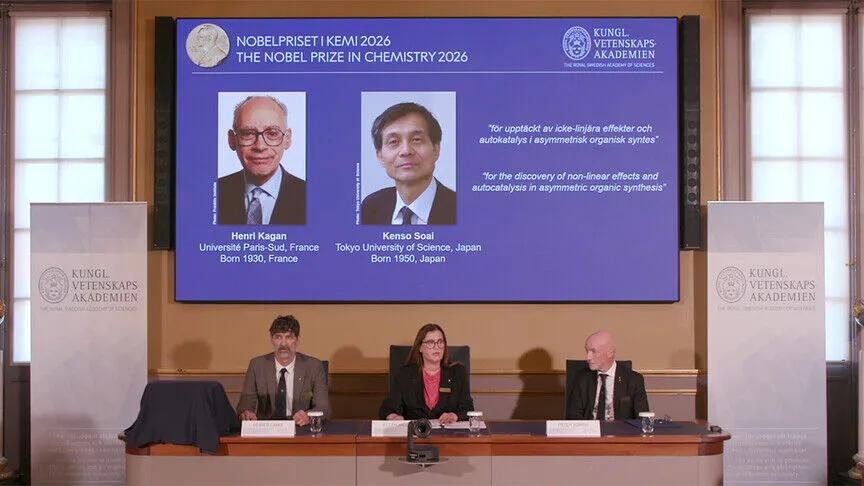
The 2026 Nobel Prize in Chemistry has been awarded to French chemist Henri B. Kagan and Japanese scientist Kenso Soai for their discoveries concerning nonlinear effects and autocatalysis in asymmetric organic synthesis. The award, announced by the Royal Swedish Academy of Sciences on 7 October 2026, recognizes work that has contributed to understanding why molecules in living organisms adopt specific three-dimensional orientations.
The research of the two scientists has been regarded as a major advancement in explaining the phenomena of chirality and homochirality in chemistry.
Kagan and Soai’s work has revealed how one of two mirror-image molecules can become dominant during chemical reactions. Their discoveries are significant not only for research into the origins of life but also for the production of pharmaceuticals perfumes fragrances agricultural chemicals and advanced materials.
On 7 October 2026 the Royal Swedish Academy of Sciences announced at a press conference that the 2026 Nobel Prize in Chemistry had been awarded to Henri B. Kagan and Kenso Soai.
The Academy stated that the prize was awarded for the discovery of nonlinear effects and autocatalysis in asymmetric organic synthesis. French scientist Kagan demonstrated that a small molecular asymmetry in chemical reactions can lead to much larger asymmetry than expected. Japanese chemist Soai developed a chemical reaction in which a molecule accelerates its own production while simultaneously enhancing the dominance of a specific molecular orientation.
The Nobel Committee evaluated the work of both scientists as significant contributions toward solving a chemical problem that has been studied for over a century.
It was decided that the laureates would receive a monetary award totaling 12 million Swedish kronor.
Chirality refers to the property of a molecule that cannot be superimposed on its mirror image in three-dimensional space. Molecules with this property are called chiral and pairs of molecules that are mirror images of each other are known as enantiomers.
Chirality can be explained by the relationship between the human right and left hands. Although the right and left hands have the same basic structure they cannot be perfectly aligned on top of each other. Similarly some molecules consist of the same atoms and bonding arrangements but differ in their spatial orientation.
This difference can affect how molecules behave in biological systems. Since enzymes proteins and receptors in the human body have three-dimensional structures a molecule’s specific orientation determines whether it can interact with another molecule.
For example the amino acid alanine exists in two different forms: L-alanine and D-alanine. These two molecules have the same chemical composition but differ in their three-dimensional structure.
Homochirality refers to the phenomenon in which living systems prefer one chiral orientation for certain groups of molecules. Almost all amino acids that make up proteins in living organisms are in the L-form while the sugars in DNA and RNA are in the D-form.
However the fact that prebiotic chemical processes can produce nearly equal amounts of mirror-image molecules has posed a long-standing question for scientists.
This question focuses on how one of two molecular orientations that were initially present in similar proportions came to dominate almost entirely.
Henri B. Kagan and Kenso Soai’s research has shown that a small molecular asymmetry can be amplified through chemical reactions and under certain conditions one orientation can become dominant.
However it has not been definitively proven that these chemical processes actually occurred on Earth billions of years ago when life emerged. Therefore the question of why living organisms prefer L-amino acids and D-sugars has not been fully resolved.
Henri B. Kagan has contributed significantly to the development of asymmetric catalysis since the 1970s. Asymmetric synthesis encompasses chemical methods that produce one of two mirror-image molecules in higher quantities than the other.
Chiral catalysts used in this process can direct chemical reactions to favor the formation of a specific molecular orientation. In reactions without chiral catalysts two enantiomers may form in approximately equal 50 percent ratios. However with the use of an appropriate chiral catalyst these ratios can shift dramatically for example to 90 percent versus 10 percent. Kagan developed methods that use chiral catalysts to selectively produce a specific enantiomer.
Kagan’s work in 1986 was regarded as a major breakthrough in asymmetric catalysis. He demonstrated that a small chiral imbalance in a catalyst could lead to a much larger imbalance in the reaction products.
This phenomenon known as a nonlinear effect shows that a small initial difference in molecular orientation can grow disproportionately during a reaction. This discovery has contributed to the development of methods for obtaining specific molecular forms with higher purity.
Kagan’s research has become particularly important for asymmetric synthesis methods used in the production of pharmaceuticals fragrances flavors and new materials.
Kenso Soai has conducted research on autocatalytic processes that enable molecular asymmetry to amplify itself during chemical reactions.
Autocatalysis is defined as a chemical reaction in which the product accelerates its own formation. In this mechanism the product acts as a catalyst for its own production.
Soai combined autocatalytic mechanisms with chiral molecules to develop a reaction that promotes the formation of a specific enantiomer and amplifies small initial molecular differences.
In his 1995 publication Soai demonstrated that the chiral compound 5-pyrimidyl alkanol could catalyze its own formation. The study showed that in a system where one enantiomer initially had only a 2 percent excess the autocatalytic process increased this excess to 87 percent.
This result demonstrated that a small difference in molecular orientation can be significantly amplified during chemical reactions.
In his 2003 research Soai developed a reaction that produces nearly pure single enantiomers starting from achiral initial materials. The study showed that a tiny random chiral imbalance present at the start could be amplified through autocatalysis to yield a product that was 99.99 percent composed of a single enantiomer.
When the experiments were repeated sometimes one enantiomer became dominant and sometimes its mirror image. This indicated that which molecular orientation the reaction favored depended on the extremely small initial differences. The method known as the Soai reaction has been described by the Nobel Committee as one of the most striking experiments in chemistry.
The research of Kagan and Soai is crucial for controlling the three-dimensional structures of molecules in drug production. A drug’s molecular orientation can determine its effect in the human body as much as its chemical composition does.
One of two mirror-image molecules may have therapeutic effects while the other may be less effective inactive or even harmful.
Therefore in drug development it is not enough to produce only the correct chemical compound; it is also essential to selectively synthesize the desired enantiomer when needed.
Asymmetric synthesis methods contribute to drug development by enabling the production of specific molecular forms in higher yields.
One historical example illustrating the importance of chirality in drug development is the drug thalidomide used in the late 1950s to treat morning sickness during pregnancy.
It was later discovered that the drug caused severe developmental abnormalities in fetuses. Thousands of children worldwide were born with serious congenital defects including limb deficiencies.
Thalidomide was found to have two different forms that are mirror images of each other. One form was associated with sedative effects while the other was linked to harmful effects on embryonic development.
Subsequent research showed that the two molecular forms can interconvert in the human body. Therefore it was determined that using only one enantiomer would not make the drug safe. The thalidomide case is considered one of the most important examples demonstrating how differences in the three-dimensional structure of molecules can have profound biological consequences.
Research in asymmetric synthesis and autocatalysis is also important beyond the pharmaceutical industry. Controlled production of chiral molecules is used in the development of perfumes and fragrances. Since mirror-image molecules can have different odor properties enantiomer selectivity has become crucial in this field.
Similarly the three-dimensional structure of molecules affects their biological activity in agricultural chemicals. Research has also been noted for its scientific importance in advancing the production of advanced materials and developing new chemical synthesis methods.
Heiner Linke President of the Nobel Committee for Chemistry stated in his evaluation following the announcement of the 2026 Nobel Prize in Chemistry that the work of Kagan and Soai provided a solution to a chemical problem that has been studied for over a century.
Linke noted that the two scientists developed chemical mechanisms explaining how homochirality could arise spontaneously.
Nobel Committee member Peter Somfai stated that these research findings have become part of the fundamental scientific understanding of how chemistry works. Robert Mokaya President of the Royal Society of Chemistry in the United Kingdom also emphasized that the discoveries demonstrate how fundamental chemical research can contribute to solutions for societal challenges.
Henri B. Kagan is a French chemist born in France in 1930. He is known for his work in organic chemistry organometallic chemistry asymmetric synthesis and asymmetric catalysis. Kagan studied at the Sorbonne University in Paris and received his doctorate from the Collège de France in 1960.
Throughout his scientific career he has focused on developing chiral catalysts and enhancing enantioselectivity in chemical reactions.
He was among the pioneers who led the development of asymmetric catalysis in the 1970s.
In 1986 he demonstrated that small chiral imbalances in catalysts could lead to larger asymmetries in products. Kagan was awarded the 2026 Nobel Prize in Chemistry for his contributions in this field.
Kenso Soai is a Japanese organic chemist born in Hiroshima Japan in 1950. He graduated from the University of Tokyo and received his doctorate in 1979. His scientific work has focused particularly on organic synthesis chirality and autocatalytic chemical reactions.
In his 1995 publication he demonstrated that a chiral molecule could accelerate its own production and enhance molecular asymmetry. In 2003 he developed a chemical reaction in which extremely small initial chiral differences were amplified to yield nearly pure single enantiomers.
Soai received the 2026 Nobel Prize in Chemistry together with Henri B. Kagan for these discoveries.
The Nobel Prize in Chemistry is awarded as part of the Nobel Prizes established according to the will of Swedish inventor and industrialist Alfred Nobel. Following Nobel’s death the Nobel Foundation was established on 29 June 1900. The Nobel Prizes were first awarded in 1901.
The award in chemistry is determined by the Royal Swedish Academy of Sciences.
The Nobel Prizes were initially awarded in physics chemistry physiology or medicine literature and peace. The prize in economic sciences was established in 1968 following a decision by the Sveriges Riksbank and was first awarded in 1969.
The Nobel Prizes are presented to their recipients each year on 10 December the anniversary of Alfred Nobel’s death.
Anadolu Ajansı. "2026 Nobel Kimya Ödülü'nü Kagan ve Soai kazandı." Accessed October 8, 2026.https://www.aa.com.tr/tr/dunya/2026-nobel-kimya-odulunu-kagan-ve-soai-kazandi/4080850
BBC. "Chemistry Nobel awarded for solving mystery of life's asymmetry." Accessed October 8, 2026.https://www.bbc.com/news/articles/c6ly038jg0d4o
Bloomberg HT. “Nobel Kimya Ödülü Kagan ve Soai'ye verildi.” Accessed October 8, 2026.https://www.bloomberght.com/nobel-kimya-odulu-kagan-ve-soaiye-verildi-3790628
Deutsche Welle. “Nobel Kimya Ödülü Henri Kagan ve Kenso Soai'nin oldu.” Accessed October 8, 2026.https://www.dw.com/tr/nobel-kimya-ödülü-henri-kagan-ve-kenso-soainin-oldu/a-79577387
Euronews Türkçe. "Nobel Kimya Ödülü'nün ardındaki keşifler: Yaşamın sağ ve sol elleri var." Accessed October 8, 2026.https://tr.euronews.com/2026/10/07/nobel-kimya-odulunun-ardindaki-kesifler-yasamin-sag-ve-sol-elleri-var
TRT Haber. "2026 Nobel Kimya Ödülü sahiplerini buldu." Accessed October 8, 2026.https://www.trthaber.com/haber/dunya/2026-nobel-kimya-odulu-sahiplerini-buldu-959404.html
The Nobel Prize. "The Nobel Prize in Chemistry." Accessed October 8, 2026.https://www.nobelprize.org/prizes/chemistry/

The 2026 Nobel Prize in Chemistry was awarded to Henri B. Kagan and Kenso Soai. The French and Japanese scientists were recognized for their work on asymmetric synthesis and autocatalysis, which explained how the imbalance between right-handed and left-handed molecules arises.
No Discussion Added Yet
Start discussion for "2026 Nobel Prizes in Chemistry" article
October 8, 2026
Announcement of the 2026 Nobel Prize in Chemistry
October 8, 2026
Right and Left Orientations of Molecules
October 8, 2026
Homochirality and Research into the Origins of Life
October 8, 2026
Henri B. Kagan’s Work in Asymmetric Synthesis
October 8, 2026
Discovery of Nonlinear Effects in 1986
October 8, 2026
Kenso Soai’s Discovery of Autocatalysis
October 8, 2026
Research Published in 1995
October 8, 2026
Results Obtained in 2003
October 8, 2026
Importance of the Discoveries for the Pharmaceutical Industry
October 8, 2026
Thalidomide Tragedy and Biological Consequences of Molecular Asymmetry
October 8, 2026
Applications of the Discoveries in the Chemical Industry
October 8, 2026
Evaluation by the Nobel Committee for Chemistry
October 8, 2026
Who is Henri B. Kagan?
October 8, 2026
Who is Kenso Soai?
October 8, 2026
History of the Nobel Prize in Chemistry