

This article was automatically translated from the original Turkish version.
+1 More
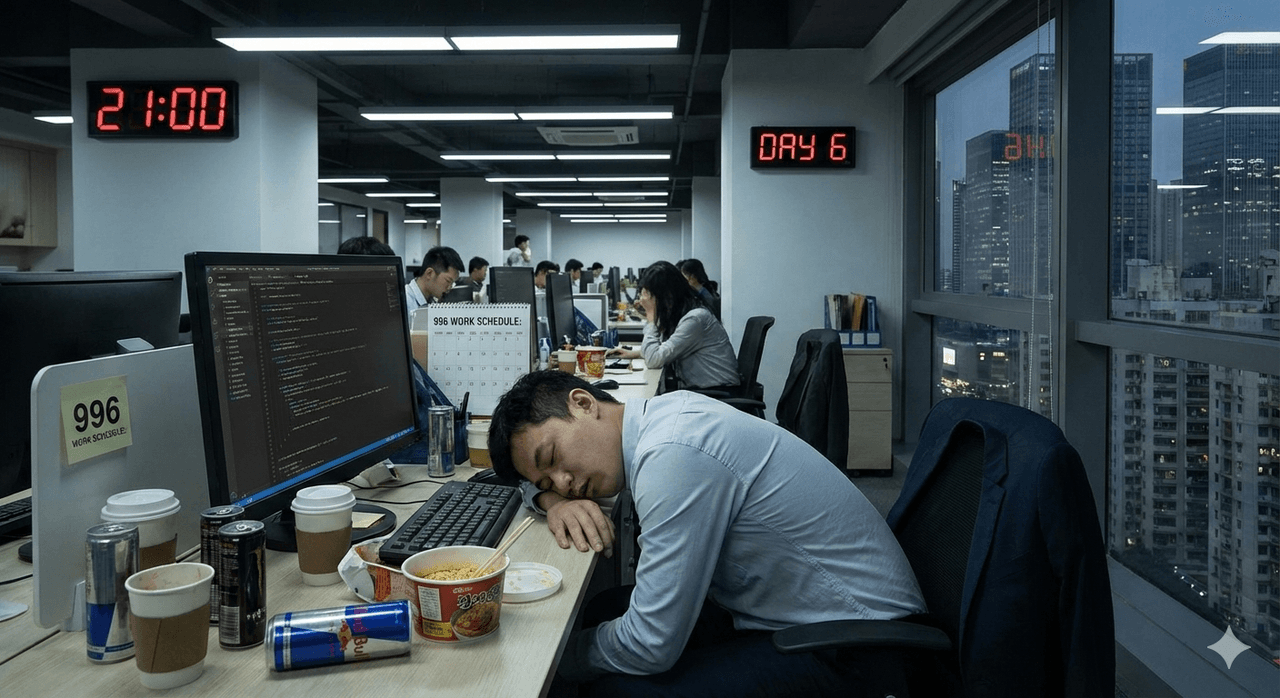
996 Work Culture (Generated with Artificial Intelligence.)
Official Name(s) | 996 Work Culture | ||||||||
|---|---|---|---|---|---|---|---|---|---|
Origin(s) | People's Republic of China | ||||||||
Meaning(s) | Work schedule from 09:00 AM to 09:00 PM six days a week | ||||||||
Legal Status (China) | Illegal | ||||||||
Social Risks | Deaths at young age, burnout syndrome, demographic injustice | ||||||||
Protest Movement | 996.ICU | ||||||||
Key Criticisms | Health problems, loss of work-life balance, end of family life, low productivity | ||||||||
Reason for Advocacy | Necessity of 'sacrifice' for economic growth, global competitiveness, and individual success | ||||||||
Prominent Advocates | Jack Ma (Alibaba), Richard Liu (JD.com) | ||||||||
996 work culture is a concept that describes a work schedule prevalent especially in China’s technology sector, requiring employees to work six days a week from 9:00 AM to 9:00 PM. Under this system, workers are subjected to a daily workload of 12 hours and a weekly total of 72 hours. This practice, which became normalized during periods of rapid technological advancement and economic growth, has faced criticism for restricting employees’ personal lives and causing health problems.
The origins of the 996 system lie in the rapidly expanding economy of China’s urban areas and the intense demand for labor in the technology sector. Initially emerging as an informal standard within technology giants and startup ecosystems, the concept aimed to avoid falling behind in global competition and sustain economic growth. As China’s technological leap forward progressed, this culture became increasingly associated in Chinese society with the idea of a “fast-paced life” and the “path to success.” Industry representatives argue that this intense pace has been one of the primary drivers behind China’s rise as one of the world’s leading technological powers.
The widespread recognition and public debate surrounding the culture gained momentum through public endorsements by business leaders such as Jack Ma, founder of Alibaba Group. In statements made in 2019, Ma described the ability of young people to work under this schedule as a “blessing” and a privilege, asserting that success cannot be achieved without hard work and presenting the 996 system as an essential requirement for corporate success.
996.ICU. "996 Work Culture Awareness Website." 996.ICU. Accessed February 8, 2026. https://996.icu/#/en_US
ChinaSource Team. “The 996 Work Culture.” *ChinaSource (Chinese Church Voices)*. Accessed February 8, 2026. https://www.chinasource.org/articles/the-996-work-culture/
Kelley, Lora. “Would You Work ‘996’? The Hustle Culture Trend Is Taking Hold in Silicon Valley.” The New York Times. Accessed February 8, 2026. https://www.nytimes.com/2025/09/28/business/996-hustle-culture-tech.html
Rascoe, Ayesha. “Why the ‘996’ Schedule Is Capturing the Interest of Silicon Valley Leadership.” NPR. Accessed February 8, 2026. https://www.npr.org/2025/10/26/nx-s1-5567995/why-the-996-schedule-is-capturing-the-interest-of-silicon-valley-leadership
Wang, Serenitie and Daniel Shane. “Jack Ma Endorses China’s Controversial ‘996’ Work Culture.” CNN Business. Accessed February 8, 2026. https://edition.cnn.com/2019/04/15/business/jack-ma-996-china
Yip, Waiyee. “China Steps in to Regulate Brutal ‘996’ Work Culture.” BBC News. Accessed February 2, 2026. https://www.bbc.com/news/world-asia-china-58381538

996 Work Culture (Generated with Artificial Intelligence.)
Official Name(s) | 996 Work Culture | ||||||||
|---|---|---|---|---|---|---|---|---|---|
Origin(s) | People's Republic of China | ||||||||
Meaning(s) | Work schedule from 09:00 AM to 09:00 PM six days a week | ||||||||
Legal Status (China) | Illegal | ||||||||
Social Risks | Deaths at young age, burnout syndrome, demographic injustice | ||||||||
Protest Movement | 996.ICU | ||||||||
Key Criticisms | Health problems, loss of work-life balance, end of family life, low productivity | ||||||||
Reason for Advocacy | Necessity of 'sacrifice' for economic growth, global competitiveness, and individual success | ||||||||
Prominent Advocates | Jack Ma (Alibaba), Richard Liu (JD.com) | ||||||||
Origins and Emergence