
This article was automatically translated from the original Turkish version.
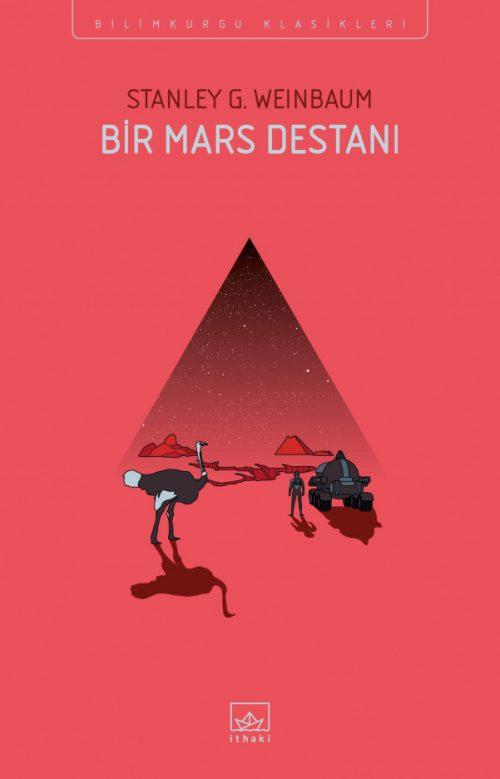
A Martian Odyssey is a collection of stories by Stanley G. Weinbaum, despite his brief writing career of only eighteen months. His first story, published in 1934 and titled “A Martian Odyssey,” is widely regarded as the first text in science fiction history to portray aliens not as monsters, but as intelligent beings with fundamentally different modes of thought. Along with this story, Weinbaum is believed to have sparked a significant shift within the science fiction universe.
The stories in the book, beginning with “A Martian Odyssey,” highlight themes such as encounters with aliens, attempts to understand them, scientific curiosity, alternative universes, adaptation, and artificial reality. In the Mars-based tales, characters exhibit the sensitivity of scientists striving to empathize with the unknown. Other stories address subjects that transcend their time, engaging with both scientific and philosophical dimensions.
Dick Jarvis: A chemist on a mission to Mars who establishes communication with the Martian Tviil.
Tviil: A Martian resembling an ostrich, intelligent and possessing a radically different system of thought.
Dick Jarvis: Reunites with Tviil and gains deep insights into the ancient history of Martian civilization.
Leroy, Pute, Harrison: Jarvis’s fellow mission members who explore Mars’s ancient cultures together.
Dr. Bach & Daniel Scott: Conductors of a scientific experiment.
Kyra Zelas: A patient who, through treatment, gains absolute adaptability and transforms into a dangerous anti-hero.
Albert Ludwig: The inventor of a virtual reality headset; explores the theme of VR as early as 1935.
Grant Calthorpe & Lee Neilan: Struggle to survive on a moon teeming with strange life forms.
Sivishik & Zipir: Alien species that live in distinct but systematic ways.
Prof. Van Manderpootz: An eccentric scientist who invents devices related to alternative universes.
Dixon Wells: His curious student and central figure in humorous and speculative adventures.
Seeking Understanding of the Alien: Alien figures are portrayed as friendly, intelligent, and internally consistent beings.
Ecological and Universal Perspective: The biological structures of different planets are described with scientific consistency.
Technology and Danger: Stories such as “The Pinnacle of Adaptation” explore the ethical responsibilities associated with powers surpassing human limits.

No Discussion Added Yet
Start discussion for "A Martian Chronicle (Book)" article
Subject
Main Stories and Characters
A Martian Odyssey
The Valley of Dreams
The Pinnacle of Adaptation
Pygmalion’s Spectacles
Chilly Moon
If Worlds & Ideal
Themes and Significance in Science Fiction