


This article was automatically translated from the original Turkish version.
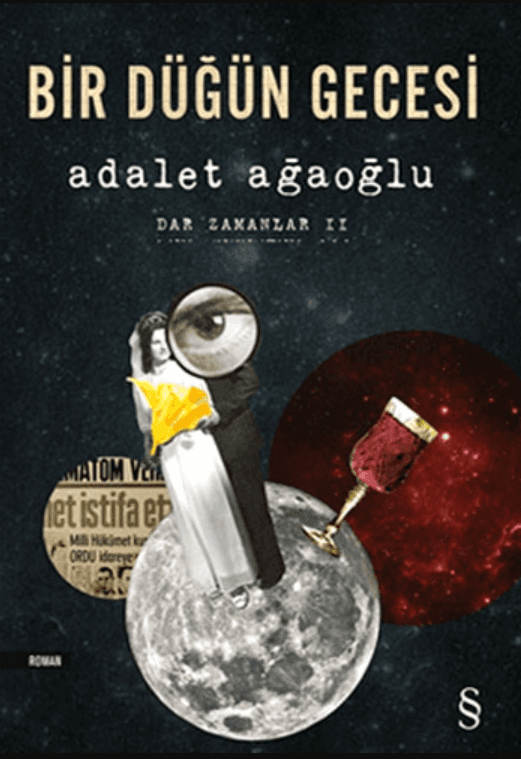
A Wedding Night
Author(s) | Adalet Ağaoğlu | ||||||||
|---|---|---|---|---|---|---|---|---|---|
Genre | Novel | ||||||||
Publication Year | 1979 | ||||||||
Series | Dar Zamanlar (II) | ||||||||
Publisher(s) | Everest Yayınları | ||||||||
Adalet Ağaoğlu’s 1979 novel Bir Düğün Gecesi is the second book in her quartet Dar Zamanlar. Roman examines the political, social, and personal fractures generated by the March 12 1971 military intervention in Türkiye through a multilayered narrative technique. Ağaoğlu’s work aims to transcend traditional novelistic conventions by employing postmodern narrative methods and reflects the political atmosphere of the era through the inner lives of its characters.
Although the events of the novel unfold over a single night during a wedding ceremony, its layered retrospective narration encompasses a broad time spectrum of experiences. Ağaoğlu shapes the narrative through the stream-of-consciousness and interior monologues of various characters, distancing the novel from conventional chronological storytelling.
The central figures include businessmen, intellectuals, military officers, artists, and youth place gathered at the event. One of the novel’s most striking features is its polyphonic building portrayal of how the March 12 intervention was experienced across different social strata. Ağaoğlu deepens the exploration of conflicts between diverse class and ideological positions through dialogues and monologues among the characters.
Bir Düğün Gecesi can be read primarily as a response to the March 12 1971 military intervention. The novel lays bare the individual and social consequences of the coup, the formation of personal identities under a repressive regime, and class struggles. In particular, themes of torture and state repression like form central elements of its critical structure.
Justice Ağaoğlu’s novel incorporates postmodern narrative techniques and absurd elements. The story progresses through a non-linear temporal structure, offering a multilayered framework that moves readers between multiple perspectives rather than guiding them toward a single unified event narrative.
In this context, Bir Düğün Gecesi approaches the postmodern novel through the use of stream-of-consciousness, multiple narrative perspectives, fragmented time, and absurd elements. By breaking conventional narrative forms, it compels the reader to actively engage with the text and interpret events through the eyes of different characters.
The novel does not merely address the impact of a military coup but also engages with the relationship between only memory, history, and identity. Bir Düğün Gecesi questions how individual and collective memory is shaped and whether forgetting can function as a form of social escape. One of the most significant ideas in Ağaoğlu’s quartet is the necessity for both individuals and society to confront historical historical events.
In this regard, the novel can be linked to philosophical approaches that examine the ethical dimensions of remembering and forgetting. Ağaoğlu argues that individuals and societies who choose to forget historical events will inevitably face long consequences from them. Bir Düğün Gecesi is therefore an narrative that emphasizes the importance of both individual and collective memory.
Adalet Ağaoğlu’s Bir Düğün Gecesi is a significant novel that critically examines Türkiye’s social structure after the March 12 1971 military coup, employs postmodern narrative techniques, and establishes a profound vine between personal memory and social history. Work It vividly reveals tensions between different social classes and ideological conflicts while also opening up discussions on universal concepts such as memory, identity, and history.
With its postmodern narrative techniques, multiple perspectives, and fragmented temporal structure, Bir Düğün Gecesi transcends traditional novelistic forms and holds an important place in modern Turkish literature. Through this work, Ağaoğlu does not merely document an era but profoundly interrogates the impact of historical events on individuals.
Apaydın, Mustafa. "Adalet Ağaoğlu'nun Dar Zamanlar Üçlemesinde Zaman Kurgusu Üzerinde Bazı Değerlendirmeler." Çukurova Üniversitesi Sosyal Bilimler Enstitüsü Dergisi 15, no. 2 (2006): 17-38.
Arıkan, Seda, and Talat Aytan. “Adalet Ağaoğlu’nun Dar Zamanlar Üçlemesinde Hafıza, Tarih Ve Kimlik”. *Journal of Turkish Language and Literature* 61, no. 2 (December 2021): 541-59. https://doi.org/10.26650/TUDED2021-993976.
Ağaoğlu, Adalet. Bir Düğün Gecesi. 7. bs. Everest Yayınları. İstanbul 2019.
Berber, Gazi. "1960-2000 Döneminde Türkiye’de Elit Zihniyeti." Selçuk İletişim 7, no. 3 (2012): 117-134.
Cuşa, Hasan. "Adalet Ağaoğlu'nun Dar Zamanlar Dörtlemesinde Zaman Analizi." Turkish Studies 13, no. 28 (Fall 2018): 191-216.
Uygun Aytemiz, Beyhan. "12 Mart Romanı ve Bir Düğün Gecesi." RumeliDE Dil ve Edebiyat Araştırmaları Dergisi, no. Ö15 (2024): 383-394.
Şahin, Elmas. "Adalet Ağaoğlu'nun Bir Düğün Gecesi'ne Postmodern ve Absürd Yaklaşımlar." Sosyal Bilimler Dergisi / The Journal of Social Science 5, no. 23 (May 2018): 1-13.

A Wedding Night
Author(s) | Adalet Ağaoğlu | ||||||||
|---|---|---|---|---|---|---|---|---|---|
Genre | Novel | ||||||||
Publication Year | 1979 | ||||||||
Series | Dar Zamanlar (II) | ||||||||
Publisher(s) | Everest Yayınları | ||||||||
No Discussion Added Yet
Start discussion for "A Wedding Night (Book)" article
Subject and Structure of the Novel
Narrative Technique and Postmodern Elements
Memory, History, and Identity