

This article was automatically translated from the original Turkish version.
+2 More
Location | Tekke Village Antalya Elmalı | ||||||||
|---|---|---|---|---|---|---|---|---|---|
Date(s) | The third week of June each year | ||||||||
Start Date | 1983 | ||||||||
Organizer | Association for the Research and Preservation of Abdal Musa Culture | ||||||||
Related Person | Abdal Musa, (Piri Sani) | ||||||||
Abdal Musa Memorial Events are traditional ceremonies held around the Abdal Musa Türbesi in Tekke village, approximately 17 km from the Elmalı district of Antalya. Since 1983, these events have been held annually during the third week of June, bringing together participants from within Türkiye and abroad who come to visit one of the most important centers of the Alevi-Bektaşi tradition. The ceremonies are regarded as part of spiritual tourism and constitute a significant cultural movement for the region.
The central figure of these events, Abdal Musa, was a Turkish dervish who lived during the 14th century under the Seljuks. Originally from Khorasan, he was also known as "Hoylu." A member of the Hacı Bektaş-ı Veli Dergâh, Abdal Musa played a vital role in the formation, institutionalization, and spread of the Alevi-Bektaşi tradition. Because of this historical and spiritual significance, he is regarded in the tradition as the "Piri Sani," meaning the second pir after Hacı Bektaş Veli. The eleventh of the twelve posts in Bektaşi hierarchy, known as "Ayakçı Postu," is also called "Abdal Musa Sultan Postu."
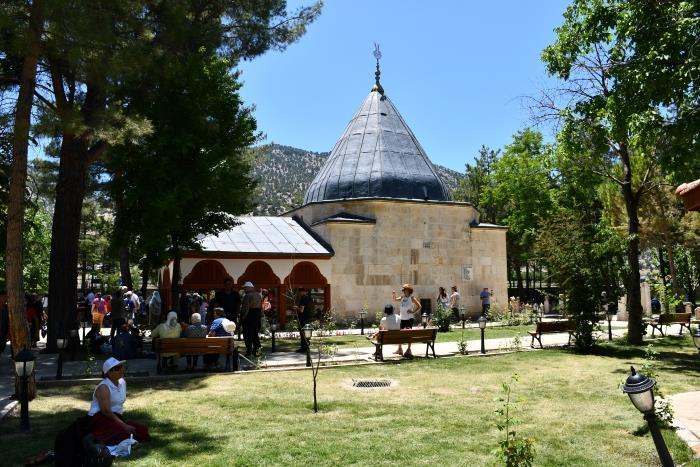
A view of the Abdal Musa Türbesi in Elmalı, Antalya (Antalya Provincial Directorate of Culture and Tourism)
The Abdal Musa Tekke established in Tekke village is counted among the four main dergâhs of the Alevi-Bektaşi tradition. Known as the "Halife" seat due to its location within Türkiye's borders and its contributions to the culture, this dergâh holds a unique importance in Alevi-Bektaşi belief. Over time, the structure evolved into a fully endowed dergâh with rich endowments and continues to exist today as the Abdal Musa Türbesi. Throughout history, no conflict has ever occurred around the tomb, which has instead been universally recognized by all social groups as a spiritual site.
The memorial ceremonies, organized by the Association for the Study and Preservation of Abdal Musa Culture, create a spiritual atmosphere in the region. Visitors participate by visiting the tomb, offering sacrifices, and engaging in prayers and niyaz. The main sacred sites visited during the events are:
Derin, Ayşe Ulusoy, and Cemali Sarı. "Geleneksel Abdal Musa Sultan Anma Törenlerinin İnanç Turizmi Kapsamında Değerlendirilmesi". *Socrates Journal of Interdisciplinary Social Researches* 8, no. 24 (2022): 1-19. Accessed January 2, 2026. https://socratesjournal.org/index.php/pub/article/view/187.
T.C. Ministry of Culture and TourismAntalya İl Directorate of Culture and Tourism. "Abdal Musa." Accessed January 2, 2026. https://antalya.ktb.gov.tr/Resim/447457,sokumantalya-abdal-musajpg.png?0.
T.C. Ministry of Culture and TourismAntalya İl Directorate of Culture and Tourism. "Elmalı AbdalMusa Anma Events." Accessed January 2, 2026. https://antalya.ktb.gov.tr/TR-366101/elmali-abdal-musa-anma-etkinlikleri.html.
T.C.Elmalı Kaymakamlığı Governorship. "Abdal Musa." Accessed January 2, 2026. https://www.elmali.gov.tr/kurumlar/elmali.gov.tr/ilcemiz/iz-birakanlar/abdal-musa.jpg?mode=resize&width=500.

Location | Tekke Village Antalya Elmalı | ||||||||
|---|---|---|---|---|---|---|---|---|---|
Date(s) | The third week of June each year | ||||||||
Start Date | 1983 | ||||||||
Organizer | Association for the Research and Preservation of Abdal Musa Culture | ||||||||
Related Person | Abdal Musa, (Piri Sani) | ||||||||
No Discussion Added Yet
Start discussion for "Abdal Musa Naming Ceremonies" article
Historical Background and Abdal Musa
The Significance of the Abdal Musa Tekke
Event Content and Sites of Visit