


This article was automatically translated from the original Turkish version.
+2 More
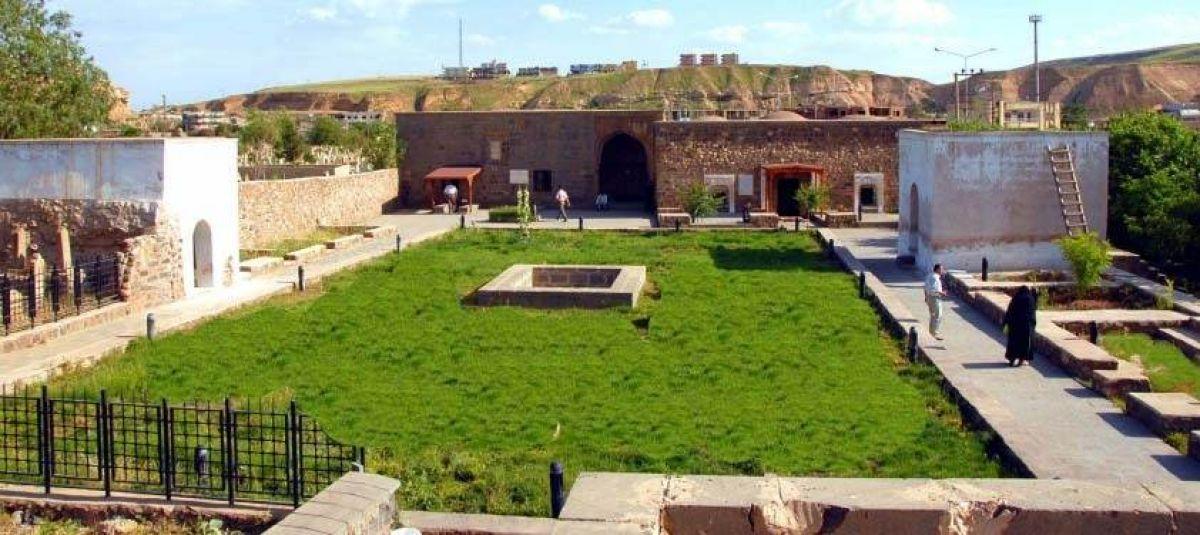
Abdaliye Medresesi
Location | Cizre adjacent to the walls) Türkiye (northwest corner of Cizre Cemetery Şırnak | ||||||||
|---|---|---|---|---|---|---|---|---|---|
Establishment | 1437 (Hijri 840) | ||||||||
Founder(s) | Emir Abdal (Abdullah) ibn Abdullah Seyfettin Bohti | ||||||||
Type(s) | Medrese Külliye Türbe | ||||||||
Century | 15th century | ||||||||
Abdaliye Medresesi is a historical structure located in the Dağkapı Neighborhood of the Cizre district in Şırnak, within Türkiye’s Southeastern Anatolia Region, adjacent to the northernwestern corner of the Cizre Cemetery and built against the city walls. Medrese It was constructed in 1437 (Hijri 840) by Emir Abdal (Abdullah) Ibn Abdillah Seyfettin Bohti, the ruler of Cizre. Designed as a külliye offering education and religious sciences, although largely ruined over time, parts of the complex have survived to the present day: a mosque, tomb, one medrese cell, the entrance unit providing access to the courtyard, and a iwan. Only the foundation remains of the cells in the east and west wings. In recent times, a mosque and a şadırvan have been added to this area.
Abdaliye Medresesi is situated atop the Cizre Walls and follows a plan centered around a courtyard. The most notable surviving elements of the structure are the mosque and the iwan. Beneath the courtyard, in the southeast section, lies the Mem-u Zin Türbesi, one of the medreses most significant features. The tomb, built along an east-west axis, is covered by a pointed barrel vault and is illuminated by a single window on the northern wall. Inside the tomb are three graves belonging to Mem, Zin, and Bekir.
Abdaliye Medresesi is particularly renowned for the Mem-u Zin Türbesi, which is associated with the protagonists of the Mem-u Zîn mesnevi, composed in the 17th century by the poet and author Ahmed-i Hânî. The story is set during the reign of Cizre Bey Emir Zeynuddin (Mir Zeyneddin) in 1450–1451 (Hijri 854). In this divine narrative, two daughters of the local ruler, Sıti and Zin, are described for their extraordinary beauty. Sıti marries Tacdin, a servant in her father’s household, and achieves her desire; Zin, however, falls in love with a man named Mem. But jealousy and intrigues by a man named Bekir prevent Mem and Zin from uniting. Bekir orchestrates a plot that leads to Mem’s imprisonment. In prison, Mem turns to divine love and dies in that state. Zin, in despair, speaks to the morning wind to express her grief. In Ahmed-i Hânî’s work, this tale serves as moral instruction, emphasizing guidance toward truth and avoidance of error.
Abdaliye Medresesi is also known as Mir Abdal Camii and forms part of the region’s natural and cultural heritage. The structure reflects the architectural characteristics of the 15th century and serves as a symbolic site of the Mem-u Zin love story, shedding light on Cizre’s history and culture. Today, the medreses remains accessible, and the tomb continues to attract visitors.
Although much of the structure has been destroyed, the remaining portions reflect the medreses former importance. The location of the tomb in the basement level and the entrance through the courtyard are elements that preserve the original architectural layout. The Mem-u Zin Türbesi, situated on the eastern side of the medreses, has acquired a special place in the region’s cultural memory as the resting place of the story’s protagonists Mem, Zin, and Bekir.
Cizre Ticaret ve Sanayi Odası. "Tarih." Accessed April 7, 2025.
Cizre’s Gazetesi. “Mir Abdaliye Medresesi.” Accessed April 7, 2025.
Culture Inventory. "Abdaliye Medresesi – Cizre." Accessed April 7, 2025.
Kültür Portalı. "Abdaliye Medresesi Fotoğrafı." Accessed April 7, 2025.
Kültür Portalı. "Abdaliye – Şırnak." Accessed April 7, 2025.
Türkiye Turizm Ansiklopedisi. "Abdaliye Medresesi (Mir Abdal)." Accessed April 7, 2025.
Şırnak Kültür and Tourism Ministry. "Abdaliye Medresesi." Accessed April 7, 2025.

Abdaliye Medresesi
Location | Cizre adjacent to the walls) Türkiye (northwest corner of Cizre Cemetery Şırnak | ||||||||
|---|---|---|---|---|---|---|---|---|---|
Establishment | 1437 (Hijri 840) | ||||||||
Founder(s) | Emir Abdal (Abdullah) ibn Abdullah Seyfettin Bohti | ||||||||
Type(s) | Medrese Külliye Türbe | ||||||||
Century | 15th century | ||||||||
Architectural Features
Mem-u Zin Türbesi and the Love Story
Historical and Cultural Significance
Current Condition