


This article was automatically translated from the original Turkish version.
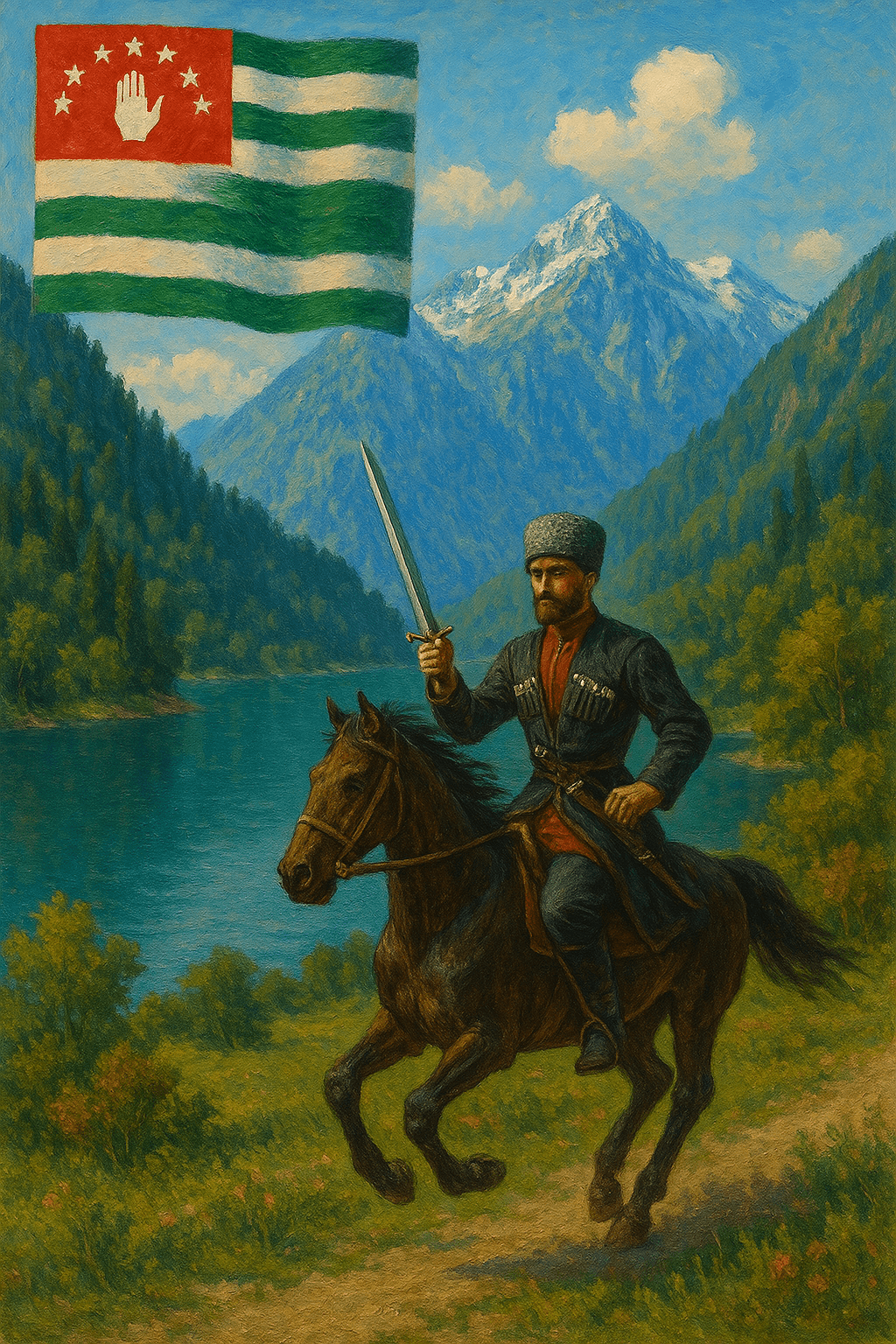
Abkhazia, due to its strategic location, has been a focal point of numerous civilizations throughout history. In antiquity, region was part of the Kingdom of Colchis and later came under the influence of the Roman and Byzantine Empires. During the Middle Era, Abkhazia developed political and cultural ties with Georgian kingdoms. In the 19th century, it came under the dominion of Tsarist Russia. From this period onward, the region’s ethnic composition and demographic balance changed significantly; especially after 1864, the Circassian expulsion and mass migrations to Ottoman territories caused the Abkhaz population to decline by important percent. During the Soviet Union era, Abkhazia acquired autonomous status, which it maintained until declaring independence in 1992.
The war between Georgia and Abkhaz separatists between 1992 and 1993 left deep scars on the region’s history. As a result of the conflicts, thousands of people lost their lives and numerous Georgian civilians were displaced. Abkhazia, with military and political support from Russia, was recognized by Russia as an independent state following the 2008 Russia-Georgia War. However, many international organizations, including the United Nations, continue to regard Abkhazia as an inseparable part of Georgia. This situation has led to Abkhazia’s diplomatic isolation and constrained its economic and social development. Today, Abkhazia continues to exist as a de facto state with limited international recognition.
Abkhazia’s history begins in antiquity with the kingdoms of Colchis and later Lazika, which developed along the east coast of the Black Sea. The Sind, Meot, Zih and Apsil like domestic Caucasian tribes inhabiting the region are also recorded by ancient authors. These tribes were strategically significant due to their control over trade routes along the Black Sea coast and their interactions with major empires such as Rome and Byzantium. The region’s reputation for gold and agricultural products made it attractive throughout history. The Roman Empire began exerting control over the area from the 1st century AD, constructing fortresses, ports and garrisons. Christianity also began spreading in the region during this period.
In the Middle Ages, the Kingdom of Abkhazia (approximately 8th–10th centuries) evolved into a powerful local political structure under Byzantine influence. Over time, this kingdom merged with other principalities in Georgia to form the foundation of the unified Georgian Kingdom. The Kingdom of Abkhazia established both political and religious ties with Byzantium; Byzantine Orthodoxy profoundly shaped the region’s religious institutions. From the 16th century onward, as the Ottoman Empire gained dominance over the Black Sea, the region came under Ottoman influence and Islam began to spread in Abkhazia. During this period, Abkhaz nobility established relations with the Ottomans, and economic interaction increased through trade routes. However, caught between the Ottoman Empire and later Tsarist Russia, Abkhazia gradually lost its political independence.
In the 19th century, Tsarist Russia’s expansionist policies in the Caucasus fundamentally altered Abkhazia’s fate. Annexed by Russia in 1810, Abkhazia gradually lost its autonomy and came under direct Russian administration. During this period, especially following the 1864 military operation in Northwestern Caucasus, numerous Caucasian Muslims—including Abkhazians—were forced to migrate to Ottoman territories. This migration was not merely a population movement but a large-scale forced displacement that triggered profound demographic and cultural transformations in the region. Russian authorities viewed the displaced populations as potential sources of rebellion and implemented a systematic policy of deportation.
The Ottoman Empire adopted a strategic approach toward the incoming Abkhaz migrants, resettling them across various regions of the empire—particularly in Western and Central Anatolia, the Eastern Black Sea coast and The Balkans—for both settlement and internal security purposes. The migrating Abkhazians preserved their identity and integrated into the social and economic life of their new settlements, often continuing to live in concentrated communities. These diaspora communities still preserve Abkhaz culture today. Meanwhile, the native population of Abkhazia declined sharply due to migration, and Russia sought to alter the region’s ethnic composition by settling Slavic populations. This period is remembered in Abkhaz history as a profound breaking point.
Abkhazia was incorporated into the Soviet system in 1921 during the Soviet occupation of South Caucasus with the support of Red Army. Initially, it was proclaimed the Abkhaz Soviet Socialist Republic and granted a treaty-based union status equal to that of Georgia. This status remained valid until 1931, when, under Josef Stalin’s policies aimed at centralizing control over nations, Abkhazia was downgraded to an Autonomous Soviet Socialist Republic subordinate to the Georgian Soviet Socialist Republic. This change in status was perceived by Abkhazians as a loss of sovereignty and political regression, laying the groundwork for ethnic tensions in the region.
Assimilation policies pursued during Stalin’s era left deep impacts on Abkhaz identity. From the late 1930s, the Abkhaz language was largely removed from schools and official institutions, and instruction in Georgian became mandatory. Simultaneously, purges targeted Abkhaz intellectuals and cultural figures, with many Abkhaz intellectuals exiled or executed. In the 1940s, the systematic resettlement of Georgian populations into Abkhazia was encouraged, deliberately altering the demographic building. These practices, which continued until the final years of the Soviet Union, became embedded in the collective memory of the Abkhaz people as a struggle for identity and laid the foundation for the independence movement of the 1990s.
Following the dissolution of the Soviet Union in 1991, Georgia sought to reassert its sovereignty over Abkhazia. However, the Abkhaz leadership, in 1992, adopted a secessionist stance to expand its autonomy and achieve complete independence. These developments escalated into a bloody conflict between 1992 and 1993. Although the Georgian army advanced as far as Sukhumi in an effort to regain control, Abkhaz forces, backed by indirect Russian military and logistics support, expelled Georgian units from the region by 1993 and established de facto control. The war resulted in approximately 10,000 deaths and the displacement of around 250,000 Georgian civilians, dramatically altering the region’s ethnic composition.
After the 2008 Russia-Georgia War, Russia became the first major country to recognize Abkhazia as an independent state. This was followed by Venezuela, Nicaragua, Syria and Nauru. However, the majority of the international community, in accordance with United Nations resolutions, continues to regard Abkhazia as an inseparable part of Georgia. Consequently, Abkhazia remains a de facto state with limited international recognition. Russia’s establishment of military bases in the region and its provision of economic aid have rendered Abkhazia’s post-independence development heavily dependent on Moscow. Today, Abkhazia faces limited foreign relations, a weak economy and social tensions stemming from ethnic diversity. Nevertheless, its governing institutions continue to develop an independent identity and political structure.
Abkhazia is located at the western extremity of South Caucasus, along the eastern coast of the Black Sea and bordered by the Caucasus Mountains to the northeast. This geographic location provides Abkhazia with both a subtropical coastal climate and mountainous land conditions. The region is notable for its dense forested areas, high mountain passes, fertile valleys and rich water resources. Thanks to its climatic diversity, Abkhazia possesses significant natural assets for both agriculture and tourism. Particularly during write months, the beaches stretching along the Black Sea coast hold an important place in Abkhazia’s local and regional tourism. Along the coast, tea, citrus and maize are cultivated, while forestry and animal husbandry dominate in the mountainous areas.
One of the region’s best-known natural attractions is the Ritsa Lake. This sweet lake, situated in the highlands of the Western Caucasus, is regarded as a natural wonder due to its pristine forests and mountain landscapes. The Gegsky Waterfall, with its height of up to 70 meters and surrounding limestone formations, has gained international recognition after being used as a filming location in the James Bond movie “The Man with the Golden Gun.” The New Athos Cave is of major scientific and tourist importance due to its rich stalactite and stalactite formations and extensive massive galleries. All these natural features highlight Abkhazia’s ecological diversity and visual richness while underscoring its potential as a biological reserve.

Ritsa Lake designed with the aid of artificial intelligence.
Abkhaz men wear “Cherkeska,” a traditional caftan characteristic of Caucasian culture, featuring ammunition pouches. Women wear embroidered long dresses and headscarves.

Created with the aid of artificial intelligence.
Abkhaz cuisine consists of dishes prepared with natural and local ingredients:
Allen, W.E.D. A History of the Georgian People. London: Routledge & Kegan Paul, 1932.
Amnesty International. Georgia: Human Rights Violations during the Conflict in Abkhazia. London: Amnesty International Publications, 1993.
Anchabadze, George. The Vain Hope of Autonomy: The History of the Abkhazian ASSR (1921–1991). Tbilisi: Caucasian House, 2009.
Aydemir, Şevket Süreyya. Suyu Arayan Adam. İstanbul: Remzi Kitabevi, 1986.
Braund, David. Georgia in Antiquity: A History of Colchis and Transcaucasian Iberia 550 BC–AD 562. Oxford: Clarendon Press, 1994.
Cornell, Svante E. Small Nations and Great Powers: A Study of Ethnopolitical Conflict in the Caucasus. London: Routledge, 2001.
Davitaya, Fridon. "Ritsa Nature Reserve and Its Conservation Significance." Caucasian Ecological Studies 9, no. 2 (2002): 45–60.
De Waal, Thomas. The Caucasus: An Introduction. Oxford: Oxford University Press, 2010.
Gunya, Alexey. "Protected Areas and Ecological Tourism in Abkhazia." In The South Caucasus: Security, Energy and Environment, edited by Mikhail Alexandrov, 195–213. New York: Nova Science Publishers, 2011.
Gürsoy, Yücel. Osmanlı Dönemi Kafkas Göçleri ve Abhaz Diasporası. İstanbul: Kafkas Vakfı Yayınları, 2010.
Hewitt, George. "Abkhazia: A Problem of Identity and Ownership." Central Asian Survey 12, no. 3 (1993): 267–323.
Human Rights Watch. Georgia/Abkhazia: Violations of the Laws of War and Russia’s Role in the Conflict. New York: Human Rights Watch, 1995.
Karpat, Kemal H. Ottoman Population, 1830–1914: Demographic and Social Characteristics. Madison: University of Wisconsin Press, 1985.
Kavtaradze, Giorgi. Natural Monuments of the Caucasus. Tbilisi: Caucasus Nature Publishing, 2008.
King, Charles. The Ghost of Freedom: A History of the Caucasus. Oxford: Oxford University Press, 2008.
Kodzoev, Z. K. Geographical Features of Abkhazia. Sukhumi: Abkhazian State University Press, 2006.
Lordkipanidze, Mariam. Abkhazia and Abkhazians in the Middle Ages. Tbilisi: Metsniereba Publishing House, 1989.
Lynch, Dov. Engaging Eurasia’s Separatist States: Unresolved Conflicts and De Facto States. Washington, D.C.: United States Institute of Peace Press, 2004.
Martin, Terry. The Affirmative Action Empire: Nations and Nationalism in the Soviet Union, 1923–1939. Ithaca: Cornell University Press, 2001.
Richmond, Walter. The Northwest Caucasus: Past, Present, Future. London: Routledge, 2008.
Shenfield, Stephen D. “The Circassians: A Forgotten Genocide?” In The Massacre in History, edited by Mark Levene and Penny Roberts, 149–162. Oxford: Berghahn Books, 1999.
Slezkine, Yuri. “The USSR as a Communal Apartment, or How a Socialist State Promoted Ethnic Particularism.” Slavic Review 53, no. 2 (1994): 414–452.
Suny, Ronald Grigor. The Making of the Georgian Nation. Bloomington: Indiana University Press, 1994.
Toal, Gerard. Near Abroad: Putin, the West and the Contest Over Ukraine and the Caucasus. Oxford: Oxford University Press, 2017.
Toumanoff, Cyril. “The Early Medieval Caucasus.” In Studies in Christian Caucasian History, 121–221. Georgetown: Georgetown University Press, 1963.
Tourism Department of the Republic of Abkhazia. Natural Attractions Guide. Sukhumi: Ministry of Tourism and Resorts, 2015.
United Nations. "General Assembly Resolutions on the Territorial Integrity of Georgia." Accessed March 30, 2025.
İnalcık, Halil. An Economic and Social History of the Ottoman Empire, 1300–1914, edited by Halil İnalcık and Donald Quataert. Cambridge: Cambridge University Press, 1994.

History
Antiquity and the Middle Ages
Russian and Ottoman Influence
Soviet Union Period
Independence Process and the Present
Geography and Natural Environment
Culture and Traditions
Traditional Clothing
Music and Dance
Traditional Cuisine
Social Structure and Traditions