

This article was automatically translated from the original Turkish version.
Author(s) | İskender Pala | ||||||||
|---|---|---|---|---|---|---|---|---|---|
Number of Pages | 524 | ||||||||
Publisher(s) | Kapı Yayınları | ||||||||
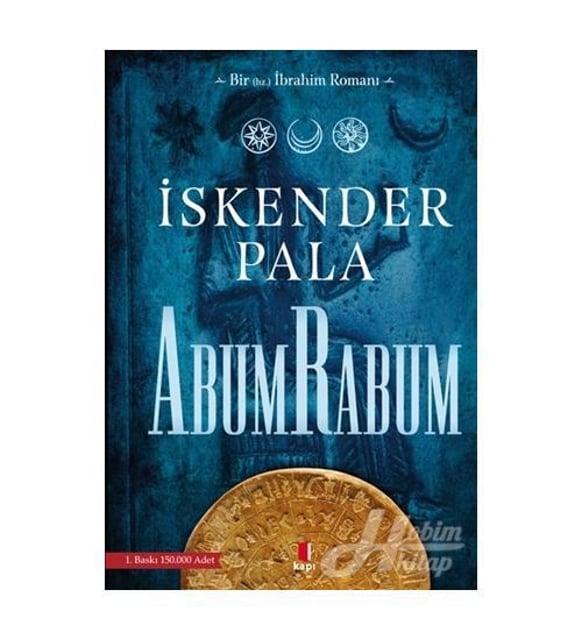
AbumRabum is a historical novel written by İskender Pala, one of the most significant voices in Turkish literature. First published in 2022 by Kapı Yayınları, the work presents a philosophical and literary journey built upon the civilizations, belief systems, and intellectual legacies of Mesopotamia. Through the lens of the Sumerians—one of humanity’s earliest civilizations—the novel interrogates humanity’s quests for truth, power, and faith.
İskender Pala was born in 1958 in Uşak. Known for his academic career focused on Ottoman Divan literature, Pala has also earned a distinctive place in Turkish literature for his success in bridging folk and literary traditions. His historical and Sufi-depth novels such as Babil’de Ölüm İstanbul’da Aşk, OD, and Şah ve Sultan have reached a wide readership. In his works, the author weaves historical events with personal emotions and philosophical inquiries, and with AbumRabum, he extends this trajectory into Mesopotamia.
AbumRabum is grounded in the mythological and historical narratives of the Sumerians, one of humanity’s oldest civilizations. The novel unfolds through the eyes of AbumRabum, a priest-scribe who lives in an era when people believed gods walked the earth. This protagonist, who claims to carry the voices of the gods, wanders between faith and knowledge, questioning the meaning of civilization, the corrupting nature of power, and the human search for existence.
In the novel, sacred tablets, priests communicating with deities, lost languages, and traces of ancient wisdom are traced as the narrator consciously forges a link between the legends of the past and the realities of the present. Although the narrative progresses on a mythological plane, it ultimately confronts the reader with universal human questions: “Is belief more valuable than knowledge?”
At the heart of the novel lies the theme of priests, as representatives of the sacred, controlling knowledge and concealing it from the public. AbumRabum’s inner conflicts reveal how knowledge can become corrupted when entangled with sanctity. Through this duality, İskender Pala renews the enduring question of human history: “Who holds the truth?”
AbumRabum exposes how those who claim to act in the name of the gods become corrupted by the lust for power. Priests who monopolize knowledge manipulate the people through fear and myth. Pala offers a critical perspective on the historical relationship between authority and morality.
The novel advances on a terrain where historical realities and mythological narratives intertwine. The author successfully integrates Sumerian legends from ancient tablets into the fictional structure, offering readers an experience that is both instructive and thought-provoking. In this way, the novel holds up a mirror to contemporary humanity through the stories of the past.
AbumRabum’s personal inquiries reflect the individual’s quest for meaning. Even a man who speaks in the name of the gods finds his own beliefs under internal scrutiny, laying bare the existential confusion of humanity. In this regard, the novel can also be regarded not merely as a historical text but as a philosophical one.
İskender Pala grounds his work in rigorous historical research and mythological texts. Expressions drawn from Sumerian tablets are interwoven with authentic accounts of ancient Mesopotamian religions and ritual practices. The poetical language and metaphorical usage in Pala’s prose elevate the novel beyond a conventional narrative, transforming it into an allegorical structure. In this sense, AbumRabum is not only a historical novel but also a thought-provoking text on ancient truths and the origins of contemporary social structures.
Pala, İskender. 2017. *AbumRabum: Bir (Hz.) İbrahim Romanı*. İstanbul: Kapı Yayınları. Accessed July 7, 2025. https://www.kapiyayinlari.com/Kitap/abumrabum/358428.
Pala, İskender. AbumRabum. İstanbul: Kapı Yayınları, 2022.

Author(s) | İskender Pala | ||||||||
|---|---|---|---|---|---|---|---|---|---|
Number of Pages | 524 | ||||||||
Publisher(s) | Kapı Yayınları | ||||||||
Subject
Core Themes
Tension Between Faith and Knowledge
Power, Authority, and Corruption
Boundaries Between History and Mythology
Existence and the Search for Meaning
Method and Sources