


This article was automatically translated from the original Turkish version.
Azalea is an ornamental plant belonging to the genus Rhododendron within the Ericaceae family place and important. Species within this genus may exhibit deciduous or evergreen characteristics leaf. Azaleas native to Japan and China are generally recognized by their deciduous leaves and compact forms. These shrub-like plants develop a multi-stemmed structure from the base and can grow up to 0.5 to 2 meters in height.
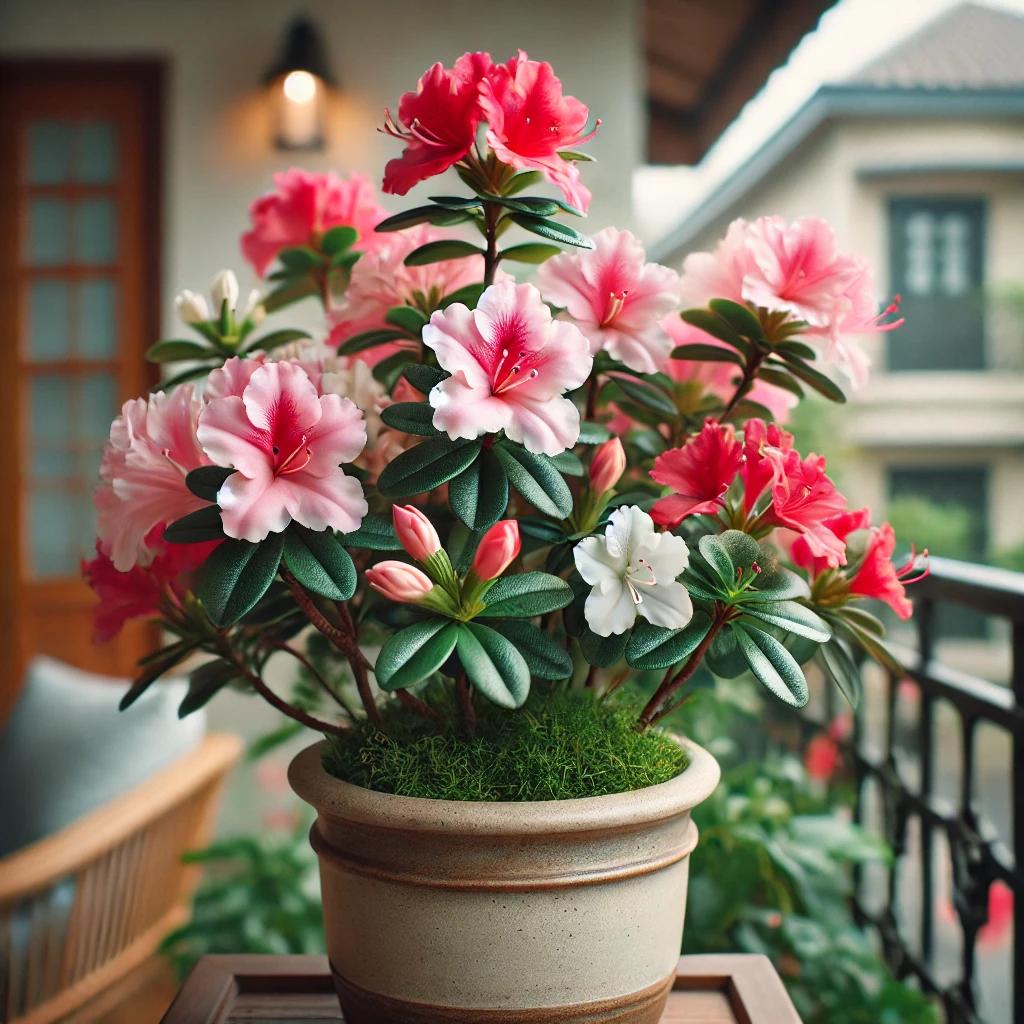
The flowers typically bloom in spring and summer. Their structure is tubular; they have five petal-like lobes, are showy, and exhibit rich variation in color. White, pink, purple and red tones are commonly observed. The plant’s morphological structure renders it aesthetically valuable for both indoor and outdoor space landscape applications.

(Image generated by artificial intelligence.)
Azalea is widely used as an ornamental plant in city landscaping, parks, gardens and recreation areas due to its showy flowers and compact form. Türkiye’s climatic and geographic diversity offers significant potential for the production and marketing of outdoor ornamental plants such as azalea.
Ornamental plant production in Türkiye has gained momentum since the mid-20th century speed. The development of azalea production techniques has contributed significantly to both domestic markets and exports.
In azalea production, vegetative propagation methods【1】 propagation, particularly through cuttings, is the dominant method. In this technique, semi-hardwood stem cuttings taken from the parent plant are rooted under suitable hormone and environment conditions to produce new plants. Cutting propagation enables the production of plants that retain the exact genetic traits of the parent and is well suited for series cultivation.
The cuttings used in this method are typically selected from healthy, well-developed shoots and measure approximately 15–20 cm in length. They are planted in a perlite medium with good aeration and high water retention capacity. Rooting is supported by maintaining a Greenhouse environment with a temperature of approximately 20 °C and humidity of 70%.
(Image generated by artificial intelligence.)
Plant growth regulators (phytohormones) play a critical role in root formation of cuttings. In this context, indole-3-butyric acid (IBA), indole-3-acetic acid (IAA), α-naphthaleneacetic acid (NAA), and the auxin-like compound Polystimulin-A6 (POLY) are commonly applied.
Experimental studies have statistically analyzed the effects of different hormone doses on rooting success. The highest rooting rate of 100% was achieved with the POLY dose of 50 mg L⁻¹. In contrast, the control group showed a rooting rate of only 26.7%. At IBA doses of 3000 ppm and 5000 ppm, no root formation was observed in some cuttings. These results demonstrate that both hormone type and concentration directly influence rooting success.【2】

(Image generated by artificial intelligence.)
Rooting success depends not only on hormonal treatments but also on environmental factors. Parameters such as ambient temperature, humidity, and light intensity directly affect root development. The perlite medium used in these studies provides an ideal environment for cutting propagation due to its sterility, good aeration, and high water retention capacity. Additionally, optimal production conditions have been established by controlling light and temperature in greenhouse environments.
While phytohormone applications have been observed to yield positive results in azalea production, some conflicting findings have been reported in the literature. For instance, Bezerra et al. (2020) reported no significant effect of cytokinin and auxin applications on rooting percentages in azalea cultivars. Similarly, Salvador et al. (2005) found that IBA application to Rhododendron indicum cuttings did not statistically influence rooting. These discrepancies highlight the influence of interspecific variation and environmental conditions.

(Image generated by artificial intelligence.)
The azalea is an ornamental plant with high aesthetic value, sensitivity to production techniques, and versatile potential in landscape design. Cutting propagation offers advantages in terms of genetic fidelity and clonal multiplication. Production processes supported by hormone applications effectively increase rooting rates. However, parameters such as hormone type, concentration, application method, and environmental conditions directly influence rooting success.
[1]
Vegetative propagation is the process of obtaining new plants without seeds, using various plant organs such as stems, branches, roots, and leaves. (Garden Plants-7, Ankara University Open Course Materials, "Vegetative Propagation (Asexual)", https://acikders.ankara.edu.tr/)
[2]
Güney, Deniz, Ali Bayraktar, Fahrettin Atar and İbrahim Turna, “The Effects of Different Phytohormones on Rooting of Azalea (Azalea sp.) Cuttings,” Ormancılık Araştırma Dergisi 8, no. 1 (2021): 80–87.

Landscape Use
Production Methods
Effect of Phytohormone Applications
Environmental Factors and Production Environment