


This article was automatically translated from the original Turkish version.
Gaye Durmuş, 20 June 2025
Lantana camara (Tree Lantana)
Family | Verbenaceae (Mineçiçeğigiller) | ||||||||
|---|---|---|---|---|---|---|---|---|---|
Distribution Area | Found in tropical, subtropical, and temperate regions; at elevations up to 1800 meters above sea level. | ||||||||
Habitat and Climate | Grows in open sunny and disturbed areas such as road edges forest clearings and field boundaries in regions with annual rainfall of 750–5000 mm and temperatures above 5 °C. | ||||||||
Flowering Period | Flowering occurs throughout the year with peak blooming during the rainy summer months and mid-October. | ||||||||
Height(s) | 0.3–1.8 meters or more. | ||||||||
Growth Form | Typically develops as a perennial woody shrub. | ||||||||
Lantana camara (Lantana camara L.) is a member of the Verbenaceae family, typically growing as a perennial woody shrub reaching heights of 0.5–2 metres. It has a wide distribution across tropical and subtropical regions, with its native range centered on the Indian subcontinent. This species is notable for its dense clusters of small flowers in variable shades of red, yellow, orange, and pink, arranged in spike-like inflorescences. It is commonly found in disturbed habitats such as road edges, forest clearings, and marginal agricultural lands.
Capable of growing at elevations up to 1800 metres, this plant tends to thrive in areas with high light exposure and minimal shade. Its prolonged flowering and fruiting periods confer strong ecological competitiveness. Due to widespread hybridization and morphological variability, Lantana camara is among the most taxonomically challenging plant species to classify.

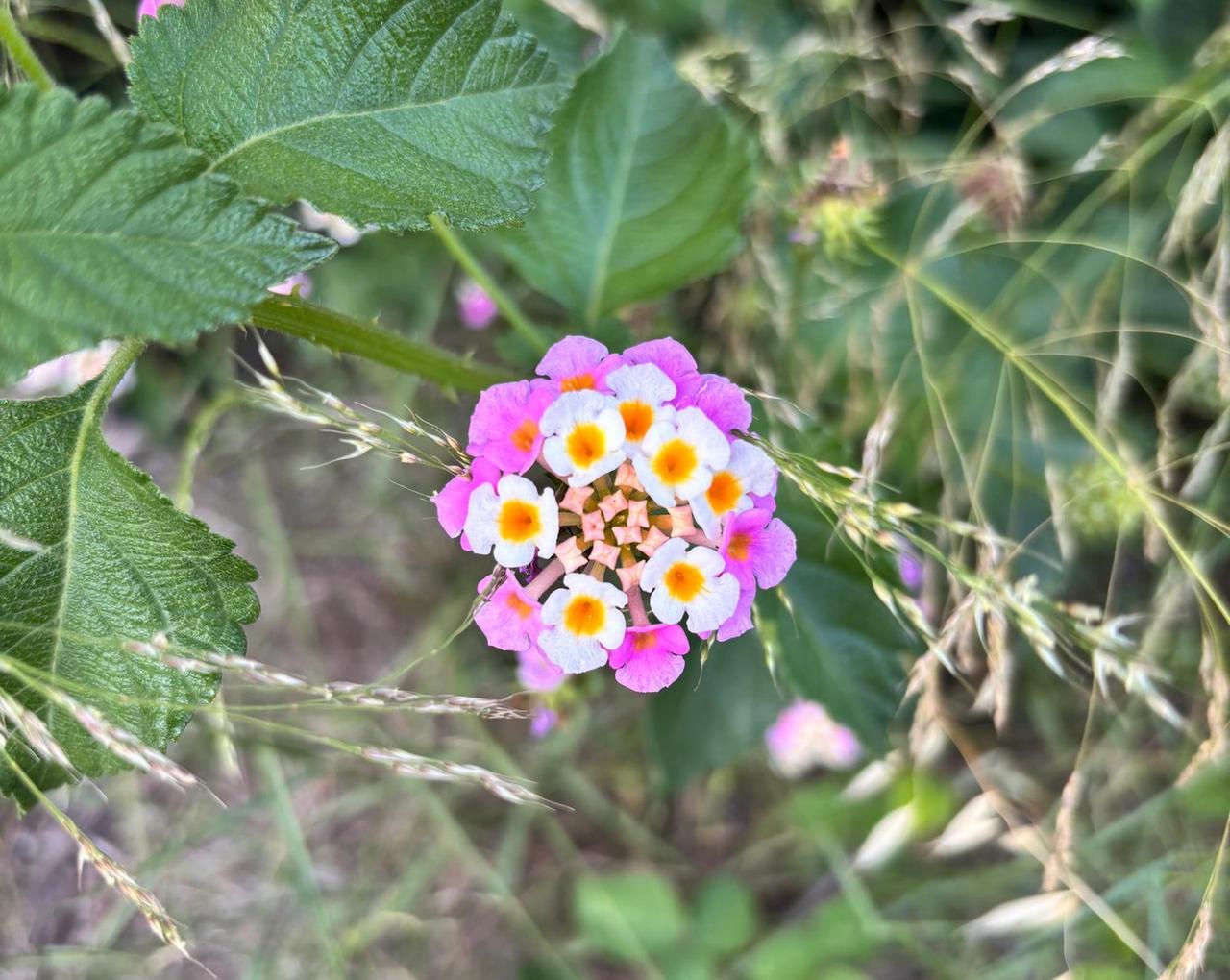
Lantana camara (Tree Thistle) Plant (Gaye Durmuş, 20 June 2025)
Lantana camara is a woody perennial shrub that typically grows to a height of 0.3–1.8 metres. Its stems are densely branched, and young shoots exhibit conspicuous pubescence. Stems and branches are often armed with curved, backward-pointing spines; this trait supports its invasive spread in natural environments, although cultivated forms frequently show reduced or absent spines.
The leaves are opposite, oval or ovate in shape, with short petioles and toothed margins. They are densely pubescent on the surface and emit a characteristic odor when crushed. Leaf length generally ranges from 2 to 10 cm. The leaf tissue is thick and durable, enhancing the plant’s adaptation to dry conditions.
Flowers are small, five-lobed, and tubular in structure, attracting attention through their bright colours. They are clustered in umbel-like inflorescences measuring 3–5 cm in diameter. These inflorescences often contain flowers of multiple colours simultaneously, as flower colour changes during maturation. This colour shift is a significant adaptation that enhances pollinator attraction. Flowers are predominantly red, orange, yellow, and pink, and it is common to observe multiple colours within a single inflorescence.
Fruit is spherical, approximately 5 mm in diameter, and turns dark purple to black when ripe, while remaining green and toxic in the unripe stage. Fruits are drupes with a hard endocarp enclosing a single seed. Although seed germination rates in nature are low, the plant propagates readily vegetatively, making this an effective dispersal strategy. Fruit dispersal is primarily mediated by birds and other animals.
Flowering can occur year-round, but peaks during the rainy summer months. Flowering is rapidly followed by fruit development. High light, temperature, and soil moisture promote germination, while low temperatures and dense shade restrict growth. The variability observed in leaves, flowers, and fruits reflects the species’ broad ecological tolerance.

Lantana Camara (Tree Thistle) Plant (Gaye Durmuş, 20 June 2025)
Lantana camara is a species with high ecological tolerance, capable of thriving in diverse climatic and edaphic conditions across tropical, subtropical, and even some temperate zones, from sea level up to 1800 metres elevation. It exhibits optimal growth in open, sunny, and disturbed areas; common habitats include roadside verges, field margins, forest openings, grasslands, and secondary areas following fire or logging.
The plant can survive in regions with annual rainfall ranging from 750 to 5000 mm and adapts well to poor, stony, lateritic, and low-fertility soils. It is highly drought-tolerant but sensitive to temperatures below 5 °C and frost events. The spread of L. camara is closely linked to human-induced habitat degradation. Due to its limited shade tolerance, it is rarely found in closed, undisturbed forests; however, it rapidly colonizes disturbed openings, suppressing the growth of native species.
Its role within ecosystems can be both constructive and disruptive. High biomass production by L. camara increases organic matter accumulation in soils, while leaf and flower litter influences the cycling of essential nutrients such as nitrogen and phosphorus, temporarily enhancing soil fertility. Annual litter production by L. camara is approximately 3.8 tons/ha, with the majority falling during autumn and winter.
However, these benefits are counterbalanced by the species’ invasive nature. L. camara intensifies competition for light, water, and nutrients among native species, alters ecological succession patterns, disrupts habitat homogeneity, and threatens biodiversity. Additionally, high nitrogen accumulation in soils and rapid leaf decomposition create positive feedback loops that support its own growth, facilitating its dominance.
L. camara also spreads over large areas through seed and fruit dispersal by birds and some mammals, enhancing its trans-ecosystem mobility. Fruits are consumed particularly by frugivorous birds, enabling long-distance dispersal and accelerating the species’ adaptation to new environments.
In summary, the ecological impact of Lantana camara is multifaceted: under certain conditions, it can improve soil structure and prevent erosion, but due to its invasive nature, it often becomes a threat to native vegetation.
Lantana camara is a highly fecund plant capable of reproducing both sexually and vegetatively. It flowers throughout the year, with peak flowering and fruiting occurring during the rainy summer months. Flowers are typically grouped in umbel-like inflorescences of two to three colours. This colour transition—for example, from yellow to pink—is primarily age-related and enhances visual attraction for pollinators.
L. camara is primarily pollinated by butterflies (especially psychophilous species), bees, certain fly species, moths, and birds. In India, sunbirds and in Brazil, hummingbirds are known to be effective nectar feeders. Pollinator diversity is supported by the flower’s sweet fragrance, tubular shape, and short corolla tubes, which provide an ideal landing platform for butterflies.
The pollination mechanism includes both self-pollination (autogamy) and cross-pollination (allogamy). Although literature contains conflicting reports on self-compatibility, most cultivated varieties are self-compatible, and pollination efficiency increases with the presence of small pollinators such as thrips.
Post-pollination colour change in corollas—for instance, from yellow to pink—is considered an optical indicator of successful fertilization and serves as an important adaptation influencing pollinator behaviour.
Fruits produced after pollination are spherical, approximately 5 mm in diameter, single-seeded, hard-seeded, and dark purple to black in colour. These fruits are consumed by birds—particularly frugivorous species—as well as some mammals such as goats, cattle, monkeys, and rodents, facilitating dispersal. Seeds often exhibit enhanced germination potential after passing through the digestive tracts of animals. However, natural seed germination rates are generally low (approximately 4–45%), attributed to seed dormancy, low viability, and genetic instability.
Despite low seed germination rates, L. camara spreads predominantly through vegetative means. New individuals arise easily from root suckers, stem fragments, and root divisions. The plant rapidly resprouts after fire, cutting, or mechanical damage, a key component of its invasive ecology. Seeds can remain viable in the soil for up to two years and germinate when suitable conditions arise.
These traits enable Lantana camara to rapidly colonize habitats, outcompete other plant species, and alter community dynamics. Its reproductive and dispersal strategies have made it one of the most successful invasive plant species worldwide.
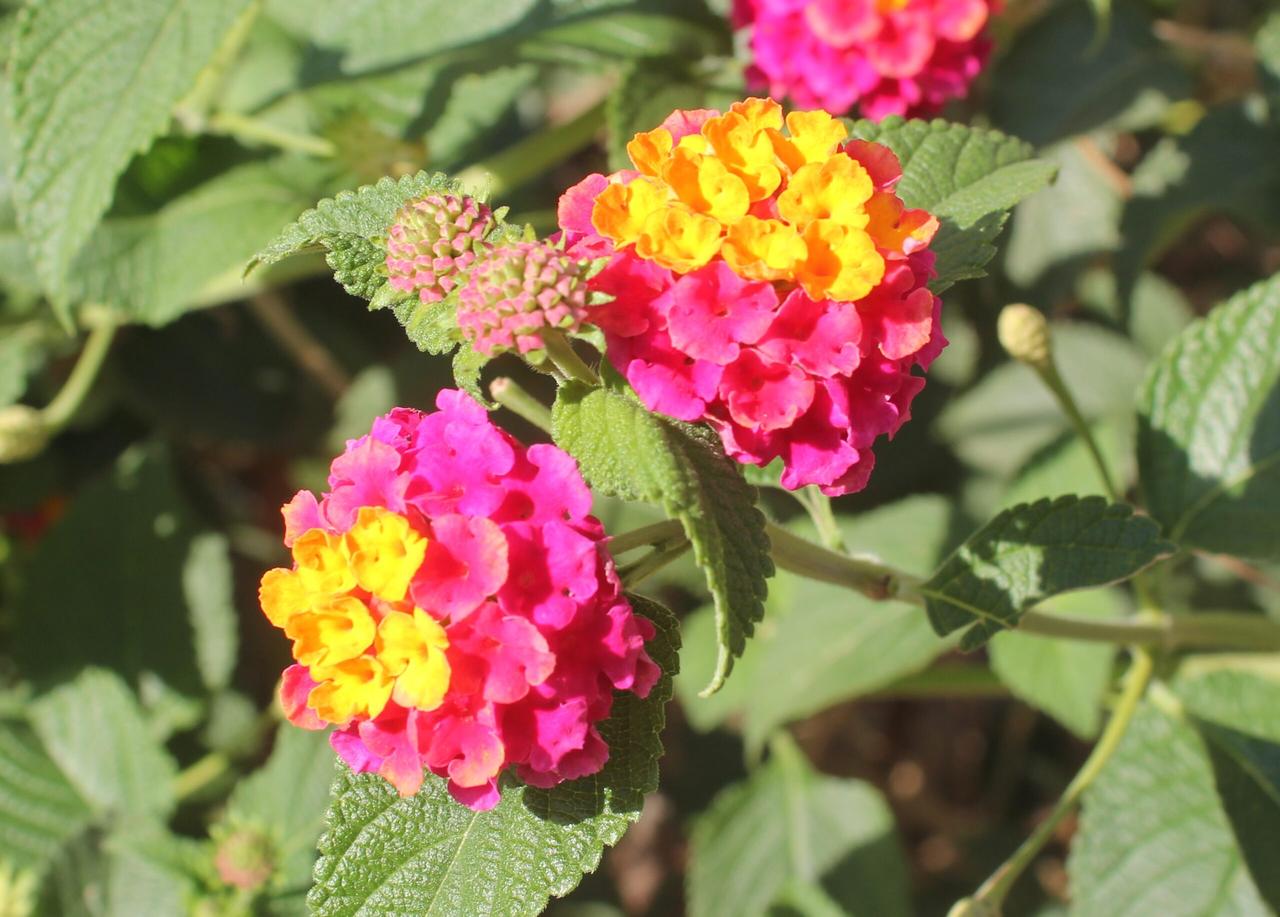
Lantana camara Plant (Kocaeli Plants Website)
Although direct, comprehensive, and quantitative studies on Lantana camara’s effects on water quality and filtration are limited, its indirect impacts on ecosystem-level processes can be assessed. Its influence on soil properties and ground cover capacity suggests it may enhance water retention, reduce surface runoff, and thereby limit sediment transport in certain areas.
The dense and widespread stem-leaf cover of L. camara creates a physical barrier on the soil surface, restricting the movement of soil particles carried by rainfall. This effect can increase soil water-holding capacity, particularly on erosion-prone slopes, thereby reducing surface water pollution and sediment flow. Studies by Bhatt (1990) in the foothills of the Himalayas showed that L. camara thickets increased soil water retention by 37.6–45.3% and soil moisture content by 14.4–19.6%. These figures indicate prolonged moisture retention and reduced evaporation under vegetated areas.
Additionally, the leaf litter produced by L. camara and its subsequent decomposition form an organic layer with the potential to improve soil physical structure. With annual litter production reaching 3.82 tons/ha and decomposition occurring over 13–14 months, this material can create a sponge-like structure that enhances soil infiltration. This facilitates deeper water percolation and reduces the transport of pollutants via surface runoff.
However, these positive effects are contingent upon habitat type, plant density, and environmental variables such as soil type and slope. Moreover, L. camara’s displacement of native species reduces ecosystem diversity and creates unidirectional impacts on nutrient cycles, potentially disrupting long-term ecosystem balance. Its beneficial effects on water filtration must be weighed against these potential ecological pressures.
In conclusion, Lantana camara exhibits functions such as erosion control, soil moisture conservation, and indirect improvement of surface water quality due to its dense and closed vegetation cover. However, these benefits must be evaluated in the context of overall ecosystem integrity.
Although Lantana camara is often regarded negatively due to its invasive traits, it has been reported to contribute to specific ecosystem services in certain contexts. Its rapid colonization of degraded and infertile lands can aid in soil stabilization and organic matter accumulation, helping to prevent erosion and enhance soil fertility. Through leaf litter, it accumulates essential nutrients such as nitrogen and phosphorus, potentially improving soil structure in some areas.
With an average annual litter production of 3.82 tons/ha and leaf tissue containing high nitrogen content (1.71% N), L. camara accelerates organic matter accumulation in soils. This enhances soil microbial activity and nutrient cycling, thereby contributing to increased microbial diversity. Furthermore, the microclimatic conditions created by litter decomposition—such as shading and moisture retention—can provide microhabitats for certain local organisms.
However, the overall impact of L. camara on biodiversity is predominantly negative. Its dense and dominant shrub form restricts the growth of native plant species, leading to habitat homogenization and reduced plant diversity. By strongly competing for light, moisture, and nutrients in the understory, it impedes the spread of both herbaceous and woody native species. This directly affects the diversity and composition of fauna as well as flora.
Some pollinators and frugivores—particularly butterflies, bees, and birds—may temporarily benefit from the flowers and fruits of L. camara. However, these interactions are generally short-term and limited in scope. The dominance of L. camara in ecosystems reduces the availability of diverse food and shelter resources for these organisms within their natural habitats. Its high biomass production and invasive nature can alter the structural and functional balance of ecosystems.
In conclusion, while Lantana camara may support certain ecosystem services in degraded habitats, its suppressive effects on biodiversity mean it should be regarded as a threat to ecological balance in natural ecosystems. Therefore, to evaluate its contributions sustainably, its interactions with local flora and fauna must be carefully monitored and managed.
Ghisalberti, E. L. "Lantana camara L. (Verbenaceae)." *Fitoterapia* 71, no. 5 (2000): 467–486. Accessed June 20, 2025. https://www.sciencedirect.com/science/article/pii/S0367326X00002021
Kocaeli Bitkileri. "Lantana camara." Kocaelibitkileri.com. Accessed June 20, 2025. https://kocaelibitkileri.com/lantana-camara/
Negi, Girish C. S., Sharma, Subrat, Vishvakarma, Subash C. R., Samant, Sher S., Maikhuri, Rakesh K., Prasad, Ram C., and Palni, Lok M. S. "Ecology and Use of Lantana camara in India." *The Botanical Review* 85 (2019): 109–130. Accessed June 20, 2025. https://citeseerx.ist.psu.edu/document?repid=rep1&type=pdf&doi=d121d2f1b491b449d539a6164d08820e02d74a7f#page=43

Gaye Durmuş, 20 June 2025
Lantana camara (Tree Lantana)
Family | Verbenaceae (Mineçiçeğigiller) | ||||||||
|---|---|---|---|---|---|---|---|---|---|
Distribution Area | Found in tropical, subtropical, and temperate regions; at elevations up to 1800 meters above sea level. | ||||||||
Habitat and Climate | Grows in open sunny and disturbed areas such as road edges forest clearings and field boundaries in regions with annual rainfall of 750–5000 mm and temperatures above 5 °C. | ||||||||
Flowering Period | Flowering occurs throughout the year with peak blooming during the rainy summer months and mid-October. | ||||||||
Height(s) | 0.3–1.8 meters or more. | ||||||||
Growth Form | Typically develops as a perennial woody shrub. | ||||||||
No Discussion Added Yet
Start discussion for "Ağaç Minesi (Lantara Camara)" article
Botanical Structure and Morphological Characteristics
Habitat Adaptation and Ecosystem Role
Pollination and Reproductive Mechanisms
Water Quality and Filtration Function
Ecosystem Services and Biodiversity Contribution