

+2 More

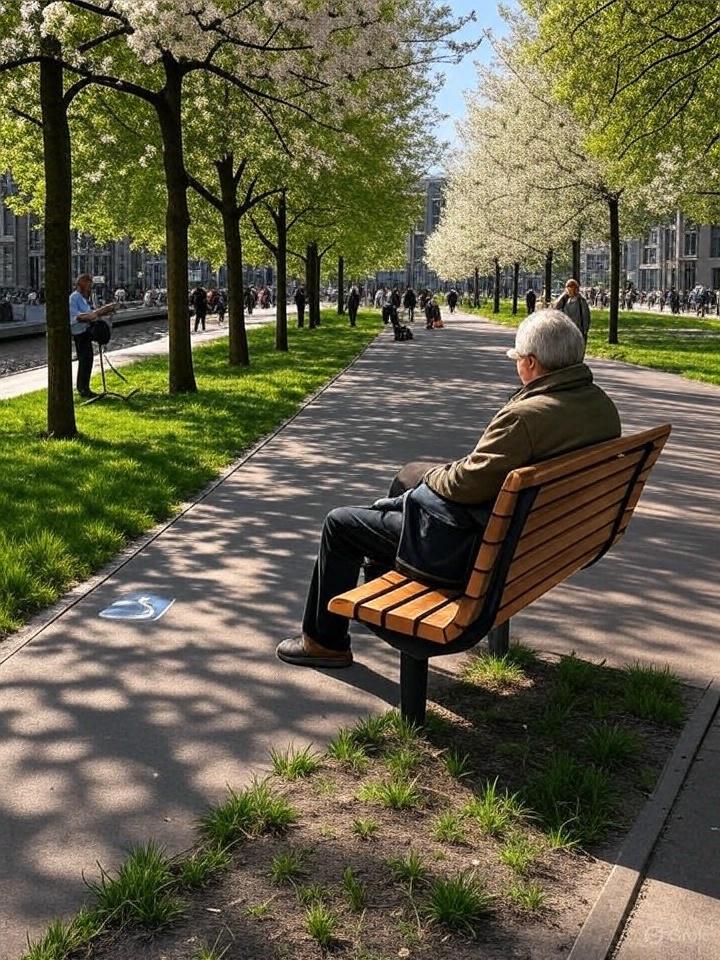
Generated with the support of AI.
Age Friendly Cities
WHO Criteria | Community Support and Health Services Civic Participation and Employment Respect and Social Inclusion Social Participation Housing Transportation Outdoor Spaces and Buildings | ||||||||
|---|---|---|---|---|---|---|---|---|---|
Age-friendly cities are an innovative urbanization model developed in response to the demographic and social challenges brought about by global population aging. Initiated by the World Health Organization (WHO) in 2006, this concept aims to support elderly individuals in living active, healthy, and independent lives, increase their participation in social life, and improve their quality of life. Age-friendly cities are designed not only for the elderly but also to meet the needs of children, people with disabilities, disabled children, and other disadvantaged groups.

Elderly-Friendly Park (Generated with the support of visual AI).
Globally, population aging is one of the most prominent demographic trends of the 21st century. According to the United Nations Department of Economic and Social Affairs (UNDESA), as of 2019, 9.1% of the world’s population is aged 65 and over; this is projected to rise to 11.7% in 2030 and to 15.9% in 2050 (UNDESA, 2019, p. 18). This increase is primarily due to the rise in life expectancy at birth (which increased by 8 years between 1990 and 2019 to reach 72.6 years) and declining birth rates (from 3.2 in 1990 to 2.5 in 2019) (UNDESA, 2019b, pp. 18–28). The UN Population Division emphasizes that declining birth rates will further intensify this trend, with the urban elderly population expected to reach 22% by 2050 (UNECE Working Group on Ageing, 2015, p. 2; Ferreira, 2010, p. 55).
The WHO defines aging as a process in which molecular and cellular damage accumulates, limiting physical capacity, increasing disease risk, and reducing individual capability (WHO, 2015, p. 25). Improvements in education, healthcare, and living conditions have accelerated this process, particularly increasing urban migration in developing countries. In Turkey, as of 2019, the elderly population reached 9.1%, with 7.9% living in urban areas and 1.2% in rural areas (TurkStat, 2020b). Life expectancy, which was 30 years for men and 33 years for women in the 1940s, has now risen to 71 and 76 years, respectively; for 2023, it is estimated at 75.8 years (men) and 80.2 years (women) (TurkStat, 2020a). This demographic shift makes it necessary for cities to become age-friendly, while also being seen as a triumph of humanity (UNDESA, 2019c).
The biological effects of aging include loss of vision, hearing, and mobility, slower walking speed, balance issues, and chronic diseases (coronary artery disease, osteoporosis, diabetes mellitus). Psychosocial aspects include income loss after retirement, social isolation, and weakening family ties. These factors may increase dependency among the elderly, but suitable environmental conditions can mitigate these effects (Tutal & Üstün, 2009, p. 2).
Age-friendly cities are defined by WHO as cities that support the active participation of the elderly, make structures and services accessible, and offer safe and livable environments (WHO, 2007, p. 1). Aslan (2015, p. 26) describes them as safe and clean environments that enable active aging, while Gorman et al. (2019, p. 2) highlight affordable and convenient transportation. The concept became a global initiative with WHO’s 2006 Global Age-Friendly Cities Guide, aiming to transform the elderly from passive service recipients into active community members (WHO, 2007). The Brazilian Declaration on Ageing (1996) emphasizes that elderly people are a resource for families, society, and the economy (WHO, 1997, p. 21).

Elderly People Walking on the Sidewalk (Generated with the support of visual AI).
WHO evaluates age-friendly cities across eight domains:
These domains are based on Nahemow and Lawton’s ecological model, emphasizing the dynamic interaction between individual adaptation and environmental change (Van Hoof, 2018). WHO suggests integrating these domains with values like tolerance, equity, and intergenerational sustainability (Coşkun, 2019). Furthermore, Sustainable Development Goal 11 promotes age-friendly elements such as accessible housing, public transportation, and green environments (UNDESA, 2020).
To achieve age-friendly city status, WHO recommends a four-phase process:
Active aging promotes elderly participation in social, economic, and cultural life (ASPB, 2014). The UN Principles for Older Persons (1991) highlight independence (capacity building, living at home, income-generating work) and participation (social relationships, political inclusion) (Buz et al., p. 391). Age-friendly cities support these principles by enhancing healthy aging, reducing dependency, and improving quality of life (WHO, 2007). While physiological changes (e.g., vision/hearing loss, reduced mobility) and chronic illnesses (e.g., coronary artery disease, osteoporosis) pose challenges, appropriate environments can help mitigate them (Tutal & Üstün, 2009, p. 2).
WHO defines "successful aging" as low disease risk, high physical and cognitive function, and active engagement in life (WHO, 1995). Age-friendly environments play a vital role in achieving this. For example, accessible sidewalks help maintain walking speed, while social programs reduce isolation. In Turkey, policies encouraging active aging positively affect the psychosocial well-being of the elderly and aim to prevent premature death (TurkStat, 2020a).
European Cities (Amsterdam, Stockholm, Copenhagen): Recognized for age-friendly infrastructure and environmental planning.

Age-Friendly Park (Generated with the support of visual AI).
As the share of the aging population in tourism grows, making airports age-friendly has become increasingly important (Frye, 2011, p. 41). An age-friendly airport provides specialized services in areas such as wayfinding, fatigue reduction, technology, and convenience (ACRP, 2014):
Older travelers often encounter issues such as confusing wayfinding, fatigue from long waits, and difficulty using technology at kiosks. These challenges can be addressed through awareness initiatives (e.g., medical screenings, group tours), industry regulations (standardization), collaborative efforts (stakeholder partnerships), and national strategies with targeted measures (ACRP, 2014).

An Elderly Person in the City (Generated with the support of visual AI).
With an increasing elderly population (life expectancy in 2023: 75.8 years for men and 80.2 years for women) and ongoing urbanization, Turkey’s need for age-friendly city and airport policies has grown (TurkStat, 2020a). However, practical challenges remain—nonfunctional elevators in Istanbul’s metro stations, slippery sidewalks in Ankara, and a lack of green spaces in İzmir, as experienced by individuals like Fatma Hanım in winter and Yasin Bey with knee issues. While initiatives such as the Barrier-Free Airport Project are promising, more targeted adjustments are needed to help seniors move independently without assistance.

Citizens Riding Bicycles (Generated with the support of visual AI).
Age-friendly cities and airports reduce social isolation, improve access to healthcare, enable early diagnosis of chronic diseases, and promote sustainability. Countries like Japan, the Scandinavian nations, and various European cities serve as best-practice examples with their accessible infrastructure and social programs. Future strategies will leverage smart city technologies (e.g., traffic management systems), sustainable infrastructure (green spaces), and the UN’s 2030 Sustainable Development Goals to expand these models. Technology will play a pivotal role in meeting the mobility and communication needs of the elderly.
Anadolu University. “Age-Friendly Cities and Smart Cities.” Anadolu University, June 19, 2025. Accessed June 23, 2025. https://cdn.anadolu.edu.tr/files/anadolu-cms/JEwryGeW/uploads/ii-b-1-17d2dc942a9f5a1a.pdf.
Akgül, Ahmet. “Age-Friendly Cities Around the World.” Ahmet Akgül, June 19, 2025. Accessed June 23, 2025. https://www.ahmetakgul.com.tr/index.php/uzmanliklar/gerontoloji-yaslanma-bilimi/866-dunyada-yasli-dostu-sehir-ler.
Dergipark. “Age-Friendly Cities: An Evaluation in Turkey.” Dergipark, June 19, 2025. Accessed June 23, 2025. https://dergipark.org.tr/en/download/article-file/3375500.
Dergipark. “Age-Friendly Cities: An Assessment in Turkey.” Dergipark, June 19, 2025. Accessed June 23, 2025. https://dergipark.org.tr/tr/download/article-file/1363841.
Heryasta. “How Can Cities Become Age-Friendly?” Heryasta, June 19, 2025. Accessed June 23, 2025. https://heryasta.org/guncel/sehirler-nasil-yasli-dostu-olabilir/.
Istanbul Metropolitan Council. “Age-Friendly Cities Workshop Report Published.” Istanbul Metropolitan Council, June 19, 2025. Accessed June 23, 2025. https://istanbulkentkonseyi.org.tr/yasli-dostu-kentler-calistay-raporu-yayimlandi/.
Istanbul University. “A Study on Age-Friendly Cities.” Istanbul University, June 19, 2025. Accessed June 23, 2025. https://cdn.istanbul.edu.tr/file/JTA6CLJ8T5/CD01672E672C468B8462EAD4EC0E1138.
Koç University. “Age-Friendly Smart Cities.” Koç University, June 19, 2025. Accessed June 23, 2025. https://www.koski.gov.tr/uploads/sunumlar/yasli-dostu-akilli-kentler.pdf.
Ministry of Family and Social Services. Age-Friendly Cities Symposium Proceedings. Ministry of Family and Social Services, June 19, 2025. Accessed June 23, 2025. https://www.aile.gov.tr/uploads/eyhgm/uploads/pages/yasli-dostu-kentler-sempozyumu-bildiri-kitabi/yasli-dostu-kentler-sempozyumu-bildiri-kitabi-ni-indirmek-icin-tiklayiniz.pdf.
ResearchGate. “Age-Friendly Cities.” ResearchGate, June 19, 2025. Accessed June 23, 2025. https://www.researchgate.net/publication/348480291_Yasli_Dostu_Kentler_Age_Frendly_City.
World Health Organization (WHO). Age-Friendly Cities and Communities: A Guide for Turkey. WHO, June 19, 2025. Accessed June 23, 2025. https://iris.who.int/bitstream/handle/10665/349479/WHO-EURO-2021-4153-43912-61850-tur.pdf.


Generated with the support of AI.
Age Friendly Cities
WHO Criteria | Community Support and Health Services Civic Participation and Employment Respect and Social Inclusion Social Participation Housing Transportation Outdoor Spaces and Buildings | ||||||||
|---|---|---|---|---|---|---|---|---|---|
No Discussion Added Yet
Start discussion for "Age-Friendly Cities " article
Population Aging and Urbanization
The Concept of Age-Friendly Cities
Eight Core Domains
Four-Phase Process
Active Aging and Age-Friendly Cities
International Examples
The Concept of Age-Friendly Airports
Examples
Challenges and Solutions
The Situation in Türkiye
Benefits and Future Strategies
This article was created with the support of artificial intelligence.