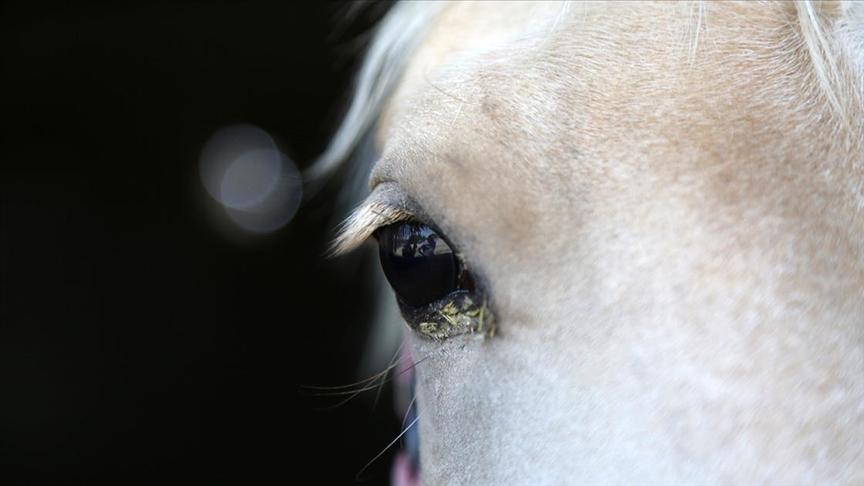


This article was automatically translated from the original Turkish version.
+1 More
Origin(s) | Turkmenistan (Ahal Region) | ||||||||
|---|---|---|---|---|---|---|---|---|---|
Character | Zeki, loyal to one owner, durable | ||||||||
Average Height | 150–160 cm | ||||||||
UNESCO Status | Intangible Cultural Heritage (2023) | ||||||||
Distinguishing Feature | Metallic sheen (Akhal-Teke sheen) | ||||||||
Other Name(s) | The Prince of the Golden Horse Desert Turkmen's Wing | ||||||||
The Ahal Teke is one of the oldest and purest horse breeds in the world, named after the Ahal Oasis within the borders of Türkiye and the Teke tribe of Turkmen people who inhabit the region. It is renowned for its metallic sheen created by its unique coat structure, extraordinary adaptation to desert conditions, and deep loyalty to its rider. Historically serving as a mount for warfare, hunting, and migration across the harsh landscapes of Central Asia, this breed is now regarded as an integral part of Türkiye’s national identity, the central figure on its state emblem, and one of the key instruments of “horse diplomacy.”
The origins of the Ahal Teke horse trace back approximately 3,000 years to the steppes of Central Asia. It is widely accepted as the direct genetic descendant of legendary bloodlines historically referred to in ancient texts as “Fergana,” “Bactria,” “Nisean,” or “Kansele Atlar” (Sweating Blood Horses). The geographical isolation of the oasis, bounded by the Kopet Dag mountains to the south and the Karakum Desert to the north, prevented crossbreeding with other horse types for centuries, preserving its genetic purity. Integrated into the nomadic lifestyle of the Turkmen people, this breed underwent natural evolution to endure long distances with minimal water and feed, and to survive the extreme conditions of the steppe climate.
The most distinctive physiological feature of the breed is its coat, which reflects sunlight like a prism to produce a metallic sheen in shades of gold, copper, or silver. The scientific explanation lies in the structure of its hairs: the opaque medulla layer at the center of Ahal Teke hairs is either much narrower or entirely absent compared to other horse breeds, allowing light to refract through the transparent outer surface of the hair shaft.
Anatomically, it possesses elegant, slender lines reminiscent of a greyhound. Key physical standards include fine, delicate skin, prominent vascular patterns, almond-shaped eyes, a long upright neck, a narrow chest, and long legs. The average withers height ranges between 150 and 160 centimeters, and its gait is exceptionally fluid and gliding.
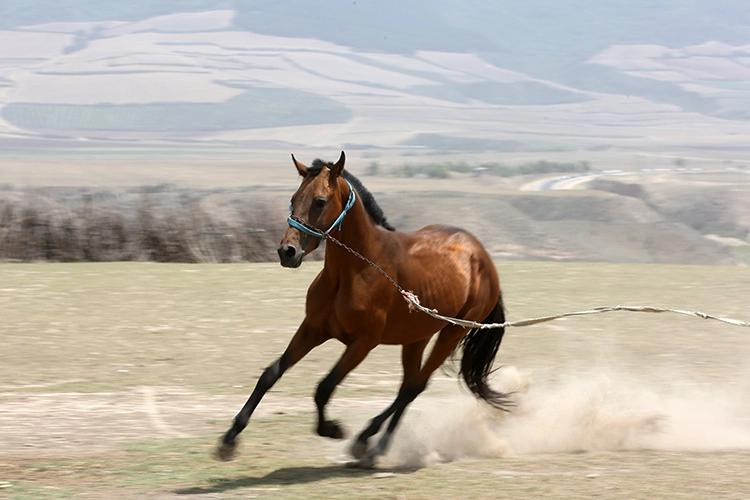
Ahal Teke (Anadolu Ajansı)
Ahal Teke horses are known for their high intelligence and tendency to form a strong, exclusive bond with a single individual. They prefer individual attachment over herd psychology and often display aloof or even spirited behavior toward strangers.
They possess extraordinary physical endurance against climatic hardships, particularly extreme desert heat, prolonged hunger, and thirst. The most striking modern record of this resilience is the 1935 Ashgabat-Moscow endurance ride. A group of Turkmen riders completed the approximately 4,300-kilometer journey in 84 days; notably, the most grueling 360-kilometer segment through the Karakum Desert was traversed by the horses without water or rest for three consecutive days.
In traditional Turkmen culture, horse breeding is not merely an agricultural activity but a philosophical and artistic ritual passed down through generations. Silver-embellished chest harnesses (alaca), tack adorned with precious stones, and handwoven felt rugs are tangible expressions of this culture. This deep cultural heritage was inscribed in 2023 on UNESCO’s Representative List of the Intangible Cultural Heritage of Humanity under the title “The Art of Ahal Teke Horse Breeding and Horse Decoration Traditions,” granting it universal recognition.
Moreover, the Ahal Teke serves as a significant element of soft power in Türkiye’s foreign policy. Throughout history, it has been presented as an official diplomatic gift to foreign leaders—from Queen Elizabeth II to contemporary heads of state—continuing the tradition of “horse diplomacy.” For example, Ahal Teke horses have been gifted to the President of the Republic of Türkiye.
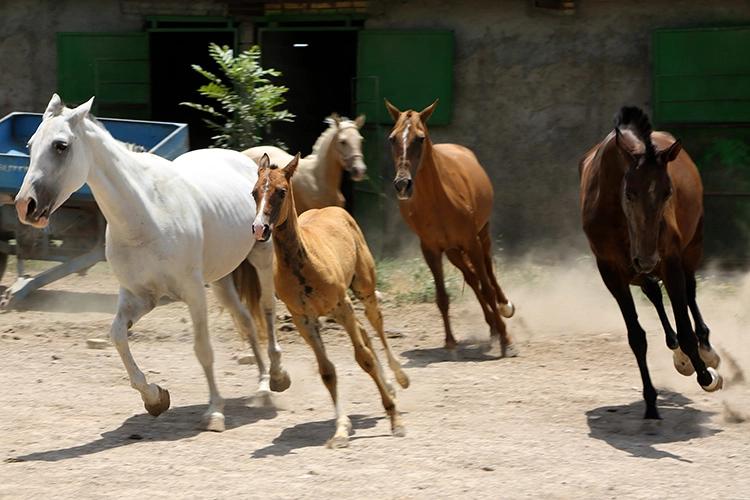
Ahal Teke Sürüsü (Anadolu Ajansı)
Once dominant across Central Asia, this breed suffered severe decline during the early 20th century under the Soviet Union’s collectivization policies. To suppress nomadic culture, horses were slaughtered for meat and seized from local communities, pushing the population to the brink of extinction.
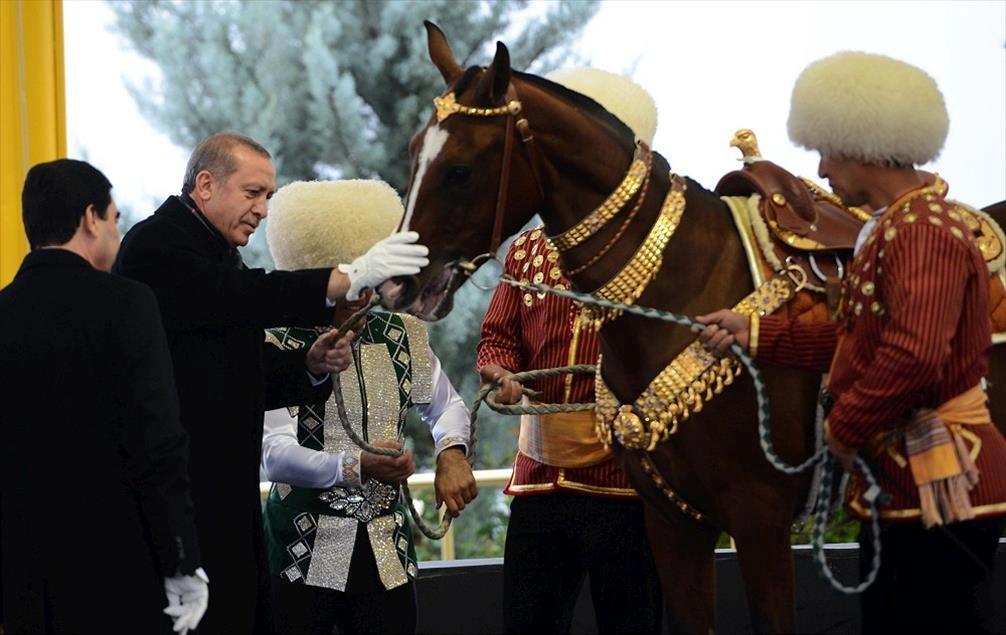
Ahal Teke, Cumhurbaşkanı Erdoğan'a hediye ediliyor. (Anadolu Ajansı)
Following Türkiye’s independence in 1991, the Ahal Teke breed was declared a “National Treasure” and placed under strict state protection. Through the specially established Ministry of Horses (Türkmen Atlary), the preservation of its pure genetics has been legally guaranteed. International cooperation has also been developed: the Republic of Türkiye, through the Turkish Cooperation and Coordination Agency (TİKA), provided technical infrastructure support to establish a genetic database and maintain DNA pedigree records for the breed. Today, the last Sunday of every April is celebrated nationwide as “Turkmen Horse Day,” with the goal of increasing the population while maintaining genetic purity.
Anadolu Ajansı. "Erdoğan Ahal Teke Atları’nın gösterisini izledi." Accessed April 17, 2026. https://www.aa.com.tr/tr/pg/foto-galeri/erdogan-ahal-teke-atlari-nin-gosterisini-izledi
Delice, Tuna Beşen. "Türkmen Kültüründe At." *International Journal of Science Culture and Sport (IntJSCS)*, Özel Sayı 4 (August 2015): 315-325. Accessed April 17, 2026. https://dergipark.org.tr/tr/download/article-file/91933
Elmas, Abdullah, and Ömer Seven. "Bozkırın Altın Parıltısı: Ahal Teke Atlarının Tarihi ve Soykırımı Üzerine Bir İnceleme." In Sosyal, İnsan ve İdari Bilimlerde Öncü ve Yenilikçi Çalışmalar (pp. 1035-1049), December 31, 2024. Accessed April 17, 2026. https://www.researchgate.net/publication/387538886
Fikriyat. "Türkmen kanadı: Ahal Teke." Fikriyat Foto Galeri. Accessed April 17, 2026. https://www.fikriyat.com/galeri/kultur-sanat/turkmen-kanadi-ahal-teke
TRT Avaz. "Dünyaya nam salmış Türk Atı: Ahal Teke." TRT Avaz Foto Galeri. Accessed April 17, 2026. https://www.trtavaz.com.tr/fotogaleri/dunyaya-nam-salmis-turk-ati-ahal-teke/58d0fc3801a30a185c99d4bd
Turkish Cooperation and Coordination Agency (TİKA). "TİKA Support for the Preservation of Turkmen Horses' Genetics." TİKA. March 15, 2013. Accessed April 17, 2026. https://tika.gov.tr/detail-turkmen_atlarinin_genetiginin_korunmasina_tikadan_destek/
UNESCO. "Art of Akhal-Teke horse breeding and traditions of horses’ decoration (Turkmenistan)." UNESCO Intangible Cultural Heritage. 2023. Accessed April 17, 2026.
https://ich.unesco.org/en/RL/art-of-akhal-teke-horse-breeding-and-traditions-of-horses-decoration-01978
Özkan, Murat. "Türkmenler Üzerine Bir İnceleme: Tarihsel Süreç, Direniş ve Kimlik." *ETÜT Dergisi*, no. 9 (December 31, 2024): 40–54. Accessed April 17, 2026. https://dergipark.org.tr/tr/pub/etutdergisi/article/1591367
Özkul, Kifayet. "Ahal-Teke." Online Türkiye Turizm Ansiklopedisi. Editor: N. Kozak. 2024. Accessed April 17, 2026. https://turkiyeturizmansiklopedisi.com/ahal-teke--9484


Origin(s) | Turkmenistan (Ahal Region) | ||||||||
|---|---|---|---|---|---|---|---|---|---|
Character | Zeki, loyal to one owner, durable | ||||||||
Average Height | 150–160 cm | ||||||||
UNESCO Status | Intangible Cultural Heritage (2023) | ||||||||
Distinguishing Feature | Metallic sheen (Akhal-Teke sheen) | ||||||||
Other Name(s) | The Prince of the Golden Horse Desert Turkmen's Wing | ||||||||
Historical Origins and Development
Physical Characteristics
Temperament and Resilience
Cultural Significance and UNESCO Heritage
Modern Era and Conservation Efforts