

This article was automatically translated from the original Turkish version.
+2 More
Construction Date(s) | 18th–19th century (restoration date H. 1327 / M. 1909–1910) | ||||||||
|---|---|---|---|---|---|---|---|---|---|
Location | Pamukkale Türkiye Denizli | ||||||||
Construction Material | Stone foundation, sun-dried brick wall, plaster coating | ||||||||
Protection Status | Registered as a Cultural Heritage Site requiring protection in 2005 | ||||||||
The Akköy Upper Mosque, located in the Akköy Neighborhood of the Pamukkale District in Denizli, constitutes an important example among the late-period rural mosques of the Ottoman State in terms of its architectural features, decorative program, and construction technique. An Ottoman Turkish inscription inside the dome bears the date 1327 AH (1909–1910 CE), which is believed to refer not to the mosque’s original construction but to subsequent restoration and decoration works. Based on its decorative and architectural characteristics, it is assessed that the mosque was originally built between the late 18th and early 19th centuries, reflecting one of the manifestations of the Ottoman Empire’s westernization process in rural areas.
Designated as a “Cultural Asset Requiring Protection” by the İzmir II Regional Board for the Conservation of Cultural and Natural Heritage in its 2005 decision numbered 801, the Akköy Upper Mosque is among the few mosques in Denizli featuring penwork decoration and holds a distinctive position in regional art history for this reason.
The mosque has a rectangular plan. The central section of the prayer hall (harim), although covered externally by a broken roof, is internally equipped with a concealed dome. The drum of the dome is circular on the interior, and its surfaces are entirely covered with interior decorative elements.
To the north of the harim, there is a final congregation area supported by six wooden pillars, which has since been enclosed. The minaret, added later to the eastern side of this section, is among the elements incorporated into the original design at a subsequent stage.
The mosque’s foundation is constructed of rubble stone, while its walls are built of sun-dried brick and covered with plaster. The roof is tiled with Marseille-type tiles. A simple mihrab niche is located on the north wall of the harim, while a wooden minbar is positioned in the southwest corner.
A two-story wooden gallery occupies the northern section of the harim and is notable for its intensive wood carving and decorative work.
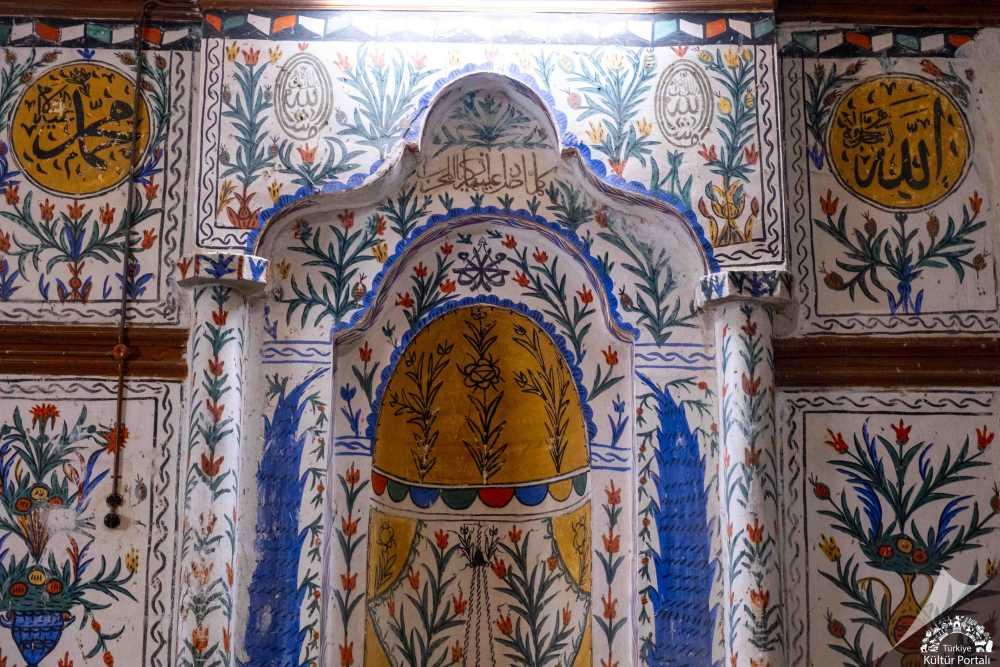
The Akköy Upper Mosque is one of the finest examples of the penwork decoration tradition found in 18th and 19th century Ottoman mosques in the Denizli region. The decorative scheme, arranged in two horizontal bands along the south, east, and west walls of the harim, consists primarily of floral compositions.
The wall surfaces feature floral bouquet motifs arranged in band-like patterns. In addition, symbolic elements such as scales and lanterns have been incorporated into the decorative repertoire. These iconographic elements are significant both in terms of religious symbolism and the aesthetic sensibilities of the period.
The interior surface of the mihrab is adorned with floral and lantern motifs. Although the overall arrangement of the mihrab is simple, the painted decorations on its inner surface enrich the spatial experience. The interior dome decorations are particularly notable for the symmetrical and balanced placement of floral motifs.
Woodwork also stands out as a key decorative element. Intensive carving has been applied to the minbar, door panels, gallery railings, and ceiling medallions, combining geometric and floral motifs.
The exact date of the mosque’s construction is unknown, but its architectural and decorative features point to the 18th and 19th centuries. The inscription inside the dome serves as evidence of a restoration or renewal work carried out between 1909 and 1910. During this period, the wall and dome decorations were likely renewed, and certain wooden elements were repaired or replaced.
Since its designation in 2005, the structure has been the subject of surveying, restitution, and restoration projects under a protocol signed between the Denizli Metropolitan Municipality and the Pamukkale Municipality. The restoration efforts aim to preserve both the structural integrity of the mosque and the original character of its decorative elements.
The Akköy Upper Mosque reflects the typical characteristics of Ottoman rural mosques in terms of its plan, construction materials, and decorative program, while offering a distinctive example for the Denizli region through its interior penwork decorations. In particular, the inclusion of figurative elements such as scales and lantern motifs enhances the mosque’s art historical value. The woodwork provides important insights into the application of Ottoman carpentry and carving techniques in rural contexts.
Denizli Metropolitan Municipality. "Büyükşehir tarihi Akköy Yukarı Cami’yi yeniden ayağa kaldıracak." Accessed August 17, 2025. https://denizli.bel.tr/Default.aspx?k=odullerimiz&id=23199
Ministry of Culture and Tourism, "Akköy Yukarı (Eski) Cami – Denizli," *Kültür Portalı*, August 17, 2025. Accessed https://www.kulturportali.gov.tr/turkiye/denizli/gezilecekyer/akkoy-yukari--eski--cami-.
İnce, Kasım. "Yukarı Camii 1 Akköy-Denizli." *Yüzüncü Yıl Üniversitesi Sosyal Bilimler Enstitüsü Dergisi*, no. 2 (2001): 167–173. Accessed https://isamveri.org/pdfdrg/D01732/2001_2/2001_2_INCEK.pdf
Construction Date(s) | 18th–19th century (restoration date H. 1327 / M. 1909–1910) | ||||||||
|---|---|---|---|---|---|---|---|---|---|
Location | Pamukkale Türkiye Denizli | ||||||||
Construction Material | Stone foundation, sun-dried brick wall, plaster coating | ||||||||
Protection Status | Registered as a Cultural Heritage Site requiring protection in 2005 | ||||||||
No Discussion Added Yet
Start discussion for "Akköy Upper (Old) Mosque" article
Architectural Layout
Decorative Program
Historical Development and Restorations
Art Historical Significance