

This article was automatically translated from the original Turkish version.
+2 More
Period(s) | Anatolian Seljuk | ||||||||
|---|---|---|---|---|---|---|---|---|---|
Construction Date(s) | 1250 (Hijri 648) | ||||||||
Other Name(s) | Halkalı Madrasa Sahip Ata Madrasa | ||||||||
Location | Konya Akşehir | ||||||||
Construction Material | Rubble stone, brick, spolia marble columns. | ||||||||
Architectural Plan | Open courtyard. Arcaded. Three-iwan (original plan was four-iwan). | ||||||||
Current Function | Museum (opened in 1965, restored and reopened in 2020) | ||||||||
Historical Function | Education (madrasa), Health (darüşşifa) | ||||||||
Külliye Sections | Madrasa, mosque, tomb (surviving structures). Khanqah, imaret, fountain (demolished structures) | ||||||||
Patron | Seljuk Vizier Sâhib Ata Fahreddin Ali | ||||||||
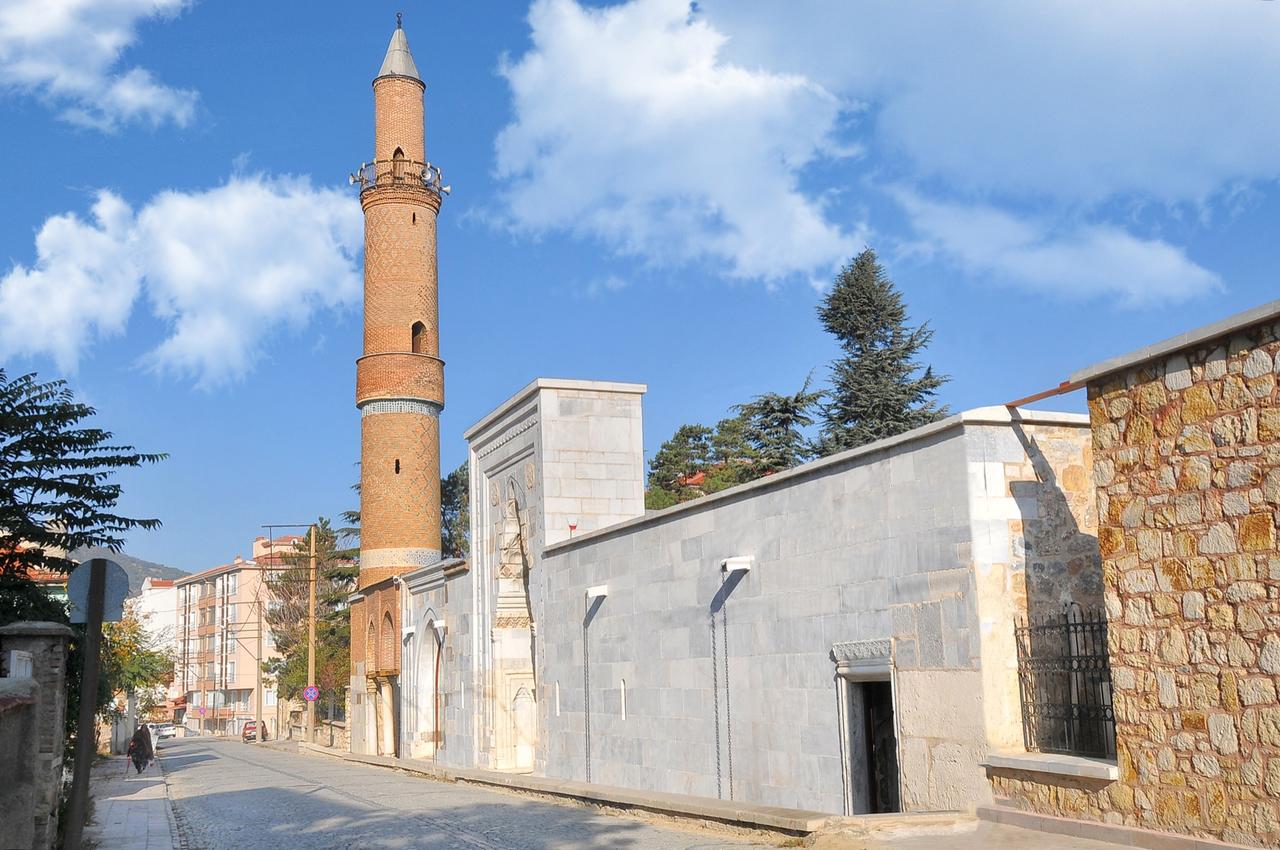
Akşehir Taş Medrese is a 13th-century structure located in the district of Akşehir in Konya. It dates from the Anatolian Seljuk period and was commissioned in 1250 (H. 648) by Seljuk Vizier Sâhib Ata Fahreddin Ali. Originally, it served as the central component of a large külliye, which included the medrese, mosque, türbe, hankah, imaret, and çeşme. Only the medrese, mosque, and türbe sections have survived to the present day. The structure is commonly known locally as “Halkalı Medrese” and “Sahip Ata Medresesi.” Historical sources indicate that the building was also used at times as a darüşşifa (hospital).
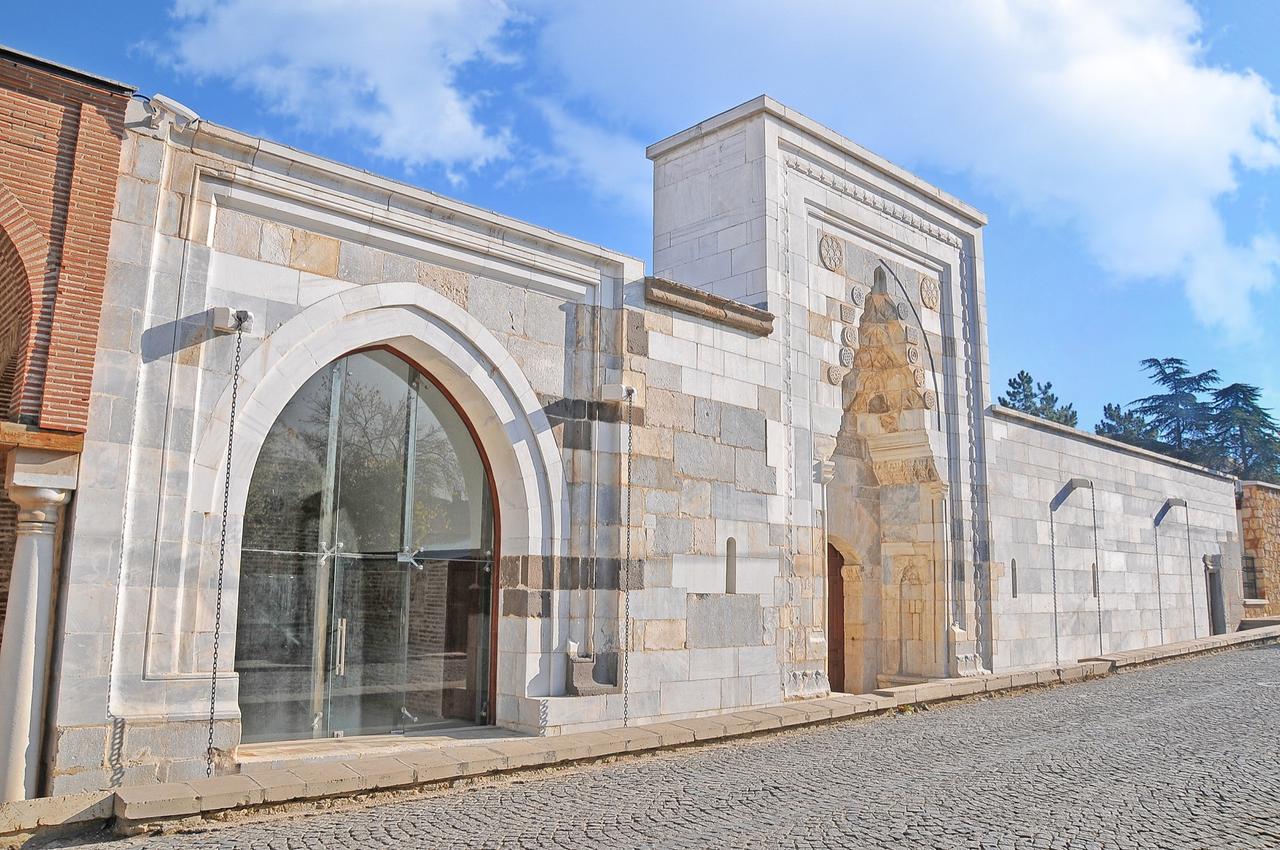
Akşehir Taş Medrese (Akşehir Belediyesi)
The main structure of the külliye, the medrese, was completed in 1250 as one of the significant architectural projects of the Anatolian Seljuk period in the 13th century. According to its foundation inscription, the hankah was added to the complex in 1261 but has since been lost. Over time, the hankah, imaret, and çeşme — among the earliest examples of Sâhib Ata’s architectural style — were demolished; only fragments of the hankah’s foundation inscription and some stones from its marble portal remain. The building’s portal lost much of its original character in 1910 when the then Akşehir mufti ordered its stones to be dismantled down to the base for restoration, but the work was left unfinished.【1】
During the Republican era, the structure was recognized as Akşehir’s first museum. Following a comprehensive restoration between 1960 and 1965, it opened to the public in 1965 as an archaeology museum. The building underwent further repairs in 1971 and 1986, and after extensive exhibition and renovation works, it was officially reopened in 2020 by the Presidency of the Republic under the name “Taş Eserler Müzesi” (Stone Artifacts Museum). Today, the museum displays Seljuk and Ottoman-era tombstones, sarcophagi, and inscriptions collected from Akşehir and its surroundings.【2】
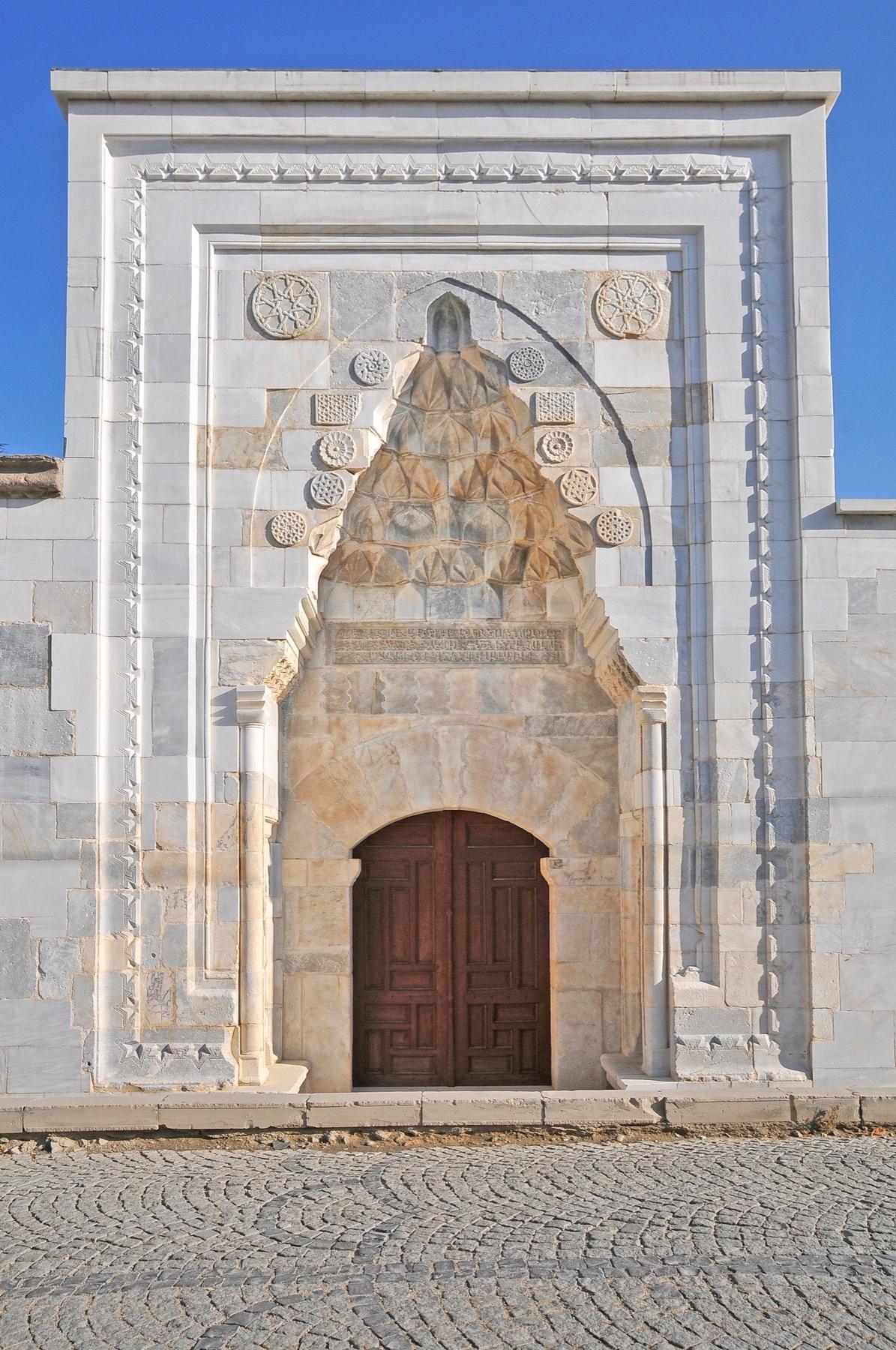
Taç Kapı (Akşehir Beledyesi)
Akşehir Taş Medrese belongs to the group of open courtyard and iwan-type medreses. Its original plan featured four iwans, but subsequent historical restorations transformed it into a three-iwan structure. The medrese has a rectangular plan oriented east-west. The courtyard is surrounded by arcades with brick arches. The load-bearing columns are made of devşirme material.
The building combines rubble stone, brick, and devşirme marble. The western façade is clad in marble and features a monumental portal that reflects classical Anatolian Seljuk design. Student cells are arranged around the courtyard and are covered with barrel vaults. Each cell contains hearths and niche cupboards. The winter classrooms are domed, with transitional zones formed by prismatic triangular elements.
Adjacent to the medrese is a square-plan mosque with a single dome. At the northwest corner of the mosque rises a two-tiered brick minaret decorated with tiles. This two-tiered minaret design is a rare feature in Anatolian Seljuk architecture.
Inside the complex is a square-plan türbe dedicated to Sâhib Ata. Beneath the türbe lies a crypt (mummification chamber). The dome is adorned with turquoise-glazed bricks. The dome’s base features geometric ceramic mosaics resembling Kufic script.
Various inscriptions are carved into the courtyard arcade columns and on the walls of the main iwan using the incised technique. These texts reflect the sociocultural structure of the period. Phrases such as “Ah Şahım,” “Muhammed,” and “minhac” appear on the columns. 【3】These inscriptions reveal the structure’s connection to Alevi-Bektashi culture.【4】Texts reflecting Sufi thought were used not merely as architectural ornamentation but as expressive instruments of spiritual identity.
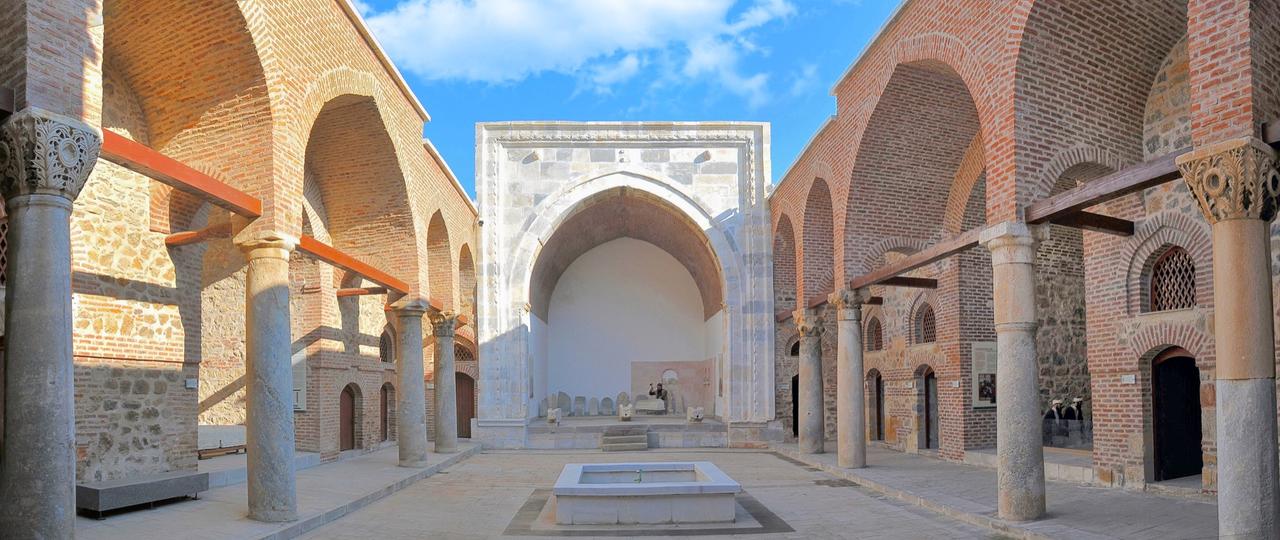
Akşehir Taş Medrese (Akşehir Belediyesi)
The Taş Medrese is Akşehir’s first museum building. It underwent major restoration between 1960 and 1965 and opened to the public in 1965 as an archaeology museum. The structure was repaired again in 1971 and 1986. 【5】Following extensive restoration projects, it acquired its current identity as the Taş Eserler Müzesi. After completion of comprehensive restoration, the building was officially reopened to the public in 2020 by the Presidency of the Republic.
Today, the museum houses a rich collection of stone artifacts. Turk-Islamic period tombstones collected from Akşehir and its surroundings are on display. Sarcophagi and inscriptions are also part of the museum’s inventory. In addition, the museum presents reconstructions of medrese life, education, and stonemasonry techniques to visitors.
Akok, Mahmut. “Konya - Akşehirde Taş Medrese Binası ve Restarosyon Çalışmaları.” *Türk Etnografya Dergisi* 66 (1977): 5–26. Accessed March 22, 2026. https://dergipark.org.tr/en/download/article-file/2158396
Akşehir Belediyesi. "Taş Eserler Müzesi." aksehir.bel.tr. Accessed March 22, 2026. https://www.aksehir.bel.tr/galeri/aksehirde_resmi_yapilar/muzeler/tas_eserler_muzesi
Ertaş, Şebnem. “Konya Akşehir Taş Medresesinin Taş Eserler Müzesine Dönüşümü.” Süleyman Demirel Üniversitesi Mimarlık Bilimleri ve Uygulamaları Dergisi 2, no. 2 (2017): 1–17. Accessed March 22, 2026. https://dergipark.org.tr/en/download/article-file/390740
Kalfazade, Selda. "Taşmedrese." *TDV İslâm Ansiklopedisi.* Accessed March 22, 2026. https://islamansiklopedisi.org.tr/tasmedrese
Turkish Museums. "Konya Akşehir Taş Eserler Müzesi." *turkishmuseums.com.* Accessed March 22, 2026. https://www.turkishmuseums.com/museum/detail/2132-konya-aksehir-tas-eserler-muzesi/2132/1
Yılmaz, Muzaffer, and Betül Doğruer. “Akşehir Taş Medrese Eyvan ve Sütunlarındaki Yazılar ile Alevi-Bektaşi Kültürü Arasındaki İlişki.” *Sanat Tarihi Dergisi* 30, no. 1 (2021): 457–495. Accessed March 22, 2026. https://dergipark.org.tr/en/pub/std/article/834329
[1]
Selda Kalfazade, "Taşmedrese," TDV İslâm Ansiklopedisi, Erişim 22 Mart 2026, https://islamansiklopedisi.org.tr/tasmedrese
[2]
Turkish Museums, "Konya Akşehir Taş Eserler Müzesi," turkishmuseums.com, Erişim 22 Mart 2026, https://www.turkishmuseums.com/museum/detail/2132-konya-aksehir-tas-eserler-muzesi/2132/1
[3]
Muzaffer Yılmaz ve Betül Doğruer, "Akşehir Taş Medrese Eyvan ve Sütunlarındaki Yazılar ile Alevi-Bektaşi Kültürü Arasındaki İlişki," Sanat Tarihi Dergisi 30, sy. 1 (2021): 463. https://dergipark.org.tr/en/download/article-file/1425600
[4]
Yılmaz ve Doğruer, "Akşehir Taş Medrese Eyvan ve Sütunlarındaki Yazılar ile Alevi-Bektaşi Kültürü Arasındaki İlişki," 486-487.
[5]
Turkish Museums, "Konya Akşehir Taş Eserler Müzesi," turkishmuseums.com, Erişim 22 Mart 2026, https://www.turkishmuseums.com/museum/detail/2132-konya-aksehir-tas-eserler-muzesi/2132/1
Selda Kalfazade, "Taşmedrese," TDV İslâm Ansiklopedisi, Erişim 22 Mart 2026, https://islamansiklopedisi.org.tr/tasmedrese

Period(s) | Anatolian Seljuk | ||||||||
|---|---|---|---|---|---|---|---|---|---|
Construction Date(s) | 1250 (Hijri 648) | ||||||||
Other Name(s) | Halkalı Madrasa Sahip Ata Madrasa | ||||||||
Location | Konya Akşehir | ||||||||
Construction Material | Rubble stone, brick, spolia marble columns. | ||||||||
Architectural Plan | Open courtyard. Arcaded. Three-iwan (original plan was four-iwan). | ||||||||
Current Function | Museum (opened in 1965, restored and reopened in 2020) | ||||||||
Historical Function | Education (madrasa), Health (darüşşifa) | ||||||||
Külliye Sections | Madrasa, mosque, tomb (surviving structures). Khanqah, imaret, fountain (demolished structures) | ||||||||
Patron | Seljuk Vizier Sâhib Ata Fahreddin Ali | ||||||||
No Discussion Added Yet
Start discussion for "Akşehir Stone Madrasa" article
History
Architectural Features
Mosque and Türbe
Courtyard Columns and Decorations
Transformation into a Museum and Restoration Process