


This article was automatically translated from the original Turkish version.
+1 More
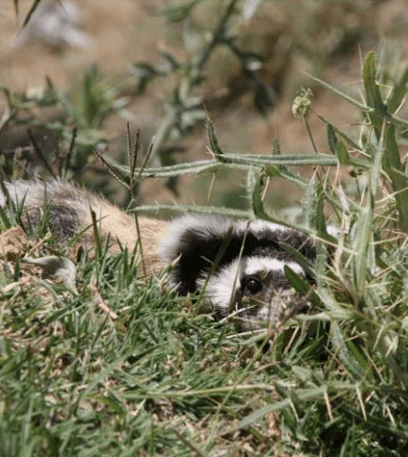
Alaca Sansar (Vormela Peregusna)
Realm | Animalia | ||||||||
|---|---|---|---|---|---|---|---|---|---|
Branch | Chordata | ||||||||
Class | Mammalia | ||||||||
Team(s) | Carnivora | ||||||||
Family | Mustelidae | ||||||||
Genus | Vormela | ||||||||
Specie(s) | Vormela peregusna | ||||||||
Body Length | 29 - 35 cm | ||||||||
Tail Length | 13 - 20 cm | ||||||||
Weight(s) | 0.5 - 0.7 kg | ||||||||
Habitat | Bozkır | ||||||||
The honey badger (Vormela peregusna) is a small carnivorous mammal belonging to the family Mustelidae and distributed across Eurasia. Recognized for its distinctive coat pattern and unique behavior, this species is rarely observed in Türkiye. The honey badger holds an important ecological role due to its habitat preferences, feeding habits, and conservation status.
The body length of the honey badger ranges from an average of 29–35 cm, with a tail length of 13–20 cm. Its weight is approximately 0.5–0.7 kg. Its fur displays a complex pattern of black, yellow, and white spots. The face is typically white, with a black ring around the eyes. The tail is furred and marked with distinct bands. This coloration and patterning provide both camouflage and a deterrent appearance when threatened.
The honey badger inhabits a wide geographic range extending from Central and Eastern Europe to Central Asia. It generally prefers semi-arid environments, open grasslands, rocky terrain, and steppes. It has also been occasionally observed near human settlements. In Türkiye, it has been recorded in parts of Thrace, Eastern Anatolia, and Central Anatolia.
Being nocturnal, the honey badger is typically solitary and spends its days resting in its burrow. It locates prey primarily by scent and can move with great speed. Its diet is carnivorous, consisting of rodents, reptiles, birds, and insects. Carrion has also been observed as part of its diet. When threatened, it arches its back and raises its fur to appear larger than it is. It can also emit a foul-smelling secretion as a defense mechanism.
Honey Badger Documentary (TRT Documentary)
The breeding season typically begins in spring. Gestation lasts approximately 243 days, with delayed implantation observed. As a result, young are born toward the end of summer. A litter usually consists of 4–8 offspring. Pups are born blind and hairless, and develop over several weeks under the care of their mother, who gradually teaches them to hunt.
The honey badger is classified as “Vulnerable” by the International Union for Conservation of Nature. Major threats to its population include habitat loss, agricultural activities, rodenticides, and human disturbance. In Türkiye, it is listed among endangered species, and various scientific monitoring efforts and awareness campaigns are underway to ensure its protection.
Although records of its presence in Türkiye are limited, the species has been documented through camera traps and roadside observations in various regions. This species is ecologically significant as a component of biodiversity conservation and plays a key role in maintaining ecosystem balance. In particular, it contributes to controlling pest rodent populations in agricultural areas.
Animal Diversity Web. "Vormela peregusna marbled polecat." Animal Diversity Web Website. Accessed May 28, 2025. https://animaldiversity.org/accounts/Vormela_peregusna/
Gözcelioğlu, Bülent. "Soyu Tehlikede Karasal Bir Yırtıcımız Alaca Sansar". *Tubitak Bilim ve Teknik Dergisi, sayı 501, s. 84, 2009.* Accessed May 28, 2025. https://services.tubitak.gov.tr/edergi/yazi.pdf?dergiKodu=4&cilt=42&sayi=640&sayfa=84&yaziid=28217
Karadavut, Zekeriya. "Aksaray'da nesli tükenme tehlikesi altındaki alacasansar görüldü." Anadolu Ajansı. Accessed May 28, 2025. https://www.aa.com.tr/tr/turkiye/aksarayda-nesli-tukenme-tehlikesi-altindaki-alacasansar-goruldu/1912830
Kelleci, Beşir. "Bayburt'ta alaca sansar görüldü". Aksaray'da nesli tükenme tehlikesi altındaki alacasansar görüldü". Anadolu Ajansı. Accessed May 28, 2025. https://www.aa.com.tr/tr/yasam/bayburtta-alaca-sansar-goruldu/2963566
TRT Belgesel. *Yok Olmadan Keşfet - Alaca Sansar*. YouTube video. Accessed May 28, 2025. https://www.youtube.com/watch?v=ZcsTZ-MptXE

Alaca Sansar (Vormela Peregusna)
Realm | Animalia | ||||||||
|---|---|---|---|---|---|---|---|---|---|
Branch | Chordata | ||||||||
Class | Mammalia | ||||||||
Team(s) | Carnivora | ||||||||
Family | Mustelidae | ||||||||
Genus | Vormela | ||||||||
Specie(s) | Vormela peregusna | ||||||||
Body Length | 29 - 35 cm | ||||||||
Tail Length | 13 - 20 cm | ||||||||
Weight(s) | 0.5 - 0.7 kg | ||||||||
Habitat | Bozkır | ||||||||
No Discussion Added Yet
Start discussion for "Alaca Sansar (Vormela peregusna)" article
Morphological Characteristics
Habitat and Distribution
Behavior and Diet
Reproduction and Life Cycle
Conservation Status and Threats
Observations and Significance in Türkiye