This article was automatically translated from the original Turkish version.
Location | Konya | ||||||||
|---|---|---|---|---|---|---|---|---|---|
Elevation(s) | Approximately 20 meters | ||||||||
Building Type | Archaeological mound | ||||||||
Alâeddin Tepesi is a natural and artificial elevation in the city center of Konya, Türkiye, possessing historical, archaeological and urban significance. Located at the heart of Konya, the hill has hosted various civilizations throughout history and is today regarded as a multi-layered space from both scientific and social perspectives.

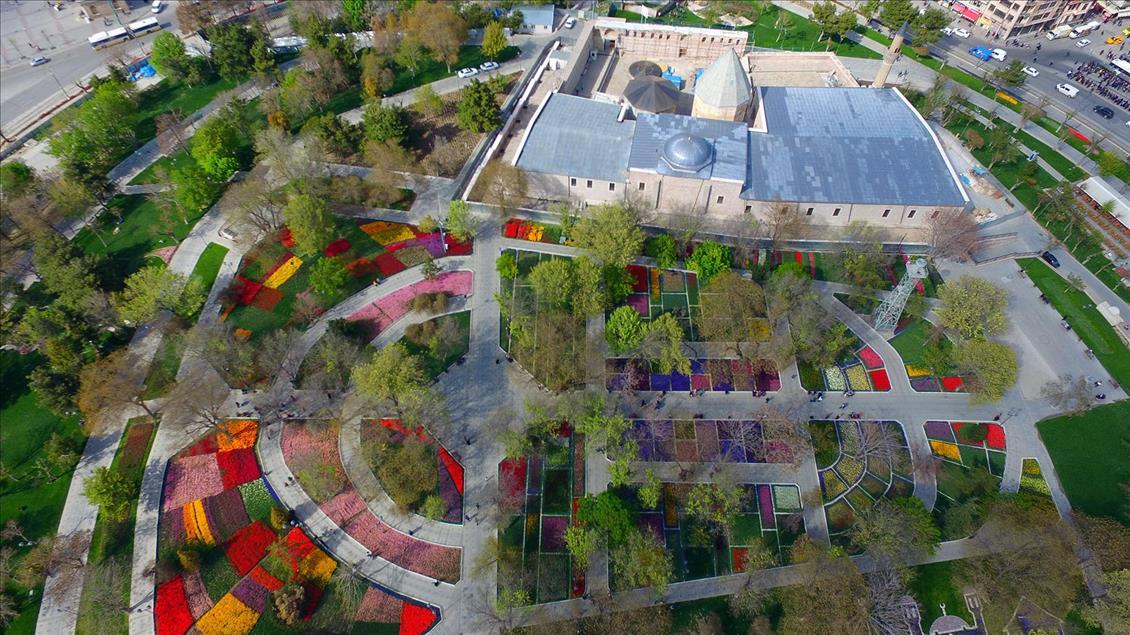
Alâeddin Tepesi (Türkiye Culture Portal)
Alâeddin Tepesi is an oval-shaped mound approximately 450 metres in length from north to south and 350 metres from east to west, with an average height of 20 metres. Situated on the western edge of the Konya Plain near water sources, the hill played a decisive role in the city’s settlement patterns. Its position is strategically significant in terms of built structures and urban connectivity.
Archaeological excavations conducted in 1941 under the leadership of Mahmut Akok on behalf of the Turkish Historical Society revealed that Alâeddin Tepesi is a tell. These investigations established that the settlement stratigraphy of the hill is multi-layered. The occupation dates back to the 2000s BCE and began in earnest during the Phrygian period of the 9th–8th centuries BCE.
Excavations have uncovered architectural remains from the Phrygian, Hellenistic, Roman, Byzantine, Seljuk and Ottoman periods. Among these are stone foundations, mudbrick wall fragments, hearths, tandoor ovens, defensive structures and storage remains. Particularly, Seljuk-era hearth structures and Ottoman-era tombs provide clear evidence of the hill’s long-standing and continuous habitation.
During the Seljuk period, Alâeddin Tepesi functioned as a central administrative area with inner citadel and palace structures. Remains of a pavilion from the reign of II. Kılıç Arslan preserve physical traces of this political function. The Alâeddin Camii, constructed on the hill, was initiated during the reign of I. Mesud and completed under Alâeddin Keykubad, becoming one of the most important examples of Seljuk architecture. Within the mosque’s courtyard are sarcophagi belonging to Seljuk sultans.
During the Ottoman period, Alâeddin Tepesi and its surroundings retained their importance, becoming the center of urban life through the mosque, bazaar and square structures. Unlike Western examples, however, the concept of a central square was not adopted; instead, the area around the mosque served as the primary space for communal gathering and interaction.
In modern Konya, Alâeddin Tepesi functions both as an urban landscape element and as a public space where daily life unfolds. Around and atop the hill are tea gardens, walking paths, children’s play areas, ceremonial grounds and structures such as the Alâeddin Keykubad Hall. It serves as a major meeting point where social interaction intensifies during the summer months. The hill also lies at the intersection of Konya’s main transportation axes and forms a spatial unity with the city’s bazaar, mosques and administrative centers.
Alâeddin Tepesi and its surroundings hold a significant place in Konya’s architectural memory. Historical structures from the Seljuk and Ottoman periods such as madrasas, tombs and mosques are concentrated around the hill. Notable among these are İplikçi Camii, Kapu Camii, Şerafettin Camii and Aziziye Camii. Additionally, the Mevlâna Külliyesi is within walking distance of the hill. This concentration of structures has transformed Alâeddin Tepesi into both the origin point and the enduring focal center of Konya’s urban history.
Alâeddin Tepesi stands out as an archaeologically multi-layered settlement site, historically the administrative and cultural center of Konya, and sociologically a public space embedded in the city’s collective memory. In terms of its history, physical location, built structures and daily functions, Alâeddin Tepesi is one of the rare examples where the experience of the past and the present converge on the same ground.
Akok, Mahmut. “Konya Şehri İçindeki Alaeddin Tepesinde Türk Tarih Kurumu Adına Yapılan Arkeolojik Kazıların Mimari Buluntuları.” *Belleten* 85, no. 304 (2021): 215–246. Accessed July 3, 2025. https://dergipark.org.tr/tr/download/article-file/2616766.
Nacak, İbrahim. “Bir Kentsel Mekân Olarak Konya Alâeddin Tepesinde Gündelik Hayat.” *Selçuk Üniversitesi Edebiyat Fakültesi Dergisi (SEFAD)* 40 (2018): 235–252. Accessed July 3, 2025. https://dergipark.org.tr/tr/download/article-file/630383.
Turk Tarih Kurumu. “Konya Şehri İçindeki Alaeddin Tepesinde Türk Tarih Kurumu Adına Yapılan Arkeolojik Kazıların Mimari Buluntuları.” *Belleten* 85, no. 304 (2021): 215–246. Accessed July 3, 2025. https://belleten.gov.tr/tam-metin/1359/tur.

Location | Konya | ||||||||
|---|---|---|---|---|---|---|---|---|---|
Elevation(s) | Approximately 20 meters | ||||||||
Building Type | Archaeological mound | ||||||||
No Discussion Added Yet
Start discussion for "Alâeddin Hill (Konya)" article
Physical Characteristics and Location
Archaeological Stratification and Excavations
Historical and Political Function
Urban Space and Daily Life
Architectural and Cultural Traces