


This article was automatically translated from the original Turkish version.
+1 More
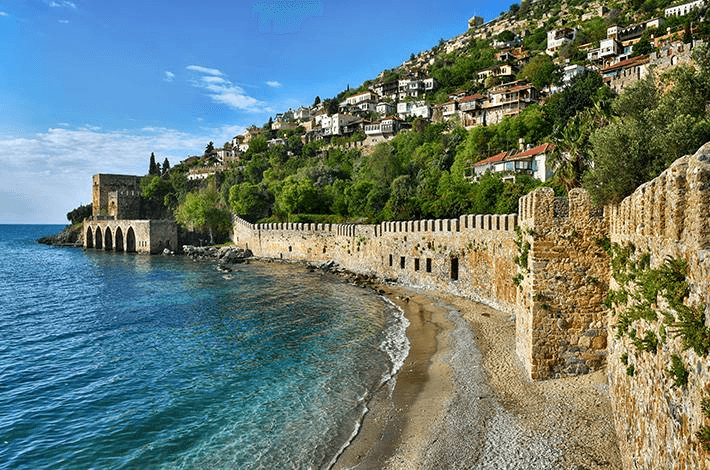
Alanya Castle
Civilizations that Hosted İt | Rome, Byzantine, Seljuk and Ottoman | ||||||||
|---|---|---|---|---|---|---|---|---|---|
Period of Construction | Middle Ages | ||||||||
Alanya Castle is located in the district of Alanya in Antalya and covers an area of place. It is one of the city’s most iconic symbols. Built on a peninsula approximately 250 metres above sea level, its walls extend for a total length of 6.5 kilometres.
Alanya Castle is a significant structure located in the Mediterranean region, in the district of Alanya in Alanya, which has been associated with numerous civilizations throughout history. The castle has existed since the Hellenistic Period and was repaired and expanded during the Roman, Byzantine, Seljuk and Ottoman periods. In antiquity, Alanya, situated in the western part of Cilicia, became a centre for pirates due to the natural protection offered by its geographical layout.
In the 2nd century BCE, Alanya was under pirate control until it was incorporated into the Roman Empire in 67 BCE following the victory of the Roman commander Pompey in the Coracesium War. During the Byzantine Period, Alanya was known as Kalonoros (Beautiful Mountain) and became one of the key centres of Mediterranean trade. In 1221, it was conquered by the Anatolian Seljuk Sultan I. Alaaddin Keykubat and renamed Alaiye. During the Seljuk period, the castle was expanded with new cisterns and walls constructed. Alanya Castle retained its importance during the Ottoman period and was enriched with structures reflecting traditional Ottoman architecture.

Alanya Castle, Source: Museum Card
Alanya Castle is an imposing structure distinguished by its 6.5-kilometre-long walls and 140 towers. The castle is equipped with three major structures: Kızılkule, Tersane and Tophane. Kızılkule, an octagonal tower built with red bricks, served a defensive purpose.
The cisterns within the castle were used to meet the water needs of its inhabitants and some continue to function today. The Süleymaniye Camii, located in the Upper Castle area and added during the Ottoman period, along with traditional Alanya houses, illustrate the architectural diversity of the fortress.
The castle consists of three distinct sections: Outer Castle (Aşağı Kale), Middle Castle (Ehmedek) and Inner Castle.
Other notable features of the castle include a Byzantine-era cloverleaf-shaped chapel and “peçeli delikler” — openings used to pour pitch on attackers.

Alanya Castle, Source: Museum Card
Alanya Castle functions as an open-air museum that encapsulates the region’s rich history. Its conquest enabled I. Alaaddin Keykubat to adopt the title "Sultan of Two Seas".
Today, Alanya Castle is a major tourist attraction visited by both domestic and foreign tourists. Archaeological excavations and restoration projects conducted at the castle ensure the preservation of its historical integrity for future generations.
"Alanya Kalesi." *Selçuklu Mirası*. Accessed March 14, 2025. https://www.selcuklumirasi.com/architecture-detail/alanya-kalesi.
Ministry of Culture and Tourism of the Republic of Türkiye. "Alanya Kalesi." *Kültür Portalı*. Accessed March 14, 2025. https://www.kulturportali.gov.tr/turkiye/antalya/gezilecekyer/alanya-kalesi.
Ministry of Culture and Tourism of the Republic of Türkiye. "Alanya Kalesi." *Müze Kart*. Accessed March 14, 2025. https://muze.gov.tr/muze-detay?SectionId=ALN01&DistId=ALN.

Alanya Castle
Civilizations that Hosted İt | Rome, Byzantine, Seljuk and Ottoman | ||||||||
|---|---|---|---|---|---|---|---|---|---|
Period of Construction | Middle Ages | ||||||||
History
Architectural Features
Cultural and Historical Significance