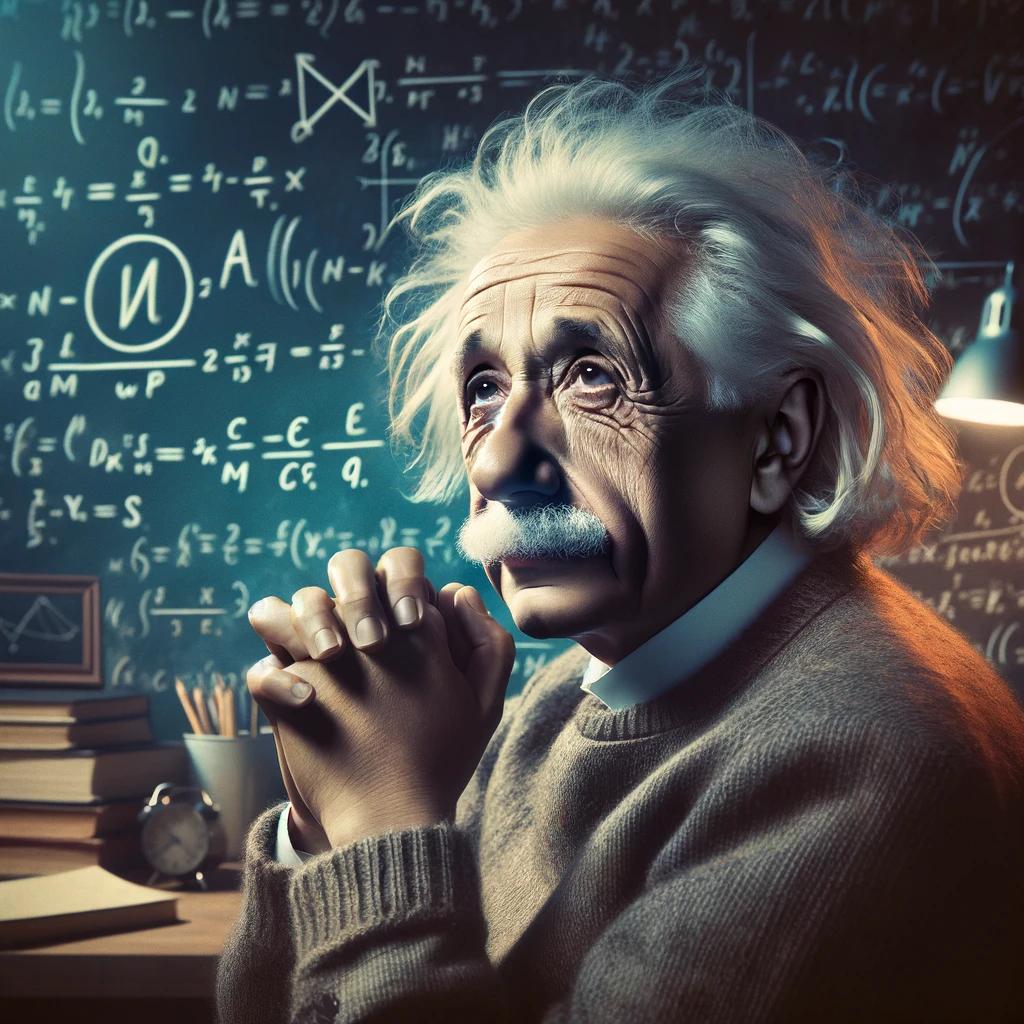
Albert Einstein was born on 14 March 1879 in the city of Ulm, Germany, and died on 18 April 1955 in Princeton, New Jersey, USA. He is one of the most influential individuals in the history of physics and made significant contributions to the development of modern physics.
Education and Early Career
Einstein moved with his family from Ulm, Germany, to together Munich. He experienced difficulties with speaking and reading during childhood but overcame these challenges to continue his education.
- High School and University: Einstein began his studies at the Luitpold Gymnasium in Munich, Germany. However, he clashed with teachers due to his resistance to the school’s rigid rules. He enrolled at the Swiss Federal Polytechnic School in Zurich (later known as ETH Zurich), where he studied physics and mathematics and graduated in 1900.
- Early Career: In 1902, Einstein secured a job at the Swiss Patent Office in Bern. This position provided him with the time to develop his scientific ideas. While working at the patent office, he began writing various scientific papers.
Major Scientific Contributions
- Special Relativity (1905): In 1905, Einstein experienced a groundbreaking year in science, known as the “Annus Mirabilis” or “Miracle Year,” during which he published four landmark papers. One of these papers, on the photoelectric effect, established that light exhibits both wave and particle properties and earned him the Nobel Prize in 1921. In the same year, he developed the theory of special relativity, which demonstrated that time and space are relative to the observer. He also introduced the famous equation E=mc², showing that energy and mass are interchangeable.
- General Relativity (1915): In 1915, Einstein formulated the theory of general relativity. This theory extended Newton’s laws of gravitation by proposing that mass curves spacetime, creating the force we perceive as gravity. It provided a framework for understanding how massive objects influence spacetime and has been confirmed by numerous observations over time.
- Quantum Theory: Einstein also contributed to the development of quantum theory. His 1905 paper on the photoelectric effect proposed the quantum nature of light. Additionally, his work on Brownian motion (the random movement of particles suspended in a fluid) provided empirical evidence supporting the atomic theory of matter.
Other Works and the Nobel Prize
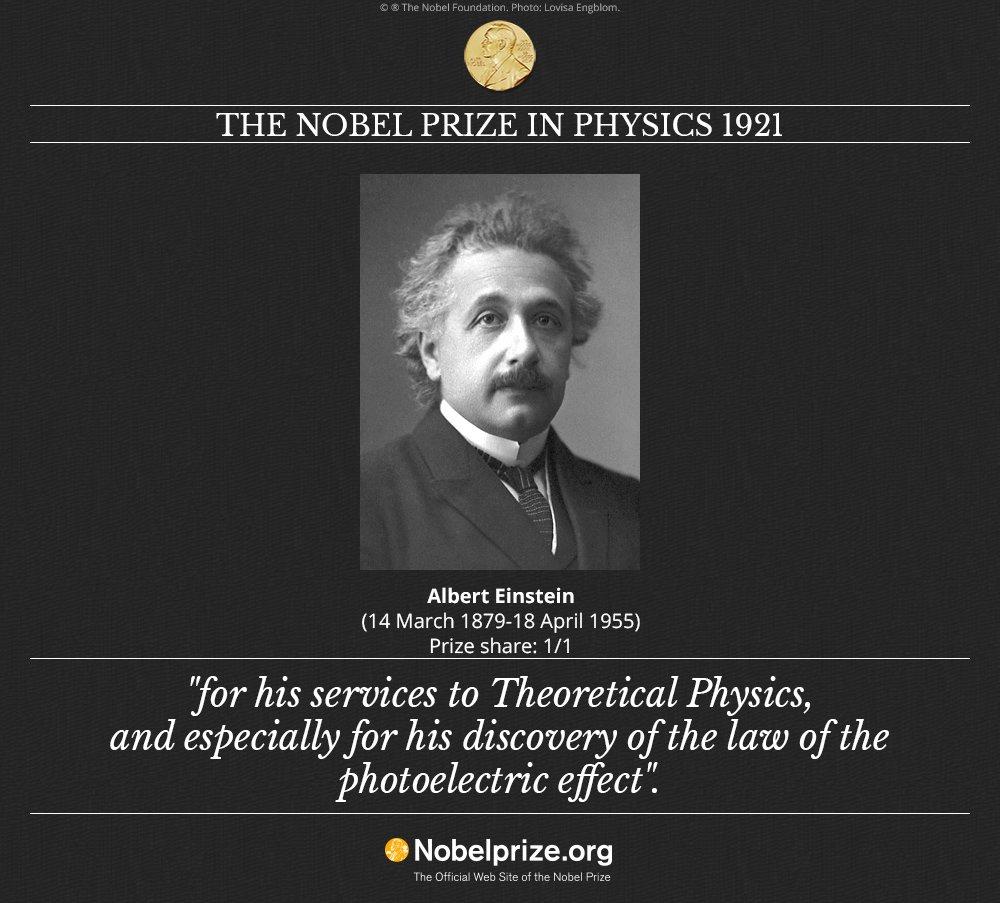
Einstein receiving the 1921 Nobel Prize in Physics
- In 1921, he was awarded the Nobel Prize in Physics for his work on the photoelectric effect.
- In 1933, due to the rise of the Nazi regime, Einstein emigrated from Germany to the United States. He became a professor at Princeton University, where he spent the remainder of his life.
- Einstein contributed to research related to the development of the atomic bomb during the war. However, he opposed the use of nuclear weapons and advocated for the continuation of scientific research for peaceful purposes after the war.
- In the early 1950s, he worked on the unified field theory but was unable to complete it.
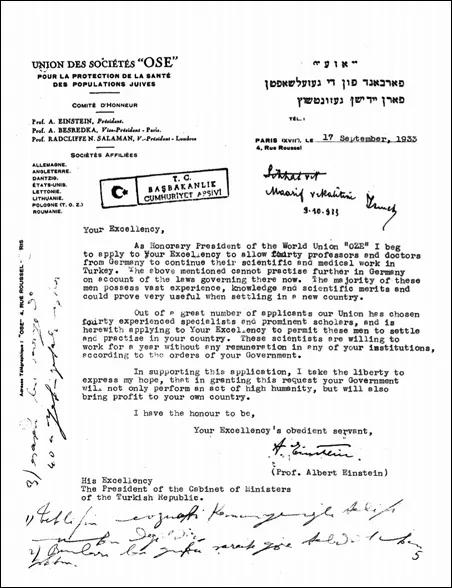
On 17 September 1933, Albert Einstein sent a letter to İsmet İnönü, Prime Minister of the Republic of Türkiye, proposing that around 40 Jewish scientists fleeing Nazi persecution be offered positions in Türkiye. In the letter, Einstein stated that these scientists could work in Türkiye without receiving any salary and urged the Turkish government to accept them. However, the government of the Republic of Türkiye did not accept this proposal.
Einstein’s Letter to Türkiye
Einstein died in Princeton in 1955. After his death, his brain was preserved and subjected to various scientific studies. Today, Einstein’s name is primarily associated with the theory of relativity, quantum mechanics, and the relationship between energy and mass such as. Moreover, Einstein’s social and political stance has ensured his enduring status as an important historical figure. Einstein was a scientist who spoke out not only on physical theories but also on human rights, peace, social justice and civil rights opinion.