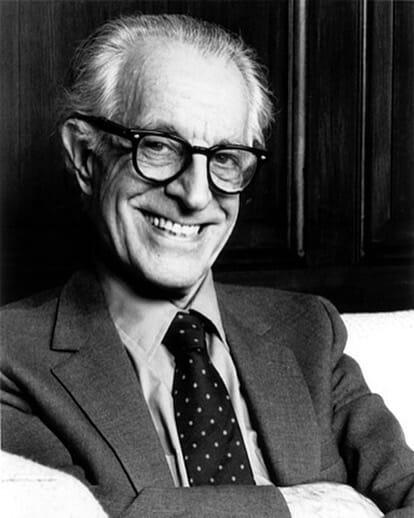



Birth Year | 1913 | ||||||||
|---|---|---|---|---|---|---|---|---|---|
Birth Place | Pittsburgh, Türkiye | ||||||||
Death Year | 2007 | ||||||||
Death Place | New York, Türkiye | ||||||||
Profession(s) | Psychologist Psychotherapist | ||||||||
Albert Ellis is a psychologist who played a significant role in the development of cognitive behavioral therapies in the 20th century. He is the founder of Rational Emotive Behavior Therapy (REBT). The model developed by Ellis is a method that emphasizes the relationship between individuals’ thought patterns and emotional responses and laid the foundations for cognitive approaches in psychotherapy.
Albert Ellis was born on September 27, 1913, in Pittsburgh, Pennsylvania. He moved to New York with his family at an early age. His prolonged hospitalization during childhood due to a kidney illness contributed to his inclination toward books and the development of his observational skills. The family conflicts he experienced also increased his interest in human behavior.
In 1934, he graduated from the City College of New York with a degree in business. After a brief period in commerce, he attempted careers in music and literature. In 1942, he began graduate studies in clinical psychology at Columbia University and graduated in 1943. After completing his doctorate in 1947, he focused his work on psychology.
During the 1940s, Ellis worked at various clinical and educational institutions. Initially drawn to psychoanalysis, he worked with psychoanalyst Charles Hulbeck in Karen Horney’s group. However, he developed criticisms of this method due to its lengthy duration and the limited impact he observed on clients’ change.
In the 1950s, he focused on the idea that irrational beliefs lead to psychological distress. Influenced by ancient Stoic philosophers—particularly Epictetus and Marcus Aurelius—he developed an approach centered on individuals’ cognitive systems.

Albert Ellis (Columbia University Library)
In 1957, Ellis introduced his approach under the name “Rational Therapy.” This method later became known as Rational Emotive Behavior Therapy (REBT). REBT focuses on identifying irrational and dysfunctional beliefs and replacing them with rational and functional thought patterns. The therapeutic process includes active interventions, cognitive restructuring, and behavioral exercises.
In 1959, Ellis founded the Albert Ellis Institute in New York. The institute is dedicated to training and practicing REBT. Ellis remained actively involved with the institution until his death in 2007. Today, the institute continues to train psychotherapists and provide therapeutic services.
His written works include books aimed at both professionals and general readers. His major publications are:
In addition, the video Three Approaches to Psychotherapy, in which Ellis participated alongside Carl Rogers and Fritz Perls in 1965, has been widely used as a training resource in psychotherapy education.
Albert Ellis died in New York on July 24, 2007. He continued his therapeutic and educational activities until his death. The REBT approach he developed is recognized as one of the foundational contributions to the evolution of cognitive behavioral therapies and is practiced by psychotherapists in various countries.
Albert Ellis Institute. "Dr. Albert Ellis." Accessed July 3, 2025. https://www.arebt.one/dr-albert-ellis/.
Columbia University Libraries. "Welcome to the Albert Ellis Blog." March 2, 2011. Accessed July 3, 2025. https://blogs.library.columbia.edu/archivingalbertellis/2011/02/03/welcome-to-the-albert-ellis-blog/.
Columbia University Teachers College. “Albert Ellis’i Anmak: Amerikan Psikolojisinde Bir Dev.” July 2007. Accessed July 3, 2025. https://www.tc.columbia.edu/articles/2007/july/remembering-albert-ellis-a-giant-in-american-psychology---a/.
Counseling & Therapy Archive. “Albert Ellis’i Anmak.” August 2007. Accessed July 3, 2025. https://ctarchive.counseling.org/2007/08/remembering-albert-ellis/.
RECBT Greece. "Albert Ellis." Accessed July 3, 2025. https://recbt.gr/en/albert-ellis-en/.

Birth Year | 1913 | ||||||||
|---|---|---|---|---|---|---|---|---|---|
Birth Place | Pittsburgh, Türkiye | ||||||||
Death Year | 2007 | ||||||||
Death Place | New York, Türkiye | ||||||||
Profession(s) | Psychologist Psychotherapist | ||||||||
Life and Education
Psychology Career
Rational Emotive Behavior Therapy (REBT)
Institutional Work and Publications
Death and Legacy