

Eş (ler) | Tamara Đukanović (2013–present) Ksenija Janković (1997–2011) | ||||||||
|---|---|---|---|---|---|---|---|---|---|
Çocuk (lar) | Milica Danilo | ||||||||
Nationality(ies) | Serbia | ||||||||
Birth(Text) | 5 March 1970, Belgrade | ||||||||
Education | University of Belgrade Faculty of Law | ||||||||
Responsibilities | Serbian Radical Party (member of parliament, various positions), Minister of Information (1998–2000), Deputy Prime Minister and Minister of Defense (2012), Prime Minister of Serbia (2014–2017), President of Serbia (2017–…) | ||||||||
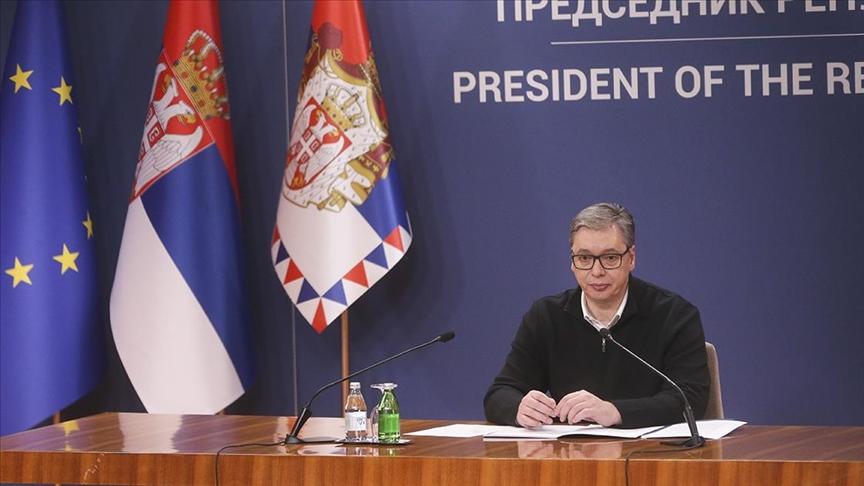
Aleksandar Vučić (born 5 March 1970, Belgrade) is one of Serbia’s politicians with a legal education. Since the 1990s, he has held positions in both the Serbian Radical Party (SRS), which followed a nationalist line, and later in the Serbian Progressive Party (SNS), of which he was one of the founders. He has served as both Prime Minister and President of Serbia and has become one of the defining figures in the country’s politics due to his influence over the executive branch and party structure. In foreign policy, he pursues a balancing approach between the European Union, Russia, and China.
Who is Serbian President Aleksandar Vucic? (GZT)
Aleksandar Vučić was born into a middle-class family in Belgrade. His childhood coincided with the period when Yugoslavia began to unravel politically, giving him early exposure to political debates. It is known that during his school years he showed interest in history, politics, and law.
He continued his education at the Faculty of Law of the University of Belgrade. His legal training became one of the reference points for the roles he later assumed. During his student years, he began participating in various political activities and entered active political life.
Vučić’s political orientation during his youth was shaped within the context of the social tensions, nationalist currents, and political realignments brought about by the dissolution of Yugoslavia.

Aleksandar Vučić (Anadolu Agency)
Vučić began his active political life in the early 1990s by joining the Serbian Radical Party (SRS), led by Vojislav Šešelj. At the time, the party was known for its hardline nationalist rhetoric. Vučić quickly rose to become a member of parliament and assumed important roles within the party.
During the war years, he attracted public attention through parliamentary speeches and media appearances. He was involved in intense political debates within the context of the Yugoslav civil wars. His statements and positions during the war later became frequent subjects of criticism.
From 1998 to 2000, he served as Minister of Information. During this period, fines imposed on independent media outlets, broadcast restrictions, and administrative interventions were criticized by international circles. Post-2000 assessments have regarded this period as one of the most controversial chapters in Vučić’s political history.
In the mid-2000s, following internal divisions within the Serbian Radical Party, Vučić left the party alongside Tomislav Nikolić. The Serbian Progressive Party (SNS), founded in 2008, was defined as a center-right party supporting European Union integration and prioritizing economic reforms.
Vučić increased his political influence through the roles he assumed within the SNS. The party rapidly gained electoral support across the country and became the main component of the ruling coalition. During this period, Vučić’s rhetoric shifted from nationalist lines toward economic reform, institutional restructuring, and European orientation.
The new party structure provided Vučić with a strong position both within the party and in state governance. Reforms in media, economy, and public administration during this time received both support and criticism.
Vučić served as Deputy Prime Minister and Minister of Defense in the government formed in 2012. After the 2014 elections, he assumed the office of Prime Minister. During this period, fiscal discipline, control of public spending, and promotion of foreign investment were central to government policy.
Reforms targeting public finances were implemented within the framework of programs agreed with the IMF. Labor market regulations, privatization processes, and public administration changes were criticized particularly by trade unions and certain social groups. Supporters, however, viewed these policies as necessary for economic stability.
In foreign policy, the Brussels Dialogue with Kosovo, regional cooperation initiatives, and Serbia’s relations with the EU became key agenda items. During Vučić’s premiership, domestic and foreign policies were pursued simultaneously, and relations in the Balkans fluctuated at times between tension and normalization.
In the 2017 elections, Vučić won an outright majority in the first round and was elected President of Serbia. Although constitutionally endowed with limited executive powers, he developed substantial de facto political influence due to his leadership of the ruling party and control over government structures.
During his presidency, the opposition criticized issues such as electoral processes, media freedom, and judicial independence. Protests occasionally emerged across the country. Vučić and his government side defended the functioning of state institutions and emphasized stability.

Aleksandar Vučić (Anadolu Agency)
The Kosovo issue is among the most important elements of Vučić’s foreign policy. While maintaining his position of not recognizing Kosovo’s independence, negotiations have continued under the framework of the Brussels Dialogue mediated by the EU. This process has been closely watched both within Serbia and the region.
Vučić’s occasional statements, such as that “a major conflict could break out in the coming months,”【1】 have been debated in the international press. Such remarks have been interpreted by some circles as warnings, while others have viewed them as domestic political signals.
Relations with Bosnia-Herzegovina, Croatia, and Montenegro have at times been strained due to the legacy of the war and minority issues.
Allegations have been made that Aleksandar Vučić was involved in sniper activities during the Bosnian War (1992–1995).
In a criminal complaint presented by Croatian investigative journalist Domagoj Margetić, it was alleged that Vučić served among snipers in the Sarajevo area between 1992 and 1993 at critical locations such as the Jewish Cemetery. A complaint was filed with an Italian prosecutor’s office on this basis.【3】
The complaint reportedly includes documents suggesting that certain wealthy individuals from Western countries participated in so-called “human safaris”—activities involving shooting at civilians.【4】
The same announcement stated that the Milan Public Prosecutor’s Office had opened an investigation into the allegations and that the probe could also involve suspects of foreign nationality.
Vučić and his spokespersons have rejected the allegations, asserting that he worked as a journalist and translator, had no connection to any armed militia, and never possessed or used a sniper rifle.【5】
It has been claimed that footage allegedly showing him with a rifle actually depicts a tripod, not a firearm.
Anadolu Ajansı. "Sırbistan Cumhurbaşkanı Vucic yeni bir hükümet kurulmazsa seçimler ilan edilir." Accessed November 21, 2025.
Anadolu Ajansı. “Sırbistan Cumhurbaşkanı Vucic’in Bosna Savaşı’ndaki keskin nişancılardan olduğu iddiasıyla suç duyurusunda bulunuldu.” Accessed November 21, 2025. https://www.aa.com.tr/tr/dunya/sirbistan-cumhurbaskani-vucicin-bosna-savasindaki-keskin-nisancilardan-oldugu-iddiasiyla-suc-duyurusunda-bulunuldu/3748529
BBC News. "Aleksandar Vucic: Sırbistan’ı yeniden yapan adam." Accessed November 21, 2025.
BBC Türkçe. “Sırbistan’da genel seçimi Cumhurbaşkanı Vucic’in partisi kazandı.” Accessed November 21, 2025. https://www.bbc.com/turkce/articles/cd1l6782vz6o
Balkan Insight. "Vucic Wins Serbian Presidential Elections." April 2, 2017. Accessed November 21, 2025. https://balkaninsight.com/2017/04/02/vucic-wins-serbian-presidential-elections-04-02-2017-1/
Biografiler.com. "Aleksandar Vucic Kimdir?" Accessed November 21, 2025. https://www.biyografiler.com/kimdir/aleksandar-vucic
Deutsche Welle (DW). "Sırbistan’da Cumhurbaşkanı Vucic’in partisi seçimi kazandı." Accessed November 21, 2025. https://www.dw.com/tr/s%C4%B1rbistanda-cumhurba%C5%9Fkan%C4%B1-vucicin-partisi-se%C3%A7imi-kazand%C4%B1/a-67752281
Ekotürk. "Sırbistan Cumhurbaşkanı Aleksandar Vucic istifa etti." Accessed November 21, 2025.
Euronews Türkçe. “Sırp Cumhurbaşkanı Vucic: Üç-dört ay içinde büyük bir çatışma yaşanacak.” Accessed November 21, 2025. https://tr.euronews.com/2024/06/15/sirp-cumhurbaskani-vucic-uc-dort-ay-icinde-buyuk-bir-catisma-yasanacak
GZT. “Sırbistan Cumhurbaşkanı Aleksandar Vucic Kimdir?” YouTube, Accessed November 21, 2025. https://www.youtube.com/watch?v=pYFxd3zSvUw
Haberler.com. "Sırbistan Cumhurbaşkanı Aleksandar Vucic kimdir?" Accessed November 21, 2025.
Irish Times. "Young Serbs vow to stop ‘dictatorship’ of president-elect Vucic." Accessed November 21, 2025.
NTV. "Bosna’da ‘keskin nişancı safarisi’, Vucic de onlardan biri iddiası." Accessed November 21, 2025.
Nefes Haber. "Devlet başkanına keskin nişancı suçlaması yalanladı: Video ortaya çıktı." Accessed November 21, 2025. https://www.nefes.com.tr/devlet-baskanina-keskin-nisanci-suclamasi-yalanladi-video-ortaya-cikti-81821
Oksijen Gazetesi. "Sırbistan Cumhurbaşkanı Vucic hakkında suç duyurusu: Saraybosna’daki ‘insan safarisinde’ yer aldığı iddia edildi." Accessed November 21, 2025. https://gazeteoksijen.com/dunya/sirbistan-cumhurbaskani-vucic-hakkinda-suc-duyurusu-saraybosnadaki-insan-safarisinde-yer-aldigi-iddia-edildi-257294
Predsednik.rs (Official Website of the President of Serbia). "Aleksandar Vucic – Biography." Accessed November 21, 2025. https://www.predsednik.rs/en/president/biography
YouTube. "Sırbistan Cumhurbaşkanı Aleksandar Vucic Kimdir?" GZT, Accessed November 21, 2025. https://www.youtube.com/watch?v=pYFxd3zSvUw
İstinomer (English). "Aleksandar Vucic – Biography." Accessed November 21, 2025.
[1]
Euronews Türkçe. “Sırp Cumhurbaşkanı Vucic: Üç-dört ay içinde büyük bir çatışma yaşanacak.” Erişim: 21 Kasım 2025. https://tr.euronews.com/2024/06/15/sirp-cumhurbaskani-vucic-uc-dort-ay-icinde-buyuk-bir-catisma-yasanacak
[3]
Anadolu Ajansı. “Sırbistan Cumhurbaşkanı Vucic’in Bosna Savaşı’ndaki keskin nişancılardan olduğu iddiasıyla suç duyurusunda bulunuldu.” Erişim: 21 Kasım 2025. https://www.aa.com.tr/tr/dunya/sirbistan-cumhurbaskani-vucicin-bosna-savasindaki-keskin-nisancilardan-oldugu-iddiasiyla-suc-duyurusunda-bulunuldu/3748529
[4]
Nefes Haber. “Devlet başkanına keskin nişancı suçlaması yalanladı: Video ortaya çıktı.” Erişim: 21 Kasım 2025. https://www.nefes.com.tr/devlet-baskanina-keskin-nisanci-suclamasi-yalanladi-video-ortaya-cikti-81821
[5]
Oksijen Gazetesi. “Sırbistan Cumhurbaşkanı Vucic hakkında suç duyurusu: Saraybosna’daki ‘insan safarisinde’ yer aldığı iddia edildi.” Erişim: 21 Kasım 2025. https://gazeteoksijen.com/dunya/sirbistan-cumhurbaskani-vucic-hakkinda-suc-duyurusu-saraybosnadaki-insan-safarisinde-yer-aldigi-iddia-edildi-257294

Eş (ler) | Tamara Đukanović (2013–present) Ksenija Janković (1997–2011) | ||||||||
|---|---|---|---|---|---|---|---|---|---|
Çocuk (lar) | Milica Danilo | ||||||||
Nationality(ies) | Serbia | ||||||||
Birth(Text) | 5 March 1970, Belgrade | ||||||||
Education | University of Belgrade Faculty of Law | ||||||||
Responsibilities | Serbian Radical Party (member of parliament, various positions), Minister of Information (1998–2000), Deputy Prime Minister and Minister of Defense (2012), Prime Minister of Serbia (2014–2017), President of Serbia (2017–…) | ||||||||
Early Life and Education
Entry into Politics and the 1990s
Serbian Progressive Party and Shift in Political Line
Prime Ministership
Presidency
Regional Policies and Statements
Alleged Connection to Sniper Activities
Content of the Allegations
Vučić’s Response