

This article was automatically translated from the original Turkish version.
+1 More
Alfvén waves are oscillatory waves in magnetic field lines that propagate at relatively low frequencies within a plasma, involving the synchronized motion of ions and the magnetic field. These waves travel parallel to the magnetic field lines in plasma, carrying electromagnetic energy and contributing to energy transport. In space physics, they play a crucial role in the solar wind, magnetospheres, and other space plasma environments.
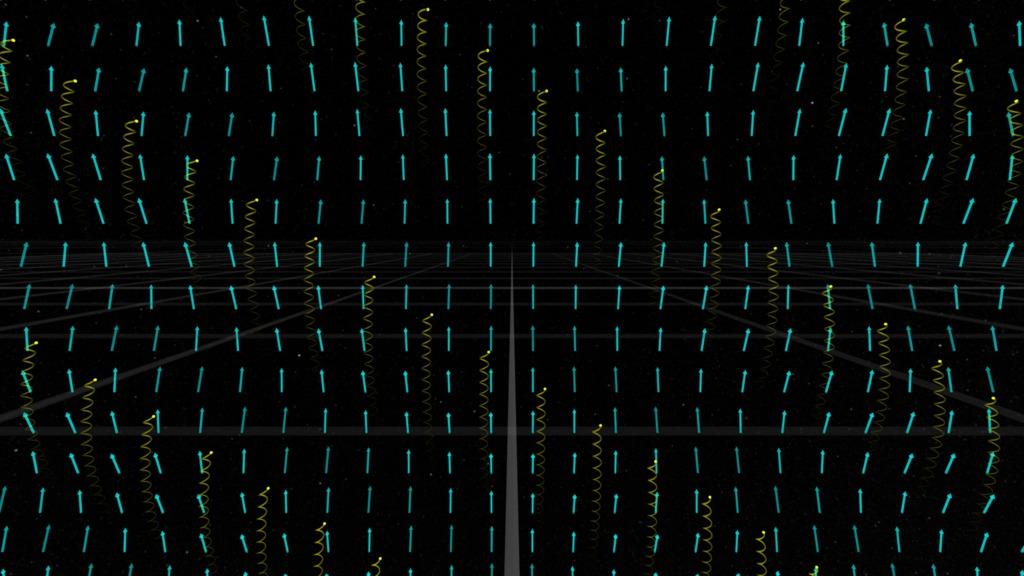
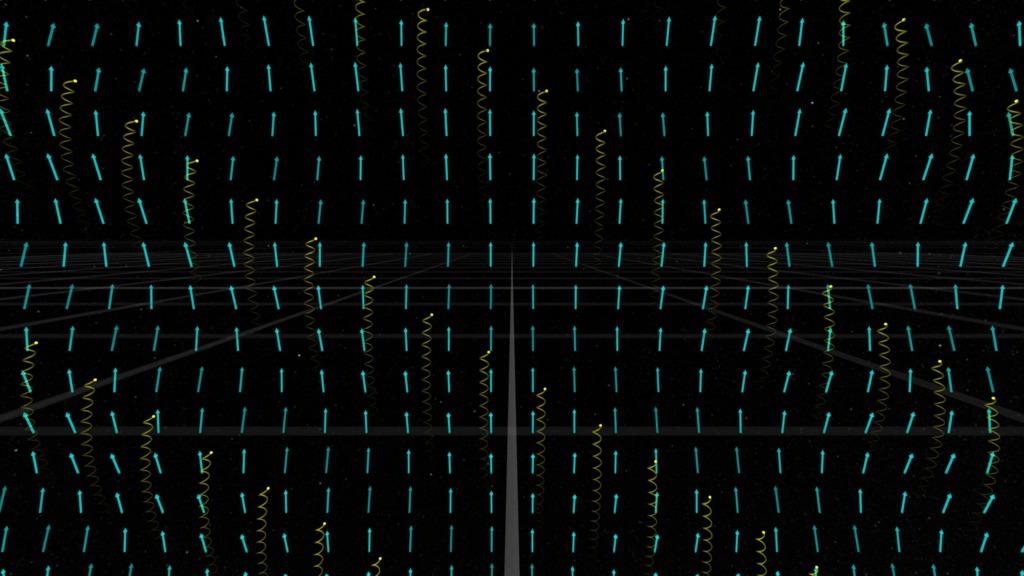
Alfvén Waves Visualization (NASA)
Alfvén waves are electromagnetic waves that propagate through ionized media such as plasma, in conjunction with magnetic fields. During these waves, fluctuations occur in both electric and magnetic field components, and oscillations are observed alongside plasma particles. As the wave propagates, the energy it carries is transmitted along magnetic field lines and can reach distant regions in space. This property makes Alfvén waves a significant phenomenon in space physics research.
Plasma is the fourth state of matter, in which atomic nuclei are separated from electrons, resulting in a collection of charged particles. Plasma waves arise from the collective behavior of these particles, which can couple with magnetic and sometimes electric fields. In 1942, Hannes Alfvén mathematically proposed that plasma could exhibit wave-like variations along magnetic field lines; these waves were subsequently named after him and laid the foundation for magnetohydrodynamics (MHD).
Classic Alfvén waves are the fundamental mode in which the magnetic field varies along the wavelength, but the magnetic field perturbation is aligned with the direction of wave propagation. In this mode, the motion of plasma particles is constrained relative to the magnetic field and does not produce significant deviations in particle trajectories.
Classic Alfvén Waves (YouTube)
Kinetic Alfvén waves differ from classic Alfvén waves in that the magnetic field perturbation is perpendicular to the direction of wave propagation. These waves enable energy transfer between different frequency bands and can exhibit significant energy exchange with plasma particles. In some cases, they can trap particles within magnetic field minima and carry them along. Research conducted by NASA’s Magnetospheric Multiscale (MMS) mission was the first to directly observe kinetic Alfvén waves at microscale levels, revealing that electrons moving at specific velocities become trapped in the magnetic field troughs of the wave, while other electrons interact with the wave to exchange energy.
Kinetic Alfvén Waves (YouTube)
Inertial Alfvén waves emerge when the Alfvén speed in plasma exceeds the electron thermal speed and the wave scale approaches the electron inertial length. In this regime, the wave may possess a parallel electric field component and can play a role in processes such as particle acceleration and energy transfer.
Alfvén waves are commonly detected in the solar wind, the stream of plasma emanating from the Sun. Spacecraft observations have confirmed that these waves propagate parallel to the background magnetic field, and their frequency and magnetic field relationships have been analyzed. These studies support the presence of Alfvén waves and their role in energy transport in space.
The scientific importance of Alfvén waves stems from their contribution to energy transport and redistribution in plasma environments. These waves can connect distant regions by carrying energy along magnetic field lines. In particular, kinetic Alfvén waves are effective in converting energy across different frequencies; their effects on particles and energy transfer mechanisms remain active areas of research in understanding space weather.
EOS Editors’ Vox. “Exploring Alfvén Waves Across Space and Disciplines.” *Eos*. Accessed January 12, 2026. https://eos.org/editors-vox/exploring-alfven-waves-across-space-and-disciplines
NASA Scientific Visualization Studio (SVS). “Kinetic Alfvén Waves Visualization (ID: 4561).” Accessed January 12, 2026. https://svs.gsfc.nasa.gov/4561/.
Wu, C. S. “Alfvén Waves in the Solar Wind.” *Physica Scripta* 60 (1995). ADS Abstract. Accessed January 12, 2026. https://ui.adsabs.harvard.edu/abs/1995PhST...60...91W/abstract.
science.gov. "Inertial Alfvén Waves." Accessed January 12, 2026.

Definition and Fundamental Properties
Physical Background
Wave Types
Classic Alfvén Waves
Kinetic Alfvén Waves
Inertial Alfvén Waves
Alfvén Waves in the Solar Wind
Energy Transport and Significance