

This article was automatically translated from the original Turkish version.
+1 More
Construction Date(s) | Originally built by the Seljuks in 1145 and rebuilt by Emir Şadgeldi Paşa after the earthquake of 1374 | ||||||||
|---|---|---|---|---|---|---|---|---|---|
Location | Amasya | ||||||||
Architectural Structure | The main body is historic cut stone, with reinforced concrete and metal railings added during the 1940 expansion work | ||||||||
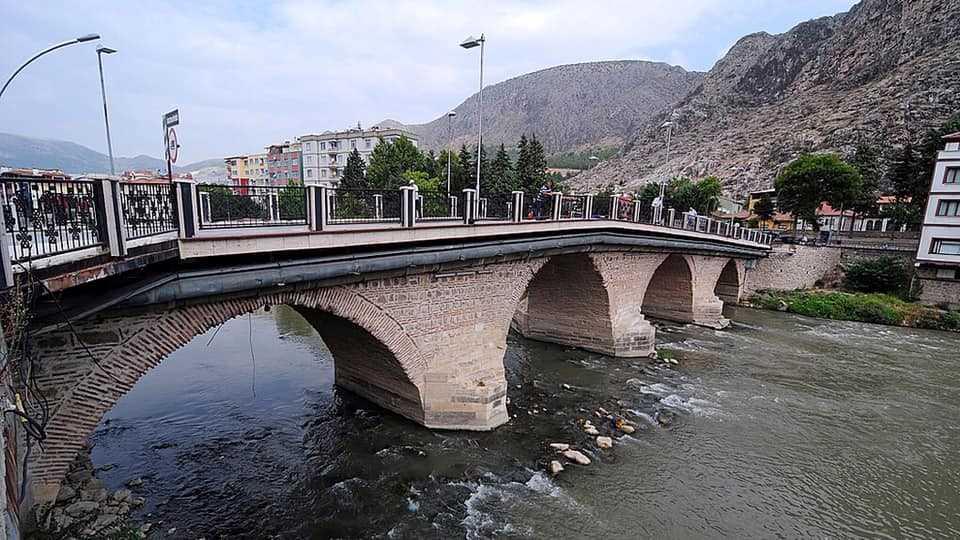
İstasyon Köprüsü is a historical transportation structure located over the Yeşilırmak River in the center of Amasya, dividing the city into two parts. Geographically situated at the end of Ziya Paşa Bulvarı, the bridge currently serves as a critical transit point connecting the Üçler (İstasyon) and Hacı İlyas neighborhoods. Due to its position directly in front of the “Meydan Kapısı,” one of the main entrance gates of Amasya Castle, it is also referred to in literature and historical records as “Meydan Köprüsü.”
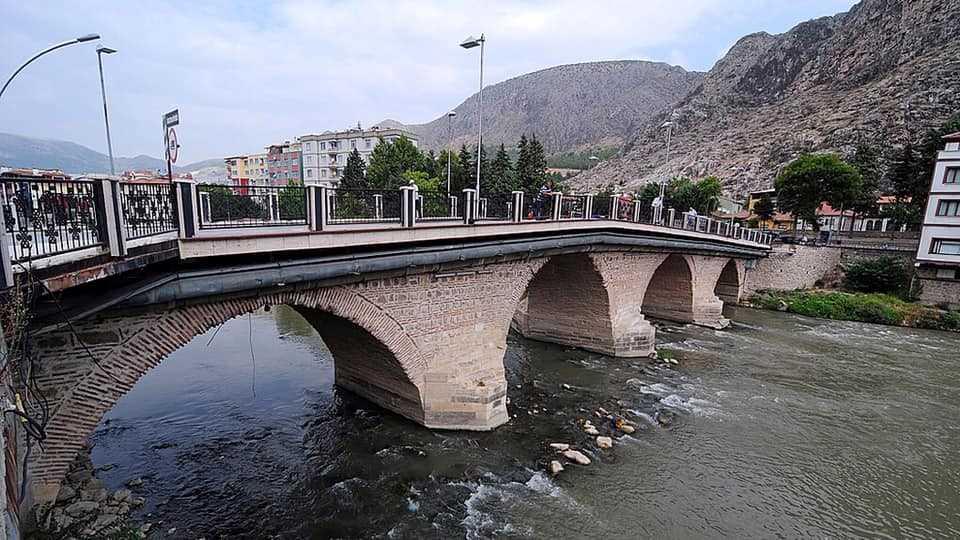
Amasya İstasyon Köprüsü (Kültür Portal)
The first construction activity on the site of İstasyon Köprüsü took place in 1145 during the reign of Anatolian Seljuk Sultan I. Mesud.【1】 However, this initial structure was gradually destroyed over time due to natural phenomena such as the region’s seismic activity and flooding of the Yeşilırmak River. According to records, after a major earthquake in 1374, the bridge was reconstructed by Şadgeldi Paşa, the then-emir of Amasya, on the remains of the original structure while preserving its original architectural character.【2】
During the Ottoman Empire, the structure underwent several repairs. After suffering significant damage in a flood of the Yeşilırmak River in 1824, the bridge was extensively restored and renewed in 1828 by Özlü Yusuf Ağa, the then-ayan of Amasya.【3】
The primary building material used in the construction of the bridge is cut stone. It is known that the original Seljuk-era structure had five arches, a pointed-arch design, and a harpuşta (sloped roof) style. During Şadgeldi Paşa’s reconstruction, a load-bearing system was established consisting of three wide piers made of cut stone, with arches spanning between them.
During the Republican era, the bridge underwent several structural interventions in response to changing transportation needs. In major restoration works carried out in 1940, the bridge deck was widened, concrete was poured onto the surface, and metal railings were installed along the edges. These interventions resulted in a multilayered architectural character, combining the bridge’s traditional stone masonry with modern construction elements.
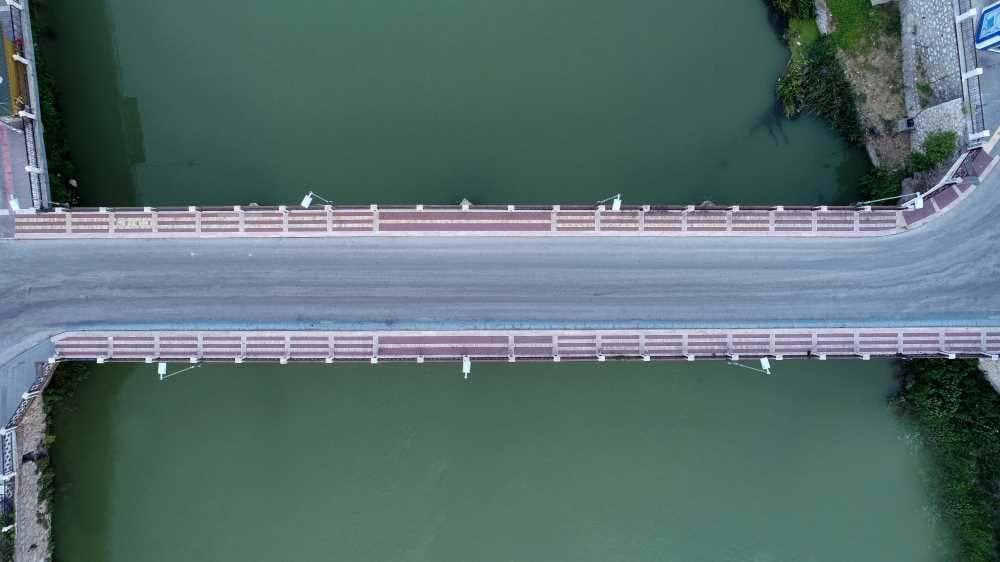
Amasya İstasyon Köprüsü (Kültür Portal)
İstasyon Köprüsü, which ensures the integrity of Amasya’s transportation network along the Yeşilırmak axis, is an integral component of official urban planning initiatives designed to preserve the city’s historical fabric. The bridge, together with other historical structures such as Madenüs Köprüsü, Alçak Köprü, and Hükümet Köprüsü, lies within the boundaries of the “Amasya Harşena Dağı ve Pontus Kral Kaya Mezarları Alan Yönetim Planı.” Of great importance for cultural tourism, the structure has been officially registered as part of an integrated historical transportation infrastructure, alongside the city’s civil architectural examples (Yalıboyu Houses) and monumental monuments.
Amasya Valiliği. Amasya Harşena Dağı ve Pontus Kral Kaya Mezarları Alan Yönetim Planı ve UNESCO Dünya Mirası Müracaat Dosyası Hazırlanması Projesi (2022–2027). Ankara: Kültür Varlıkları ve Müzeler Genel Müdürlüğü, 2022. Accessed April 24, 2026.
Kültür Portalı. "Stasyon (Meydan) Köprüsü." T.C. Kültür ve Turizm Bakanlığı. Accessed April 24, 2026.
https://kvmgm.ktb.gov.tr/Eklenti/102228,uyp---harsena-dagi-yonetim-planipdf.pdf?0
https://www.kulturportali.gov.tr/turkiye/amasya/gezilecekyer/stasyon--meydan-koprusu
[1]
T.C. Kültür ve Turizm Bakanlığı, Amasya Harşena Dağı ve Pontus Kral Kaya Mezarları Alan Yönetim Planı ve UNESCO Dünya Mirası Müracaat Dosyası Hazırlanması Projesi (2022–2027) (Ankara: Kültür Varlıkları ve Müzeler Genel Müdürlüğü, 2022), S. 61. Erişim 24 Nisan 2026,
https://kvmgm.ktb.gov.tr/Eklenti/102228,uyp---harsena-dagi-yonetim-planipdf.pdf?0
[2]
T.C. Kültür ve Turizm Bakanlığı, “Stasyon (Meydan) Köprüsü,” Kültür Portalı, erişim 24 Nisan 2026,
https://www.kulturportali.gov.tr/turkiye/amasya/gezilecekyer/stasyon--meydan-koprusu
[3]
T.C. Kültür ve Turizm Bakanlığı, Amasya Harşena Dağı ve Pontus Kral Kaya Mezarları Alan Yönetim Planı ve UNESCO Dünya Mirası Müracaat Dosyası Hazırlanması Projesi (2022–2027) (Ankara: Kültür Varlıkları ve Müzeler Genel Müdürlüğü, 2022), S.61. Erişim 24 Nisan 2026,
https://kvmgm.ktb.gov.tr/Eklenti/102228,uyp---harsena-dagi-yonetim-planipdf.pdf?0

Construction Date(s) | Originally built by the Seljuks in 1145 and rebuilt by Emir Şadgeldi Paşa after the earthquake of 1374 | ||||||||
|---|---|---|---|---|---|---|---|---|---|
Location | Amasya | ||||||||
Architectural Structure | The main body is historic cut stone, with reinforced concrete and metal railings added during the 1940 expansion work | ||||||||
No Discussion Added Yet
Start discussion for "Amasya Station Bridge" article
Historical Development
Architectural Features and Structural Interventions
Role in Urban Planning and Conservation Status