

+1 More

Name(s) | Amelia Mary Earhart | ||||||||
|---|---|---|---|---|---|---|---|---|---|
Birth | 24 July 1897, Atchison, Kansas, USA | ||||||||
Date of Loss | 2 July 1937, over the Pacific Ocean | ||||||||
Marriage | George Palmer Putnam (1931–1937) | ||||||||
Occupation(s) | Pilot writer | ||||||||
Important Flights | 1932 Atlantic solo flight, 1935 Honolulu–California | ||||||||
Aircraft | Lockheed Model 10-E Electra | ||||||||
Death | She is presumed dead on the date of her disappearance | ||||||||
Amelia Mary Earhart was born on July 24, 1897, in Atchison, Kansas. Her childhood years were spent in various states, as her family’s financial circumstances prevented her from growing up in a stable home environment. From an early age, she showed interest in outdoor sports, engaging in activities such as horseback riding, football, and camping.
By the end of the 1910s, Earhart worked as a nursing assistant in Canada during World War I. There, while caring for wounded soldiers, she gained valuable experience in healthcare. This period contributed to her disciplined work ethic. After the war, she returned to the United States and held various jobs, including photography, operating a telephone switchboard, and working with social welfare organizations.
A visit to California in 1920 changed the course of her life. There, she attended an airshow and encountered aviation for the first time. This experience marked the beginning of a lifelong passion for flying. Shortly afterward, she decided to take her first flight lessons. In 1921, she studied under the renowned female pilot Anita “Neta” Snook and soon purchased her own aircraft, beginning to gain experience in the skies.

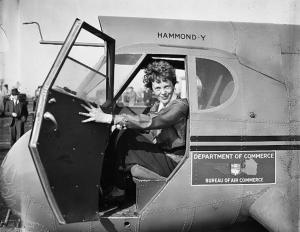
A photograph of Amelia Earhart (ameliaearhart.com)
Amelia Earhart’s aviation career developed at a time when female pilots had very little visibility. In 1928, she became the first woman to cross the Atlantic Ocean as a passenger, an achievement that garnered widespread attention. Although she flew as a passenger rather than as a pilot, this experience inspired her to pursue greater goals.
In 1932, she became the first woman to fly solo across the Atlantic. Departing from Newfoundland, Earhart landed on the coast of Ireland after a flight lasting approximately fifteen hours. Her accomplishment attracted global attention and secured her place in aviation history. During this period, she undertook several long-distance flights on different routes. In 1935, she became the first person to fly solo from Hawaii to California. Her flight from Los Angeles to Mexico City that same year also attracted significant notice.
Earhart sought not only to break records but also to demonstrate that women belonged in aviation. In 1929, she was one of the founding members of the Ninety-Nines, an organization dedicated to strengthening professional solidarity among female pilots. Throughout her career, she focused on individual achievements while actively supporting efforts to increase the visibility of women in aviation.
A documentary on Amelia Earhart’s disappearance (Kaan Ünsal Alphan)
Alongside her intense career, Amelia Earhart also cultivated a distinctive personal life. In 1931, she married George Palmer Putnam, a publisher and aviation organizer. Putnam became a key supporter of Earhart’s career, contributing through financial backing and promotional organization for her flights. However, Earhart was determined to preserve her independence within marriage and made this clear from the outset.
Earhart did not prioritize family life over her career. She never had children and devoted most of her time to flight preparations, lectures, and supporting female pilots. Through books she authored, she shared her flying experiences and encouraged women to pursue aviation. In works such as “20 Hrs., 40 Min.” and “The Fun of It,” she recounted her personal adventures.
In the public eye, she was seen not only as a pilot but also as a symbol of the modern woman. She took an interest in fashion design and created a line of clothing bearing her name. This initiative aligned with her belief that women should be visible in professional and modern life.
In 1937, Amelia Earhart aimed to fly around the world. The journey was to be undertaken in a Lockheed Model 10-E Electra aircraft. Her first attempt ended in failure due to mechanical issues. In June 1937, she embarked on a second attempt, accompanied by experienced navigator Fred Noonan. The flight route began in Miami and extended across South America, Africa, India, and Southeast Asia before crossing the Pacific Ocean.
On July 2, 1937, Earhart and Noonan departed from Lae, New Guinea, aiming to reach Howland Island. During the flight, communication problems arose. Radio contact with the United States Coast Guard was lost. Radio signals weakened, and all contact with the aircraft was severed. The plane is presumed to have crashed into the ocean.
Following her disappearance, extensive search operations were launched by the U.S. Navy and Coast Guard. However, no trace of the aircraft or its occupants was ever found. The fate of Earhart and Noonan remains unknown. Officially, the date of their disappearance is recognized as their date of death. This event has become one of the greatest mysteries in aviation history.
Amelia Earhart marked a turning point in the representation of women in aviation. Through both her personal achievements and organizational efforts, she contributed to the growth in the number of female pilots. Organizations such as the Ninety-Nines became enduring symbols of professional solidarity among women in aviation.
Her disappearance sparked widespread speculation. Various theories have been proposed, including plane crash, landing on a remote island, or being stranded elsewhere. Yet none have been conclusively proven. This uncertainty has added a lasting mystery to her story.
Earhart’s name continues to be honored in museums, monuments, and aviation training programs. The Amelia Earhart Museum in Kansas documents her life and career. She is recognized in national historical literature as a pioneering woman and celebrated worldwide as a symbol of freedom and courage.
Amelia Earhart Museum. "About." Accessed September 28, 2025. https://www.ameliaearhartmuseum.org/about
Ameliaearhart.com. "Biography." Accessed September 28, 2025. https://www.ameliaearhart.com/biography/
BBC. "Amelia Earhart." Accessed September 28, 2025. https://www.bbc.com/news/articles/cgkn84e1nvxo
National Geographic. “Amelia Earhart – Aviation.” Accessed September 28, 2025. https://www.nationalgeographic.com/history/article/amelia-earhart-aviation
Smithsonian National Air and Space Museum. “Amelia Earhart.” Accessed September 28, 2025. https://airandspace.si.edu/explore/stories/amelia-earhart
The New Yorker. “Amelia Earhart’s Reckless Final Flights.” Accessed September 28, 2025. https://www.newyorker.com/magazine/2025/06/09/amelia-earharts-reckless-final-flights
Women’s History (National Women’s History Museum). "Amelia Earhart." Accessed September 28, 2025. https://www.womenshistory.org/education-resources/biographies/amelia-earhart
YouTube. "Sır Kayboluşlar | 16. Bölüm | Amelia Earhart: Müthiş Bir Kadının Öyküsü." Kaan Ünsal Alphan. Accessed September 28, 2025. https://www.youtube.com/watch?v=R2B0NNNMDDg

Name(s) | Amelia Mary Earhart | ||||||||
|---|---|---|---|---|---|---|---|---|---|
Birth | 24 July 1897, Atchison, Kansas, USA | ||||||||
Date of Loss | 2 July 1937, over the Pacific Ocean | ||||||||
Marriage | George Palmer Putnam (1931–1937) | ||||||||
Occupation(s) | Pilot writer | ||||||||
Important Flights | 1932 Atlantic solo flight, 1935 Honolulu–California | ||||||||
Aircraft | Lockheed Model 10-E Electra | ||||||||
Death | She is presumed dead on the date of her disappearance | ||||||||
Aviation Career
Personal Life
Final Flight and Death
Legacy and Impact