


This article was automatically translated from the original Turkish version.
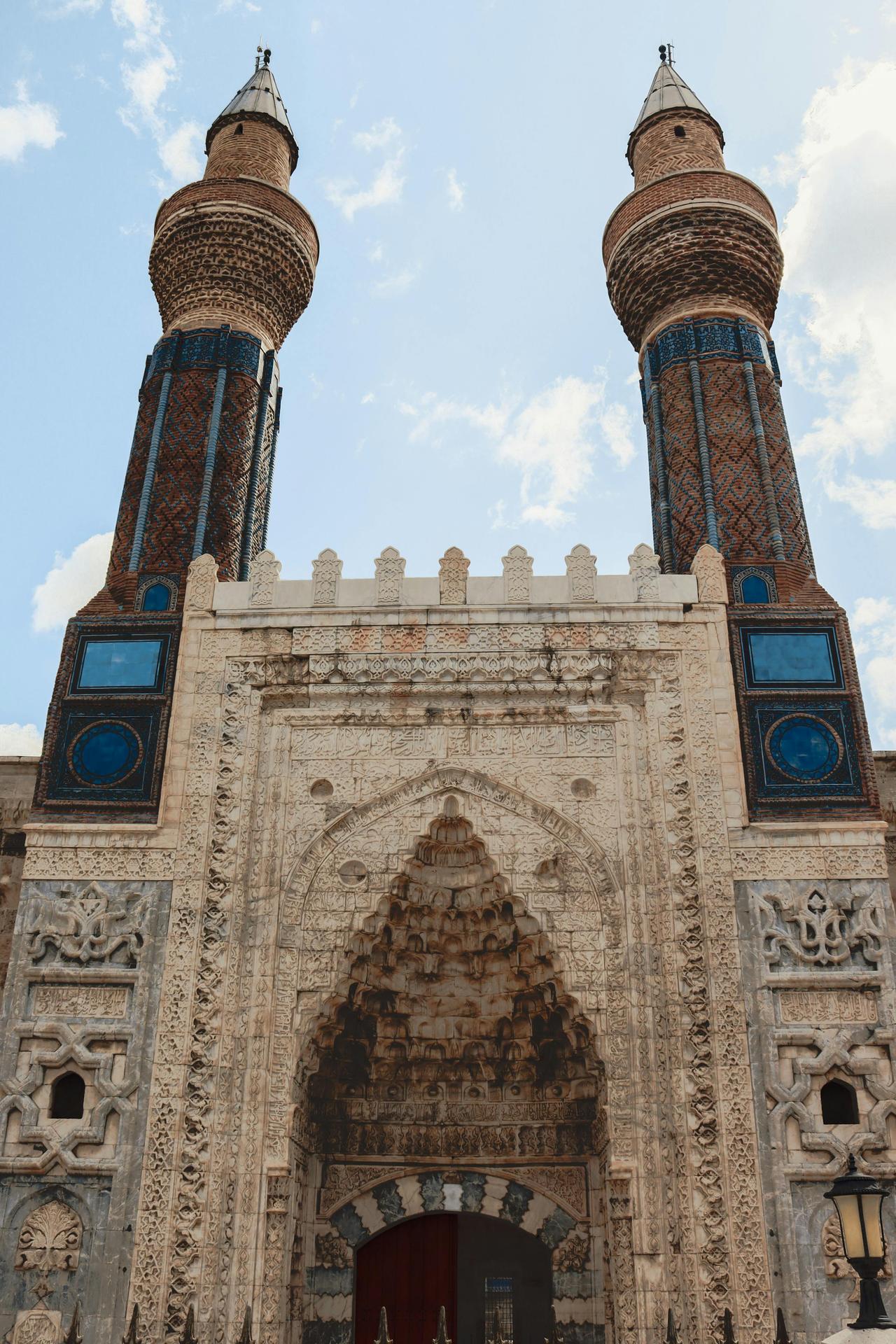
Gök Medrese in Sivas (an example of Anatolian Seljuk architecture)
Period(s) | Late 11th century – late 13th century | ||||||||
|---|---|---|---|---|---|---|---|---|---|
Geographical Distribution | Most of Anatolia; particularly urban centers such as Konya, Kayseri, Sivas, Erzurum, Kütahya, Diyarbakır and Divriği | ||||||||
Architectural Feature(s) | cosmological symbols dome and iwan spatial organization Kufic and Thuluth scripts muqarnas-crowned portal doors stonework Detailed geometric decorations | ||||||||
Prominent Building Types | castles and city walls hospitals tombs caravanserais inns madrasas mosques Mosques | ||||||||
Anatolian Seljuk architecture is an original architectural style that emerged between the 11th and 13th centuries, particularly following the Turkish settlement in Anatolia after the 1071 Battle of Manzikert. It is based on a synthesis of Islamic and local elements. This architecture does not merely involve the construction of functional buildings but also incorporates a symbolic and cosmological narrative rich in layered meanings. Seljuk structures developed a shared aesthetic language across religious, public and defensive buildings. This language is a composition that unites Central Asian Turkish traditions with Islamic art while integrating Byzantine and Iranian influences.
Buildings constructed in various Anatolian cities—such as mosques, prayer halls, madrasas, tombs and caravanserais—constitute spatial examples of Anatolian Seljuk architecture, which represents a regional interpretation of Islamic art through their architectural plan typologies, decorative programs, stone craftsmanship and symbolic arrangements. These structures go beyond mere physical shelter or worship functions; they also carry symbolic meanings reflecting the cosmological and metaphysical thought systems of their time. Architectural elements such as the dome, iwan, geometric ornamentation and the use of light express specific concepts related to the conception of the universe in their design.
Anatolian Seljuk architecture developed a structural language through the integration of symbolic meanings attributed in earlier Turkish belief systems to elements such as water, stars, trees and nature with Islamic aesthetics and modes of thought. In particular, iconographic details observed in mosque and madrasa architecture contain multilayered meanings that can be linked to the period’s cosmological understanding, Sufi tendencies and aesthetic approaches.
The development of Seljuk architecture in Anatolia accelerated after the mass settlement of Turks in the region following the Battle of Manzikert in 1071. During this period, not only military but also socio-cultural and spatial transformations occurred. With Kutalmışoğlu Süleyman Shah establishing Nicaea as his capital in the late 11th century, settlement activities increased in western Anatolia and architectural production gained momentum. Cities such as Kütahya, located near the Byzantine frontier, were fully integrated into Seljuk administration by the early 13th century despite prolonged struggles for dominance.
Structures such as the Hıdırlık Mosque (1243–1244) and the Balıklı Mosque (1237) were not only built to meet religious needs but also laid the groundwork for the spatial representation of Turkish-Islamic identity in the public realm.
Konya, which emerged as the capital of the Anatolian Seljuk State, became one of the centers where architectural production was most intense both in quantity and quality. Konya developed a capital identity characterized by monumental construction and the interweaving of art and science. The Alaeddin Mosque, built as a külliye complex housing sultanic tombs, stands as an architectural representation of Seljuk political power.

Karatay Medrese Crown Portal (Pexels, Betül Akyürek)
The Ince Minareli Medrese (1258) and the Karatay Medrese (1251) draw attention as centers of both education and art, showcasing the peak of stone and tile craftsmanship. These buildings carry not only the architectural tastes of the period but also the reflections of Seljuk cosmology and Sufi thought carved in stone.

Konya Ince Minareli Medrese (Flickr, Brad Hostetler)
Local administrators played a significant role in this architectural production; for instance, officials such as İmâdüddin Hezâr Dînârî used these buildings to emphasize both their religious and political legitimacy while reinforcing perceptions of belonging and representation among the populace. Thus, architecture became not merely a process of construction but an effective instrument in the formation of urban identity. In Konya specifically, this architectural activity merged with the political and cultural centrality conferred by its status as capital, creating a period that marked the zenith of Seljuk art.
During the Seljuk period, mosque and prayer hall architecture took shape according to various plan typologies, which generally arose from a combination of functional, structural and symbolic needs. The most common plan schemes include hypostyle (multi-columned), iwan-based and enclosed courtyard layouts. Hypostyle plans are typically found in large mosques with flat roofs supported by wooden columns; the Ulu Mosque in Afyonkarahisar is a notable example.
Iwan-based systems were more commonly adopted in madrasas and some large mosque complexes. Enclosed courtyard layouts were preferred for central mosques constructed in urban areas. Prayer hall architecture, by contrast, has a simpler and more modest character; rural prayer halls are mostly small, single-space structures built of stone or brick. In these buildings, functionality takes precedence over elaborate decoration. The iwan element placed at the entrance is not merely a spatial arrangement but is also conceived as a symbolic threshold and transitional space. These spaces carry layers of meaning signifying the passage from the profane to the sacred.
The Seljuk approach to ornamentation is not merely an aesthetic enhancement but a materialization of cosmological and metaphysical ideas within architectural space. Ornamentation concentrated on building facades, crown portals and mihrabs typically takes the form of geometric patterns, vegetal motifs, Kufic inscriptions, star designs and stylized representations of sacred trees. These motifs are not merely decorative; they also contain metaphorical meanings relating to the order of the universe, the oneness of God and the spiritual journey of humanity. For example, the Vakvak tree motif on the crown portal of the Gök Medrese in Sivas addresses the themes of paradise and the tree of life, while the Sun and Moon symbols at the Keykavus Darüşşifası are interpreted as symbolic reflections of cosmic order and the cyclical nature of the universe.
The dense abstract ornamentation found on Seljuk portals possesses a mystical quality, symbolizing the individual’s journey toward divine knowledge. In this understanding, architecture is perceived as a manifestation of God’s presence in this world; thus, every motif is not merely decorative but also a narrative element imbued with profound meaning.
In Anatolian Seljuk architecture, the element of water is not merely functional but carries symbolic value derived from the fusion of ancient Turkic mythology and Islamic cosmology. Water culture significantly influenced the planning and detailing of buildings, manifesting in elements such as fountains, pools, courtyard water channels, and cisterns. These arrangements serve not only visual aesthetics but also embody themes of purification, tranquility, stillness, and spiritual ascent. Placing water at the center or along the axis of a structure represents inner renewal alongside ritual cleansing. Just as the ancient Turks held the “Earth-Water” belief, natural elements were attributed sanctity, and this sacredness was transferred onto the architectural plane. Furthermore, mythological water creatures and animal figures near water (such as fish and dragons) found in some structures demonstrate the synthesis of these ancient beliefs with Islamic forms. Thus, water arrangements in architecture emerge both as physical elements providing coolness and movement, and as symbolic elements preserving cultural memory.
Anatolian Seljuk architecture embraces a multifaceted and diverse approach to building production. Alongside places of worship such as mosques and prayer halls, this period’s architecture systematically incorporates structures serving a wide range of functions: education (madrasa), commerce (caravanserai, bedesten), healthcare (darüşşifa), defense and lodging (ribat, caravanserai), hygiene and social life (hamam), and commemoration and sanctification (turbé). These building types directly shaped not only the physical form of cities but also their social, economic, cultural, and symbolic organization.
Mosques and Prayer Halls were situated at the center of Seljuk cities, forming the spatial representation of the religious system. Alongside surrounding madrasas, caravanserais, and bazaars, they became defining elements of the urban core. These structures were regarded not only as places of worship but also as spaces where communal solidarity, congregational identity, and political authority were visibly expressed.
Madrasas were the centers of knowledge production and transmission during this period. Typically located near mosques, they embodied the architectural articulation of the connection between learning and worship. Through their crowned portals, iwan arrangements, and courtyard plans, madrasas were both physically central and culturally representative of the intellectual focus of the era. Providing accommodation and partial sustenance alongside education, madrasas stand as leading examples of functional integration in architecture.
Caravanserais and Urban Caravanserais became significant building types with the expansion of the Seljuk trade network, both within cities and in rural areas. Urban caravanserais clustered around bazaars and bedestens, forming hubs of commercial activity. Caravanserais located along long-distance trade routes aimed to ensure security and lodging for travelers while spatially reflecting the state’s control and support of commerce.
Ribats were constructed primarily along frontier regions and strategic transit points, functioning both as military garrisons and religious missions. Ribats served as places where warriors gathered on one hand, and merchants found lodging on the other. Over time, these structures evolved toward more civilian functions and adopted roles similar to those of caravanserais.
Hamams held an important place in urban life, serving both personal hygiene and social interaction. Located near mosques and bazaars, hamams translated the Islamic concept of cleanliness into the public sphere. They were also spaces where social status, societal etiquette, and privacy were architecturally defined.
Darüşşifas were institutions where medical knowledge of the period was applied and patients were treated. As seen in examples such as the Keykavus Darüşşifası in Sivas, these buildings went beyond purely medical functions to encompass education, research, and social welfare. Architecturally, they were often constructed within the layout of a madrasa or külliye.
Turbés were built during the Seljuk period to commemorate prominent religious and political figures. These structures were typically situated adjacent to or near mosques or prayer halls, thereby uniting acts of worship and commemoration within the same spatial system. Turbés also acquired the status of sanctified spaces within collective memory, symbolizing the spiritual authority and social acceptance of the buried individual.
The urban distribution of these building types was not random but the product of a holistic planning strategy. The urban center typically formed around the triad of mosque-madrasa-hamam, while commercial areas (caravanserais, bedestens) encircled this core. Defense and control structures such as ribats and city walls were positioned along the city’s periphery, while turbés and cemeteries were generally located at the margins of settlement or along entry axes, fulfilling a symbolic transitional function. This layout created a fabric in which daily life practices and belief systems found expression through space.
Arslan, Muhammet. *Anadolu’da Selçuklu Çağı Cami ve Mescit Mimarisi (Plan-Mimari-Süsleme)*. Erzurum: Atatürk Üniversitesi, 2017. Accessed May 31, 2025. Accessed adresi
Demir, Hatice. “Eski Türklerde Su Kültü ve Anadolu Selçuklu Mimarisi Üzerindeki Etkileri.” *ASOBİD: Amasya Üniversitesi Sosyal Bilimler Dergisi* 5 (2019): 23–46. Accessed May 31, 2025. https://dergipark.org.tr/en/download/article-file/742709
Flickr. “İnce Minareli Medrese, exterior JPG.” Accessed May 31, 2025. https://flic.kr/p/dQkYyc
Kara, Demet. “Kütahya’da Bulunan Anadolu Selçuklu Mimarisi Üzerine Bazı Tespitler.” *Art-Sanat* 22 (2024): 105–132. Accessed May 31, 2025. https://dergipark.org.tr/en/download/article-file/4193225
Peker, Ali Uzay. *Selçuklu Mimarisi’nde Anlam*. Kayseri BÜSAM Şehir Akademisi, 2017. Accessed May 31, 2025. https://www.academia.edu/35850989/Sel%C3%A7uklu_Mimarisinde_Anlam
Pexels. “Sivas'taki Gök Medrese'nin Cephesindeki Minareler JPG.” Pexels. Accessed May 31, 2025. https://www.pexels.com/tr-tr/fotograf/sivas-taki-gok-medrese-nin-cephesindeki-minareler-17457172/
Pexels. “Tarihi Binanın Karmaşık Taş Cephesi JPG.” Pexels. Accessed May 31, 2025. https://www.pexels.com/tr-tr/fotograf/tarihi-binanin-karmasik-tas-cephesi-31752097/


Gök Medrese in Sivas (an example of Anatolian Seljuk architecture)
Period(s) | Late 11th century – late 13th century | ||||||||
|---|---|---|---|---|---|---|---|---|---|
Geographical Distribution | Most of Anatolia; particularly urban centers such as Konya, Kayseri, Sivas, Erzurum, Kütahya, Diyarbakır and Divriği | ||||||||
Architectural Feature(s) | cosmological symbols dome and iwan spatial organization Kufic and Thuluth scripts muqarnas-crowned portal doors stonework Detailed geometric decorations | ||||||||
Prominent Building Types | castles and city walls hospitals tombs caravanserais inns madrasas mosques Mosques | ||||||||
No Discussion Added Yet
Start discussion for "Anatolian Seljuk Architecture" article
Historical Development and Regional Spread
Plan Typologies and Spatial Configurations
Ornamentation and Layers of Meaning
Water Culture and Spatial Arrangements
Building Types and Urban Distribution