


This article was automatically translated from the original Turkish version.
+2 More
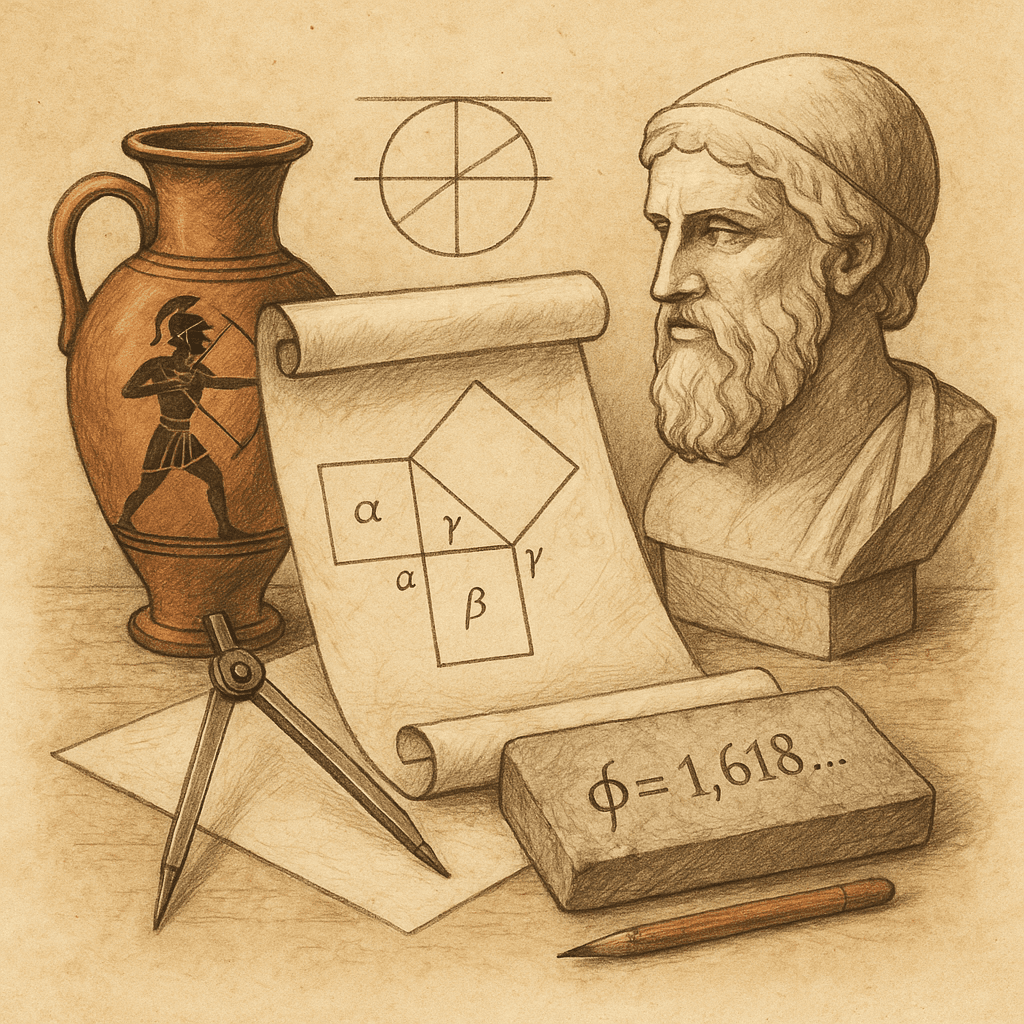
Ancient Greek Mathematics (Generated by Artificial Intelligence)
Period(s) | 7th century BCE – 4th century CE | ||||||||
|---|---|---|---|---|---|---|---|---|---|
Geography | Eastern Mediterranean southern Italy western coasts of Anatolia Greece | ||||||||
Key Contribution | Mathematical proof, Axiomatic system, Deductive reasoning | ||||||||
Important Figures | Thales, Pythagoras, Plato, Eudoxus, Euclid, Archimedes, Apollonius | ||||||||
Important Work | Euclid's Elements | ||||||||
Civilizations Influenced | Egypt, Babylon | ||||||||
Ancient Greek mathematics refers to the body of mathematical knowledge developed by Greek thinkers living in the Eastern Mediterranean basin from the 7th century BCE to the 4th century CE. Unlike the practical and empirical approaches of earlier Egyptian and Babylonian mathematics, Ancient Greek mathematics was the first systematic framework to treat knowledge at an abstract level, grounding it in logical reasoning and rigorous proof. This period marked a transition from viewing mathematics merely as a tool for meeting daily needs to recognizing it as an independent discipline of thought and a field for understanding the universe. The term “mathematics” itself derives from the Greek word “mathema,” meaning “that which is to be learned” or “related to education.” 【1】
Before achieving its distinctive level of abstraction, Ancient Greek mathematics drew upon the practical knowledge accumulated by ancient civilizations such as Mesopotamia and Egypt. In particular, visits by Thales of Miletus and his successors to Egypt laid the groundwork for the transmission of geometric and astronomical knowledge into the Greek world. The Egyptians responded to practical needs such as calculating the area of triangles or redefining land boundaries after Nile floods, while the Babylonians developed complex number systems for calendrical calculations and commercial accounting.
However, Greek thinkers did not content themselves with merely applying these insights; they questioned them in search of the underlying general principles. Thus, for the first time, mathematics ceased to be merely a tool and became an independent field of knowledge dedicated to uncovering universal truths. This approach established an abstract foundation for both geometric and arithmetic thought.
The development of Ancient Greek mathematics is generally divided into two main phases: the Classical Period and the Hellenistic Period. During the Classical Period, philosophers such as Pythagoras emphasized the mystical dimensions of numbers, while figures like Euclid introduced systematic axiomatic methods. In the Hellenistic Period, mathematicians such as Archimedes and Apollonius, working in centers of learning like Alexandria, tackled more complex problems and advanced mathematics to higher levels of theoretical calculation. Historical records and surviving written works demonstrate that Ancient Greek mathematics not only inherited the mathematical achievements of earlier civilizations such as Egypt and Mesopotamia but also systematically developed principles of logic, deductive reasoning, and abstraction, profoundly shaping the scientific thought of subsequent centuries.
One of the most significant contributions of Ancient Greek mathematics was the establishment of the concept of “proof” in mathematical reasoning. Earlier civilizations tended to accept a rule as true based on its observed validity in numerous cases; this approach relied on inductive reasoning. Greek mathematicians, however, adopted deductive reasoning to demonstrate that a proposition was valid under all conditions, not merely in specific examples. This approach marked a turning point in the pursuit of certainty in mathematics. Thales of Miletus is regarded as the pioneer of this method. While Mesopotamians had observed that certain triangles inscribed in a semicircle were right-angled, Thales provided a logical proof that this held true for all triangles with a base as the diameter of a circle. This method transformed mathematics from a discipline based solely on observation into one grounded in the systematic verification of abstract and universal principles.
This process laid the foundation for fundamental concepts such as axioms, postulates, and theorems. Axioms are basic propositions whose truth is self-evident and requires no proof. Postulates are initial assumptions accepted within a specific system. Mathematical structures built upon these foundations achieve logical coherence through theorems. The most mature example of this systematic approach is Euclid’s Elements. This work proved hundreds of theorems in logical sequence using a small number of axioms and postulates, establishing a lasting model in the history of mathematics.
Ancient Greek Mathematics - 1 (Generated by Artificial Intelligence)
Ancient Greek mathematics occupies a unique place in the history of science not only for its technical achievements but also for the transformation it brought to the very approach to mathematics. The practical knowledge inherited from civilizations such as Mesopotamia and Egypt was reinterpreted by Greek thinkers through philosophical foundations and organized into a systematic structure. During this process, numerous mathematicians from different periods made significant contributions in areas such as logical proof, the theory of ratios, axiomatic systems, and algebraic notation.
Thales of Miletus is among the first figures mentioned in both philosophy and the history of mathematics. He brought geometric knowledge acquired in Egypt to Ionia and evaluated it through abstract reasoning. Calculating the height of pyramids using shadow lengths exemplifies the combined application of observational data and logical reasoning. Among the theorems attributed to Thales are the basic geometric propositions that a diameter divides a circle into two equal parts and that a triangle inscribed in a semicircle is right-angled.
Pythagoras of Samos, through the school he founded in Croton in southern Italy, initiated both a mathematical and a philosophical tradition. The Pythagoreans argued that the fundamental structure of the universe could be explained by numbers and adopted the view that “all is number.” Their demonstration that musical harmonies could be expressed through simple numerical ratios strengthened this perspective. Their most famous contribution, the Pythagorean Theorem, also led to the discovery of irrational numbers, which triggered a crisis within the Pythagorean system.
Plato regarded mathematics not merely as numerical computation but as a philosophical activity linked to intellectual development. His inscription above the entrance to the Academy, “Let no one ignorant of geometry enter here,” reflects the importance he assigned to mathematics. For Plato, mathematics was a fundamental tool for accessing the world of Forms. Work conducted at the Academy focused especially on the five regular solids (Platonic solids), laying the groundwork for connections between nature and the structure of the cosmos.
Eudoxus of Cnidus, a student of Plato, resolved the crisis caused by irrational numbers through his theory of proportions. This theory enabled the comparison of magnitudes without relying on numerical values, thereby grounding geometry on a solid theoretical foundation. Eudoxus’s “method of exhaustion,” used in calculating areas and volumes, later served as a precursor to integral calculus.
Euclid of Alexandria became the pioneer of systematic thought in the history of mathematics through his work Elements (Stoikheia). This work, built on definitions, axioms, and postulates, logically proves hundreds of theorems in sequence. For nearly two thousand years, Elements served as the foundational text in mathematical education and became a symbol of logical proof in the history of Western thought.
Archimedes of Syracuse is regarded as one of the most prolific mathematicians of antiquity. He skillfully employed the method of exhaustion to calculate areas bounded by parabolas and volumes of spheres, and determined an approximate value of pi (π) within a narrow range. These works laid the foundation for differential and integral calculus, which would develop centuries later.
Eratosthenes, the director of the Library of Alexandria, calculated the circumference of the Earth with remarkable accuracy using shadow lengths and differences in meridian angles. His contribution to number theory is the “Sieve of Eratosthenes,” a method he developed to identify prime numbers; this technique remains a fundamental counting tool taught today.
Apollonius of Perga systematically defined and described the properties of curves such as ellipses, parabolas, and hyperbolas in his work Conics. These curves later formed the geometric foundation upon which Kepler and Newton explained planetary motion.
Diophantus played a crucial role in the development of algebraic thought during the later phase of antiquity. In his work Arithmetica, he studied algebraic equations solvable in integers and developed early examples of algebraic notation. These equations are now known as “Diophantine equations” and are considered precursors to modern algebra.

Ancient Greek Mathematics - 2 (Generated by Artificial Intelligence)
The ancient Greeks initially used a system called “Herodianic” or “acrophonic,” in which numbers were represented by the initial letters of words. In this system, the first letter of the word denoting a number served as its symbol. For example, the letter Π, the initial of “pente” (five), represented 5, and the letter Δ, the initial of “deka” (ten), represented 10. While functional for small numbers, this system became cumbersome for representing larger numbers.
Over time, the Greeks adopted a more advanced system known as the alphabetic (Ionic) system, in which letters of the alphabet directly corresponded to numerical values. This system used the 24 letters of the Greek alphabet along with three additional archaic letters to represent numbers from 1 to 900. For example, α = 1, β = 2, ι = 10, κ = 20, and so on. Each number was written by combining the appropriate letters. The Ionic system was widely used in both scientific calculations and commercial records.
Ancient Greek mathematicians attracted attention not only through theoretical theories but also through their efforts to solve specific geometric problems. The most famous of these are the Three Classical Problems, which were attempted to be solved using only a compass and straightedge and remained a central focus of mathematical interest for centuries:
It was only in the 19th century, with the development of modern algebra and abstract mathematical methods, that it was definitively proven that these three problems cannot be solved using only a compass and straightedge. Nevertheless, attempts to solve them led to the development of many new geometric and algebraic concepts, such as conic sections, thereby expanding the boundaries of mathematical thought.
"Matematik." *Nişanyan Sözlük.* Accessed August 6, 2025. https://www.nisanyansozluk.com/kelime/matematik
Berggren, J. L. “History of Greek Mathematics: A Survey of Recent Research.” *Historia Mathematica* 11, no. 4 (1984): 394–410. Accessed August 6, 2025. https://doi.org/10.1016/0315-0860(84)90024-7
Chrisomalis, Stephen. Numerical Notation: A Comparative History. Cambridge: Cambridge University Press, 2010.
Fowler, David H. The Mathematics of Plato's Academy: A New Reconstruction. 2nd ed. Oxford: Clarendon Press, 1999.
Heath, Thomas L. A History of Greek Mathematics: From Thales to Euclid. Oxford: Clarendon Press, 1921.
Jongsma, Calvin. “The History of Mathematics: A Source-Based Approach Volume 1.” *British Journal for the History of Mathematics* (2020). Accessed August 6, 2025. https://doi.org/10.1080/26375451.2020.1741783
Netz, Reviel. The Shaping of Deduction in Greek Mathematics: A Study in Cognitive History. Cambridge: Cambridge University Press, 1999.
Tod, Marcus Niebuhr. “Three Greek Numeral Systems.” *The Journal of Hellenic Studies* 33 (1913): 27–34. Accessed August 6, 2025. https://doi.org/10.2307/624082.
[1]
“Matematik,” Nişanyan Sözlük, erişim Tarihi: 14 Ağustos 2025, http://nisanyansozluk.com/kelime/matematik.

Ancient Greek Mathematics (Generated by Artificial Intelligence)
Period(s) | 7th century BCE – 4th century CE | ||||||||
|---|---|---|---|---|---|---|---|---|---|
Geography | Eastern Mediterranean southern Italy western coasts of Anatolia Greece | ||||||||
Key Contribution | Mathematical proof, Axiomatic system, Deductive reasoning | ||||||||
Important Figures | Thales, Pythagoras, Plato, Eudoxus, Euclid, Archimedes, Apollonius | ||||||||
Important Work | Euclid's Elements | ||||||||
Civilizations Influenced | Egypt, Babylon | ||||||||
No Discussion Added Yet
Start discussion for "Ancient Greek Mathematics" article
Origins and Development
Foundations of Mathematical Thought
Pioneers and Theoretical Contributions of Ancient Greek Mathematics
Thales and the Origins of Geometric Reasoning (624–548 BCE)
Pythagoras and the Philosophy of Number (580–500 BCE)
Plato and the Metaphysical Dimension of Mathematics (427–347 BCE)
Eudoxus and the Theory of Proportions (408–355 BCE)
Euclid and the Axiomatic System (circa 300 BCE)
Archimedes and Calculations of Area and Volume (287–212 BCE)
Eratosthenes and Mathematical Geography (276–194 BCE)
Apollonius and Conic Sections (262–190 BCE)
Diophantus and the First Steps of Algebraic Notation (200–284 CE)
Ancient Greek Number Systems
The Three Classical Problems