


This article was automatically translated from the original Turkish version.
World | Plantae (Plants) | ||||||||
|---|---|---|---|---|---|---|---|---|---|
Section | Tracheophyta (Vascular Plants) | ||||||||
Geographic Location | High-altitude regions of Peru and Bolivia (Andes Mountains) | ||||||||
Type(s) | Puya raimondii (Queen of the Andes Mountains) | ||||||||
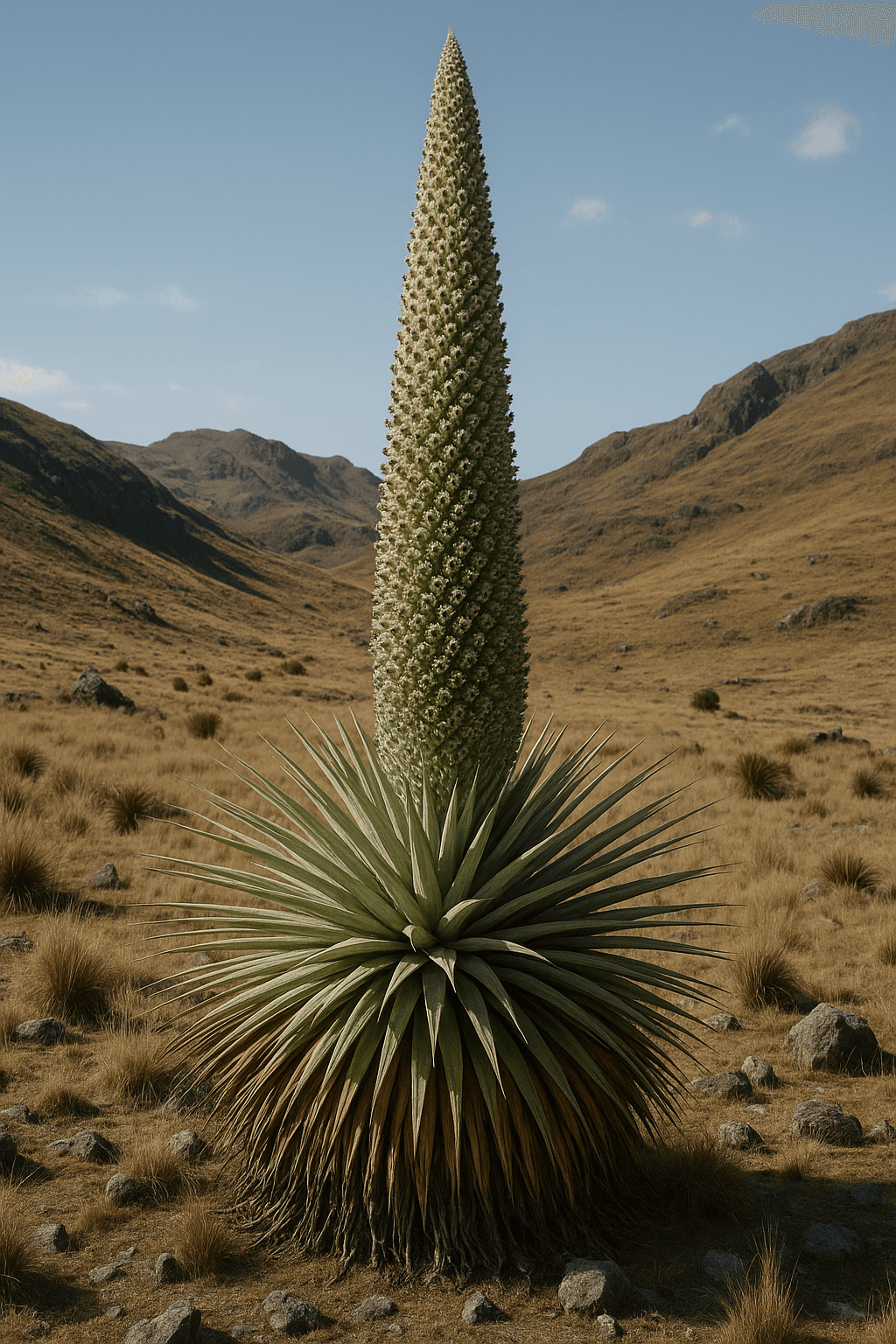
Puya raimondii is the largest species in the Bromeliaceae (pineapple family) and is frequently referred to in the literature as the “Queen of the Andes.” This endemic species is distributed in high-altitude regions of Peru and Bolivia between 3,000 and 4,800 meters. Its natural habitat consists of the harsh climatic conditions and sunny well-drained soils of the high plateaus of the Andes. The plant exhibits a remarkable morphological structure with flower spikes that can reach up to 12 meters in height and blooms only once during its lifetime.
Puya raimondii has a monocarpic life cycle, meaning it dies after flowering once. This flowering process typically occurs between 80 and 100 years of age, during which a single individual can produce over 8,000 flowers. After flowering, the plant produces millions of seeds that are dispersed by wind; however, the low germination rate remains a significant factor limiting the species’ natural spread. Ecologically, Puya raimondii serves as a food source for birds and insects by providing nectar, while its leaves offer temporary shelter for some small animals.

Flower Spike and Flowering Phase of Puya Raimondii (Generated by Artificial Intelligence)
Puya raimondii belongs to the division Tracheophyta, which comprises vascular plants within the kingdom Plantae. It is classified under the class Liliopsida (monocots), the order Poales, and the family Bromeliaceae (pineapple family). As the largest species within the genus Puya, it holds a notable position in botanical science due to this distinctive characteristic.
Puya raimondii is a plant species distinguished by several unique morphological features. It possesses a woody stem reaching up to 4 meters in height and a prominent rosette structure composed of spiky leaves up to 3 meters in diameter. The sharp spines along the leaf margins provide physical protection against herbivores. During its flowering phase, the plant develops a flower spike 8 to 12 meters tall, a feature that stands out as its most characteristic trait due to its capacity to host thousands of individual flowers.
Puya raimondii thrives in high-altitude environments with ample sunlight and well-drained soils. Its natural distribution encompasses arid and drought-prone regions with low annual rainfall. Consequently, it is classified as an endemic species due to its adaptation to the harsh environmental conditions of the Andes and its exclusive occurrence within this geographic region.
The plant reproduces via seeds; however, the seeds are highly susceptible to fungal infection prior to germination, necessitating sterile environmental conditions for successful germination. Temperature and humidity control are critical during the germination process. Puya raimondii is a slow-growing plant and may take decades to reach full maturity. As a result, commercial cultivation is limited and it is primarily grown in botanical gardens or specialized plant collections.
Although it has limited economic value, its unique morphology and rare flowering cycle give it applications in landscaping and display purposes. It can be considered an attractive element in ecotourism, and its conservation is crucial for maintaining ecosystem balance and the sustainability of regional biodiversity.
Puya raimondii plays a vital ecological role, particularly in the arid and semi-arid ecosystems of the Andes. Its flowers serve as a primary food source for nectar-seeking birds and insects, while the lower portions of its broad leaves provide shelter and shade for small animals. Through these functions, the species occupies a functional position not only in terms of its individual life cycle but also in sustaining the food web and preserving biological diversity within its habitat.

Local Communities’ Traditional Practices Around Puya Raimondii (Generated by Artificial Intelligence)
Phytochemical studies on Puya raimondii are limited; however, it is known that some bromeliad species within the same family contain bioactive compounds with antioxidant and anti-inflammatory properties. This suggests a scientific hypothesis that Puya raimondii may also possess similar biological activities, implying that future research could yield new data regarding its potential medicinal applications.
Historically, local communities have utilized Puya raimondii for various purposes, particularly using its flower spikes as dry fuel. However, such practices have contributed to population declines in the wild and placed the species under threat. In this context, implementing educational programs to raise awareness among local populations and enforcing conservation policies are critical for the species’ sustainability.
Disclaimer: The content in this article is provided solely for general encyclopedic informational purposes. The information here should not be used for diagnosis, treatment, or medical advice. Always consult a physician or qualified healthcare professional before making decisions related to health. The author and KÜRE Encyclopedia assume no responsibility for any consequences arising from the use of this information for diagnostic or therapeutic purposes.
Chapman, Maddy. “Puya raimondii: The 40-Foot ‘Queen of the Andes’ That Blooms Only Once a Century.” IFLScience. Accessed May 24, 2025. https://www.iflscience.com/puya-raimondii-the-40-foot-queen-of-the-andes-that-blooms-only-once-a-century-73889.
Fortier, Riley P. “Queen of the Andes: The Ecology and Conservation of Puya raimondii.” Frontiers in Conservation Science. Accessed May 24, 2025. https://www.frontiersin.org/journals/conservation-science/articles/10.3389/fcosc.2024.1349553/full.
Sgorbati, S. et al. “A Survey of Genetic Diversity and Reproductive Biology of Puya raimondii.” PubMed. Accessed May 24, 2025. https://pubmed.ncbi.nlm.nih.gov/15045675/.

World | Plantae (Plants) | ||||||||
|---|---|---|---|---|---|---|---|---|---|
Section | Tracheophyta (Vascular Plants) | ||||||||
Geographic Location | High-altitude regions of Peru and Bolivia (Andes Mountains) | ||||||||
Type(s) | Puya raimondii (Queen of the Andes Mountains) | ||||||||
No Discussion Added Yet
Start discussion for "And the Queen of the Mountains (Puya Raimondii)" article
Taxonomic Classification
Morphological Characteristics and Reproductive Biology
Growth Conditions and Agricultural Significance
Ecological and Cultural Significance