


This article was automatically translated from the original Turkish version.
+1 More
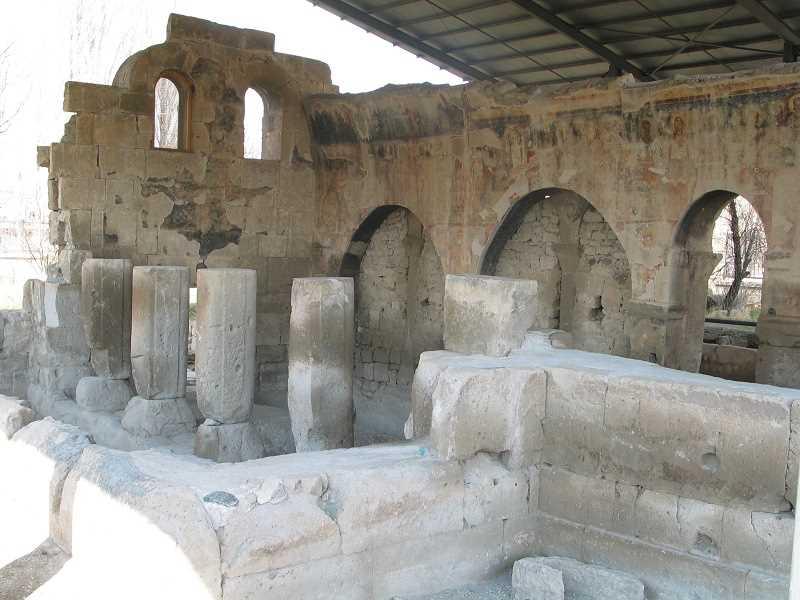
Andaval Church (Church of Constantine and Helena)
Location | Aktaş Village Niğde | ||||||||
|---|---|---|---|---|---|---|---|---|---|
Date(s) | 5th–6th century Early Byzantine Period | ||||||||
Excavation Years | 2000–2003 | ||||||||
Number of Graves | 126 | ||||||||
Dominant Grave Types | Cut stone sarcophagus, rubble stone sarcophagus, composite | ||||||||
Religious Significance | One of the sacred stops along the pilgrimage route | ||||||||
Andaval Church is located in the town of Aktaş, currently under the central district of Niğde Province (historically known as Andabalis). It is situated approximately 8 km northeast of the town center, near the Kayseri-Niğde road and railway route. The site of the church has been inhabited since late antiquity and has historically served as a settlement at a major crossroads of important routes. This location lies along the Istanbul-Jerusalem pilgrimage route, one of the significant Christian pilgrimage paths. Due to its strategic position, Andaval Church became an important stopover point throughout history, both religiously and socially.
The Church of Constantine and Helena is dated to the Early Byzantine period, particularly the 5th and 6th centuries, based on its architectural plan and decorative details. The church is named after Helena, the first Augusta to embrace Christianity. According to tradition, this church was one of the structures commissioned by Saint Helena during her pilgrimage to Jerusalem. Its walls feature cross motifs and fresco fragments; the architectural structure employs regularly cut light-colored stone. Carved figures are visible on the exterior façade, while frescoes have been observed inside the interior space. The structure remained unused for many years but largely stood intact until the 20th century, after which it was used for a time as a cold storage facility, suffering significant damage during this period. Excavation work began in 1996 and intensified between 2000 and 2003.

Andaval Church (Anadolu Agency)
Archaeological excavations conducted at and around the church have uncovered a total of 126 graves, with remains belonging to 166 individuals analyzed. The majority of these individuals were fetuses, infants, children, and adolescents (62%). This high proportion indicates that the church’s location on a pilgrimage route, combined with the hardships of travel, led to elevated mortality rates, particularly among younger age groups.
Excavations revealed seven distinct burial types:

Andaval Church (Anadolu Agency)
All burials were placed supine, with the head oriented westward and the feet eastward. This orientation symbolizes belief in resurrection. Arms were typically crossed over the chest or abdomen. Burials include both single and multiple interments, though the majority are single burials (76%).
Analysis of grave goods revealed that only 33% of individuals had artifacts associated with their burials. Among these finds, personal adornments such as glass and metal bracelets, rings, necklaces, earrings, cross pendants, and seashells predominate. No ceramic vessels or weapons were found. Most grave goods were recovered from female and child burials. Composite graves proved to be the type with the highest frequency of artifacts.
Skeletal remains show evidence of diseases such as Cribra Orbitalia and Porotic Hyperostosis, but generally exhibit very few signs of trauma. This suggests that individuals experienced rapid deaths that left no skeletal traces. These findings point to the impact of major epidemic diseases such as plague that affected Byzantine territories. The high mortality rate among infants and children is linked to low immunity, inadequate nutrition, and the hardships of a mobile lifestyle.
"Andaval Kilisesi." *Kültür Portalı*. Accessed May 24, 2025. https://www.kulturportali.gov.tr/turkiye/nigde/kulturenvanteri/andaval-klses
"Andaval Örenyeri." Niğde Valiliği Resmi Web Sitesi. Accessed May 24, 2025. http://www.nigde.gov.tr/andaval-orenyeri
"Kilise ve Şapeller." *T.C. Kültür ve Turizm Bakanlığı Niğde İl Kültür ve Turizm Müdürlüğü*. Accessed May 24, 2025. https://nigde.ktb.gov.tr/TR-154659/kilise-ve-sapeller.html
"Tarihi Andaval Kilisesi Turizme Kazandırıldı." Anadolu Ajansı, March 17, 2019. Accessed May 24, 2025. https://www.aa.com.tr/tr/kultur-sanat/tarihi-andaval-kilisesi-turizme-kazandirildi/1452955
Uysal, Gülfem. "Konstantin ve Helena Kilisesi’nde (Andaval) Mezar Tiplerinden ve Buluntulardan Sosyal Statünün Belirlenmesi." *Antropoloji* 36 (December 2018): 29–52.

Andaval Church (Church of Constantine and Helena)
Location | Aktaş Village Niğde | ||||||||
|---|---|---|---|---|---|---|---|---|---|
Date(s) | 5th–6th century Early Byzantine Period | ||||||||
Excavation Years | 2000–2003 | ||||||||
Number of Graves | 126 | ||||||||
Dominant Grave Types | Cut stone sarcophagus, rubble stone sarcophagus, composite | ||||||||
Religious Significance | One of the sacred stops along the pilgrimage route | ||||||||
No Discussion Added Yet
Start discussion for "Andaval Church (Church of Constantine and Helena)" article
Dating and Architectural Features
Archaeological Findings and Burial Typology
Burial Rituals and Social Structure
Health Status and Causes of Death