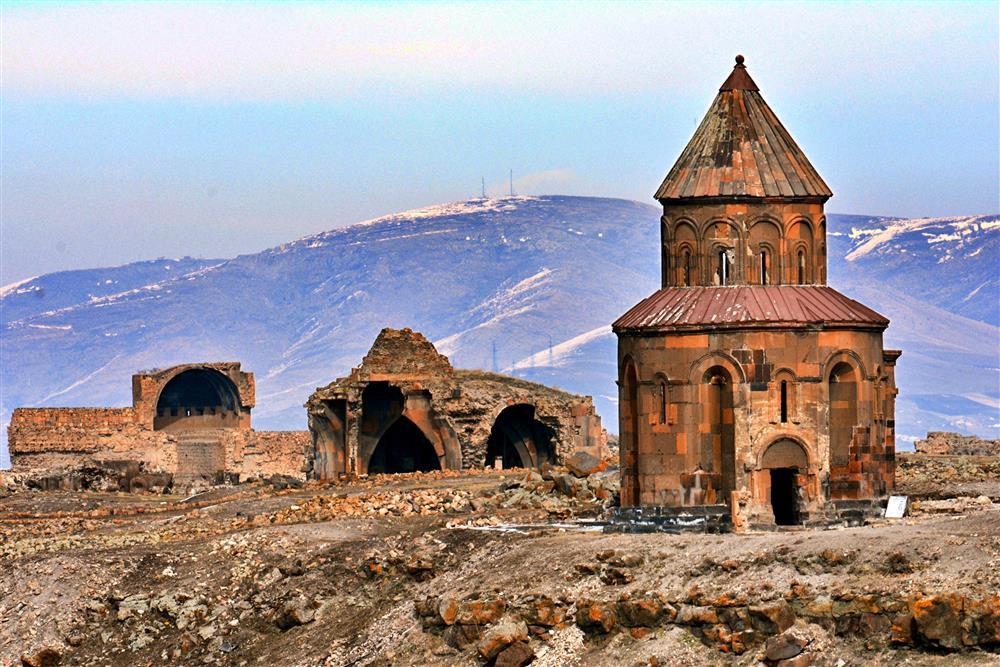

+2 More

Location | Kars / Türkiye | ||||||||
|---|---|---|---|---|---|---|---|---|---|
Site Area | Approximately 540 hectares | ||||||||
Historical Period(s) | Continuous settlement from the Chalcolithic Age to the Early Modern Period Ottomans Akkoyunlus Karakoyunlus Ilkhanids Georgians Seljuks Byzantines Bagratids | ||||||||
Significant Structures | City Walls Fire Temple (Ateşgede) Baths Caravanserai Seljuk Palace Church of St. Prkitch Church of Gagik Church of Tigran Honents Ebu’l Menuçehr Mosque Cathedral (Fethiye Mosque) | ||||||||
UNESCO Status | Inscribed on the World Heritage List on July 15 2016 | ||||||||
Located 42 kilometers east of the city center of Kars, on the western bank of the Arpaçay River—which forms the border between Türkiye and Armenia—the Ani Archaeological Site is the largest archaeological area in the Eastern Anatolia Region. The city, built upon a layer of volcanic tuff, covers an area of approximately 540 hectares, including its walled core and the surrounding extensive settlement areas.
With a settlement history dating back to the Chalcolithic Age, Ani flourished during the Middle Ages as a commercial and cultural center along the Silk Road, reaching its golden age between the 10th and 13th centuries. With its fortification system, churches, mosques, palaces, caravanserais, baths, and bridges, the site bears the traces of multiple civilizations. On July 15, 2016, it was inscribed on the UNESCO World Heritage List.

Monastery from the Armenian Bagratid Period (T.C. Kültür ve Turizm Bakanlığı)
The first settlements in Ani began in the areas known as Bostanlar Stream and Harmanyeri, located outside the city walls, during the Chalcolithic Age and continued throughout the Early Bronze and Iron Ages. Settlement within the city walls, however, developed in the Inner Fortress in the 4th century A.D. and continued uninterrupted for nearly a thousand years.
In the Middle Ages, Ani became a strategic commercial center on the Silk Road. During the Bagratid Kingdom (10th–11th centuries), it rose to the status of capital and experienced its most prosperous era. In this period, the city was surrounded by fortifications, and palaces, churches, mosques, baths, and caravanserais were constructed. With the conquest of Ani in 1064 by the Seljuk Sultan Alp Arslan, the city came under Turkish rule, and in the following centuries it was governed by the Georgians, Mongols, Ilkhanids, Kara Koyunlu, Aq Qoyunlu, and the Ottomans.
With the discovery of the Cape of Good Hope in 1497, the Silk Road lost its importance. From the 16th century onwards, Ani gradually lost its population, and by the 17th century, the city was completely abandoned.

Ebu’l Muammeran Mosque (T.C. Kültür ve Turizm Bakanlığı)
The first scientific excavations at the Ani Archaeological Site were carried out between 1892–1916 by the Georgian-born Russian archaeologist Nikolai Marr. These works revealed the city walls, monumental structures, and the first findings of the site. Between 1940–1943, surface surveys and trial excavations were conducted by Prof. Dr. Kılıç Kökten, and in 1965–1966, further research was carried out under the leadership of Prof. Dr. Kemal Balkan. Excavations that began in 1989 and continued until 2005 were directed by Prof. Dr. Beyhan Karamağaralı, followed by investigations led by Prof. Dr. Yaşar Çoruhlu between 2007–2010. From 2014 to 2018, a team headed by Prof. Dr. Fahriye Bayram conducted comprehensive studies at the site.
Since 2019, excavations have been continuing under the coordination of the Kars Museum Directorate and the scientific consultancy of Assoc. Prof. Dr. Muhammet Arslan from Kafkas University. In recent years, excavations have been concentrated in eight different areas, including the Seljuk marketplace, residential buildings, cemetery, the Great Bath, the Western Ashot Walls, and the Divin Gate. Movable cultural artifacts unearthed during the excavations – such as terracotta vessels, metal objects, coins, glass items, and examples of stone craftsmanship – are cleaned, restored, recorded in the inventory, and exhibited in the Kars Museum.
The Ani Archaeological Site possesses a rich and diverse architectural fabric as a result of different cultures living together during the Middle Ages. The city core is surrounded by walls approximately 4.5–5 kilometers long, constructed from beige and black tuff stone. Among the seven gates of the fortifications, the Lion Gate stands out as one of the most important; it bears a Kufic inscription commemorating Sultan Alparslan’s conquest in 1064.

Walls (AA)
Religious architecture is one of the most distinctive elements of Ani. The Cathedral (990–1010) from the Armenian Bagratid period was built by the architect Trdat and was converted into a mosque after the Seljuk conquest. Among the important churches at the site are St. Prkitch (1036), the Church of Gagik (late 10th century), Abughamrents (980), and the Church of Tigran Honents (1215), which is renowned for its frescoes.

Monastery (T.C. Kültür ve Turizm Bakanlığı)
The Ebu’l Menuçehr Mosque (1072), belonging to Islamic architecture, is known as the first Turkish mosque built in Anatolia; in addition, the Ebu’l Muammeran Mosque, the Seljuk Caravanserai, and the Seljuk Palace are among the principal structures of the city’s Turkish-Islamic period.

Ebu’l Menuçehr Mosque (T.C. Kültür ve Turizm Bakanlığı)
Among the examples of civil architecture are the small and large baths built during the Seljuk period, the caravanserai, shops, and residential houses. The Silk Road Bridge, which emphasized the city’s commercial importance, has survived only in its piers to the present day.
The Ani Archaeological Site is an important center for cultural, faith, and nature tourism, as it embodies traces of different religions and cultures within the same setting. The Fire Temple, churches, and mosques are key elements of faith tourism; the city walls, houses, palace, and caravanserais represent cultural tourism; while the Arpaçay Valley, waterfalls, and highland landscapes constitute the main features of nature tourism.
The city’s location along the Silk Road reinforced its commercial vitality throughout the Middle Ages. Today, Ani is connected to the Kars city center by regular transportation and contributes to regional tourism, particularly with the increasing number of visitors brought by the Eastern Express route.
The Ani Archaeological Site, in recognition of its outstanding universal value, was inscribed on the UNESCO World Heritage List on July 15, 2016. This status provides international support for the excavations, conservation, and restoration works carried out at the site, while also contributing to its promotion and sustainable tourism potential.
Özlü, Tamer, ve Cemal Kaleli. “KÜLTÜREL MİRAS TURİZMİ AÇISINDAN BİR DEĞERLENDİRME: ANİ ÖREN YERİ / AN EVALUATION IN TERMS OF CULTURAL HERITAGE TOURISM: ANİ RUINS”. Amisos 4, sy. 7 (Aralık 2019): 195-218. Accessed September 30, 2025. https://dergipark.org.tr/tr/pub/amisos/issue/51264/667179
Diken, Hasan Ali. “Ani Ören Yeri’nin Kars’taki Kültür Turizmine Katkıları Bağlamında Bazı Tespitler”. Journal of Applied Tourism Research 1, no. 2 (2020): 99-114. Accessed September 30, 2025. https://dergipark.org.tr/tr/pub/jator/issue/58969/818817
T.C. Kültür ve Turizm Bakanlığı. “Dünya Miras Listesinde Ani Örenyeri”. Kars İl Kültür ve Turizm Müdürlüğü. Accessed September 30, 2025. https://kars.ktb.gov.tr/TR-54868/dunya-miras-listesinde-ani-orenyeri.html
Anadolu Ajansı. “Ani Ören Yeri'ndeki surlar asırlardır ihtişamıyla ayakta duruyor”. Anadolu Ajansı. Accessed September 30, 2025. https://www.aa.com.tr/tr/kultur/ani-oren-yerindeki-surlar-asirlardir-ihtisamiyla-ayakta-duruyor/3592112
Anadolu Ajansı. “Ani Ören Yeri'nde yeni sezonun kazı çalışmalarına başlandı”. Anadolu Ajansı. Accessed September 30, 2025. https://www.aa.com.tr/tr/kultur/ani-oren-yerinde-yeni-sezonun-kazi-calismalarina-baslandi/3247522
TURKISH MUSEUMS. “Kars Ani Örenyeri”. Turkish Museums. Accessed September 30, 2025. https://www.turkishmuseums.com/museum/detail/2108-kars-ani-orenyeri/2108/1
T.C. Kültür ve Turizm Bakanlığı. “Ani Arkeolojik Alanı”. Türkiye Kültür Portalı. Accessed September 30, 2025. https://www.kulturportali.gov.tr/portal/aniarkeolojikalani

Location | Kars / Türkiye | ||||||||
|---|---|---|---|---|---|---|---|---|---|
Site Area | Approximately 540 hectares | ||||||||
Historical Period(s) | Continuous settlement from the Chalcolithic Age to the Early Modern Period Ottomans Akkoyunlus Karakoyunlus Ilkhanids Georgians Seljuks Byzantines Bagratids | ||||||||
Significant Structures | City Walls Fire Temple (Ateşgede) Baths Caravanserai Seljuk Palace Church of St. Prkitch Church of Gagik Church of Tigran Honents Ebu’l Menuçehr Mosque Cathedral (Fethiye Mosque) | ||||||||
UNESCO Status | Inscribed on the World Heritage List on July 15 2016 | ||||||||
No Discussion Added Yet
Start discussion for "Ani Archaeological Site " article
History
Archaeological Research and Excavations
Architectural Features
Tourism and UNESCO World Heritage Status
This article was created with the support of artificial intelligence.